
Trump's war on Iran has no clear end in sight as challenges mount: NYT
 5 Min Read
Despite tough rhetoric, the US finds itself stuck in a war with no clear exit plan.
-
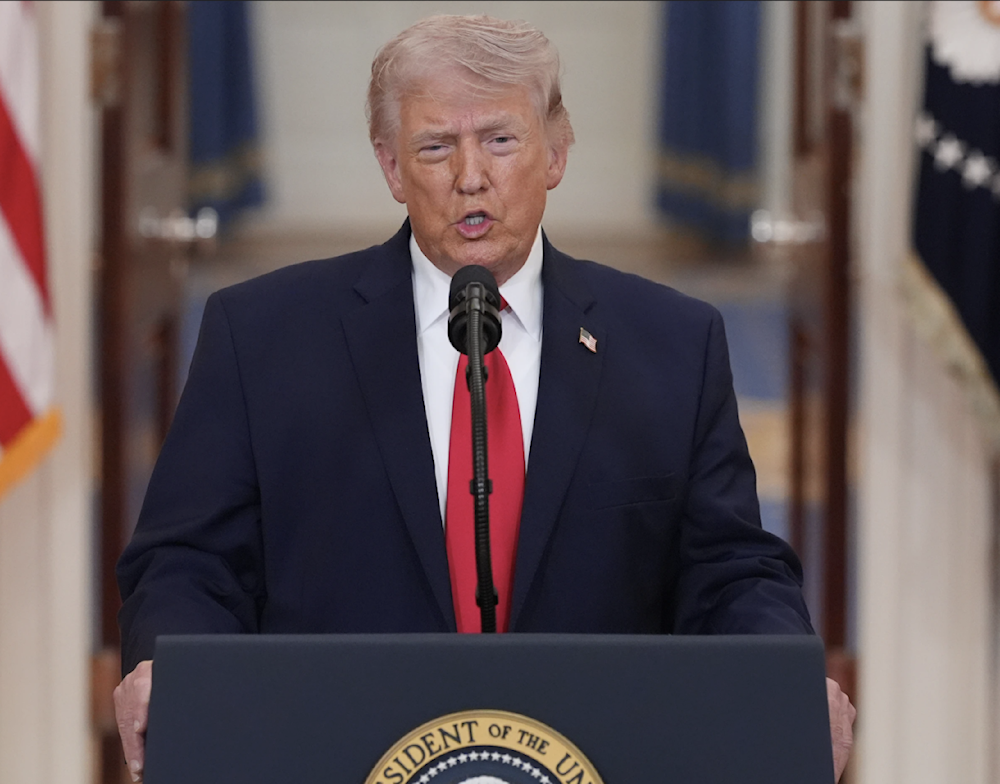
President Donald Trump speaks about the Iran war from the Cross Hall of the White House on April 1, 2026, in Washington. (AP)
More than a month into the war on Iran that US President Donald Trump promised would end within weeks, the United States finds itself ensnared in an unwinnable quagmire with no clear path to victory.
A New York Times report on Thursday details how, despite relentless aggression against Iran, Trump’s war's alleged goals—seeking to prevent Iran from acquiring nuclear weapons, instigating "regime change," and allowing oil passage through the Strait of Hormuz—remain far from being achieved.
Trump and senior White House officials are privately acknowledging that reopening the Strait of Hormuz may not be possible within the president’s self-imposed timeline for ending the war, sources familiar with internal discussions told CNN on Wednesday.
The strait, a critical oil chokepoint through which roughly 20% of the world’s oil supply flows, is a central objective for the administration, not only to conclude the war but also to ease soaring gas prices, which have emerged as a political liability for Republicans ahead of November’s midterm elections.
Top officials and intelligence sources have estimated that restoring full operations at the strait could take weeks, if not months, making it unlikely to meet Trump’s four- to six-week deadline for declaring “mission accomplished".
Iran’s unwavering resilience continues to defy US expectations. Even as the US and "Israel" unleash destructive aerial assaults on Iran’s infrastructure, the Iranian resistance remains strong, capable of striking back with missile attacks, including recent strikes on Israeli territory and US interests in the region.
Contradictory goals and misleading claims
Trump's televised address only exposed his growing desperation, as global markets reacted with skepticism, pushing oil prices up by 8% due to his lack of a coherent strategy to address the closure of the Strait of Hormuz.
In an attempt to reassure Americans in a prime-time address, claiming that the Strait of Hormuz would “open up naturally” once the war ends.
Despite his criticized rhetoric about sending Iran back to the "Stone Ages," Trump’s words ring hollow. His administration has failed to provide a real vision for the future of Iran or the region. Initially calling for "regime change," Trump now claims that the Iranian leadership has already "changed" after the martyrdom of its leaders—a misleading claim that ignores the fact that Iran's political structure remains intact, and the resistance continues to thrive.
Global isolation of the US
The US's unilateral aggression in the region has isolated it from its European allies, who have increasingly distanced themselves from Washington's illegal actions.
“This is not our war, and we’re not going to get dragged into it,” said Keir Starmer, reflecting growing opposition to what many view as an illegal and destabilizing campaign.
Rather than bringing an end to the aggression, Trump’s reckless escalation risks prolonging the war indefinitely, as Iran remains determined to outlast the US and use rising oil prices to further destabilize the global economy.
According to the NYT, Trump's business strategy of constantly shifting positions is not applicable in times of war; the longer the war drags on, the deeper the US is mired in something it cannot win, and the more credibility it loses on the world stage.
"In weaving back and forth, Trump is relying on techniques he honed in the New York real estate world, where he often succeeded at creating his own reality. But war is different. "
Trump approval drops to lowest as war on Iran hits economy
US President Donald Trump’s approval rating has fallen to some of its lowest levels of his presidency, with mounting public dissatisfaction linked to the ongoing war on Iran and worsening economic conditions, The Economist reported on Thursday.
According to YouGov/The Economist polling updated on April 2, Trump’s net job approval stands at -20, with 36% approving of his performance and 57% disapproving, marking a decline from previous weeks and placing his standing below the same point in his first term.
The report noted that the war on Iran is likely a key factor behind the drop. Public sentiment toward the war remains largely negative, with only 28% of Americans expressing support, compared to 59% who oppose it.
At the same time, the war has contributed to rising energy costs, pushing oil prices higher and driving gasoline prices above $4 per gallon for the first time since 2022. The increase is expected to feed into broader inflationary pressures, affecting transportation and manufacturing costs and raising prices for goods.
Economic concerns continue to dominate public opinion, with inflation and prices ranked as the most important issues facing Americans. Only 14% of respondents said economic conditions are improving, reflecting a broader decline in confidence.


