
'Israel' watches with concern as YAF tighten grip on Bab al-Mandab
 7 Min Read
The YAF's position near Bab al-Mandab raises concerns in "Israel" and Saudi Arabia over maritime trade, regional security, and US involvement.
-
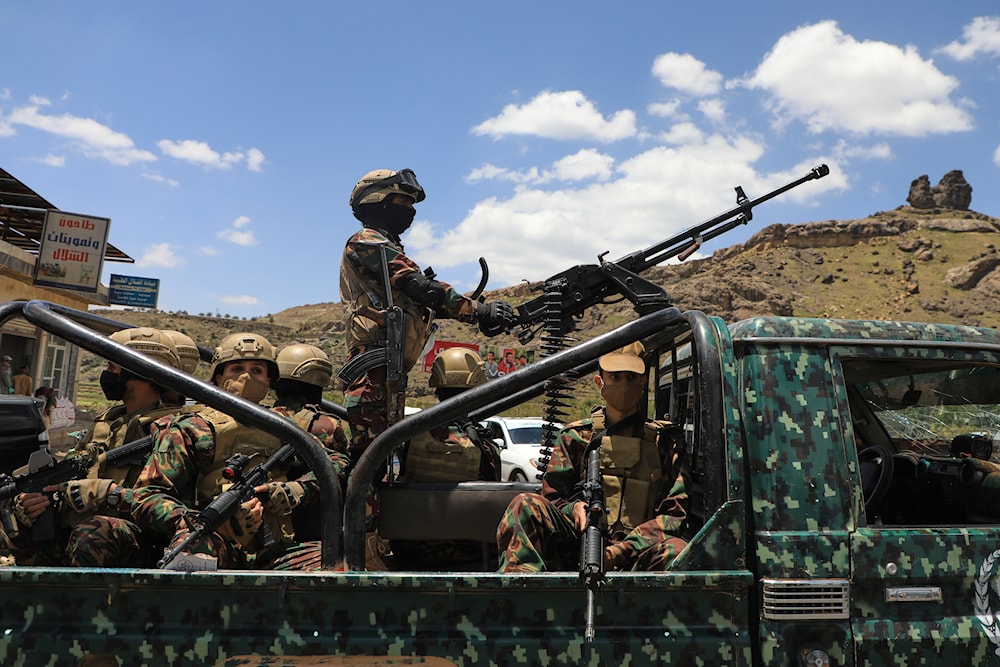
YAF fighters escort a convoy carrying prisoners freed in al-Mokha through the Bani Matar district on its way to Sanaa, Yemen, Sept. 12, 2026, following the YAF's seizure of the southern Red Sea port city (AP)
"Israel" is monitoring developments in Yemen with growing concern, an assessment by Al Mayadeen's Israeli Affairs Department has revealed.
According to this reading, the Yemeni Armed Forces' movement had previously comprised a threat against ships, as part of its support for Gaza, from the depth of Yemen with missiles and drones, yet today, its forces are positioned 18 kilometers from the narrowest point of the Bab al-Mandab Strait.
Channel 12 cited an Israeli source as saying that the Yemeni forces "are now able to see ships with the naked eye and target them with explosive-laden boats or anti-armor weapons," describing the situation as "worse than Hormuz."
The Bab al-Mandab Strait holds additional significance, as approximately 20 percent of global container traffic and six million barrels of oil pass through it daily, and it serves as the southern gateway to the Suez Canal. Israeli media therefore argue that control over the eastern bank of the strait grants the YAF a direct ability to threaten the maritime trade route between Asia and Europe.
Between maritime threat and the risk of being drawn in
"Israel" has been tracking Yemeni developments intelligence-wise since the fall of al-Mokha, according to Al Mayadeen's Israeli Affairs Department. Chief of Staff Eyal Zamir and Navy Commander Eyal Harel issued messages emphasizing that "distance no longer provides immunity" and that "the long arm reaches everywhere."
The Israeli discourse, however, reflects broader concern over economic dependence on maritime navigation, given that 98% of "Israel's" imports arrive by sea and that the sea has become, according to the security establishment, a "central battlefield". Israeli media have also reported preparations amid concerns about maritime traffic to the Israeli port of Eilat.
Nevertheless, Tel Aviv does not appear to be heading toward direct military action. Acknowledging that the development is "concerning", it emphasizes that it will not intervene unless directly attacked.
This reveals a dual dilemma: refraining from taking action allows the navigation threat to expand, while taking action could be interpreted as Israeli involvement alongside Saudi Arabia against the Axis of Resistance, embarrassing Riyadh and opening a new front that Tel Aviv does not wish to bear the cost of.
At the same time, "Israel" continues preparations on its northern front, based on the assessment that the primary confrontation remains with Iran, therefore treating Yemen as part of a broader threat network rather than an independent arena in the regional war.
Saudi Arabia: Narrowing options and a declining American bet
Israeli media reported that weeks ago, the Saudi message to Washington was that it could handle "the Houthis" itself, according to Al Mayadeen's Israeli Affairs Department. However, recent developments, according to this account, prompted Saudi Crown Prince Mohammed bin Salman to call US President Donald Trump twice in one day, requesting direct American strikes.
According to Israel Hayom, Trump refused direct intervention, saying that Yemen is "their affair, not ours." Riyadh then turned to Gulf states and Egypt, and indirectly, according to reports, to "Israel" through the US Central Command, seeking intelligence assistance.
The Saudi dilemma, according to information circulated in Israeli media, is highlighted by simultaneous pressures on three strategic routes: Hormuz to the east, Bab al-Mandab to the south, and the East-West pipeline that was established to bypass Hormuz and has itself come under attack. In the Israeli reading, this means that the alternatives Riyadh relied upon to secure its exports and trade routes have all become vulnerable to threat.
Effectiveness of the 'Mecca alliance' falls under scrutiny
In this context, Israeli analysts questioned the effectiveness of the "Mecca alliance", which comprises Saudi Arabia, Turkey, and Pakistan, arguing that the announced alliance has not been reflected in practice in addressing Yemeni developments. They also rejected the Saudi explanation for the withdrawal from the coast as a "trap to lure the Houthis."
According to these analysts, Saudi options are heading toward two paths: a wide war against the YAF, which could open the door to a regional expansion of the confrontation, or direct negotiations with Ansar Allah.
Political affairs analysts spoke of a "diplomatic-economic option" that includes opening airspace, recognizing Ansar Allah, and paying transit fees. However, this path, if adopted, could entrench the YAF's control over Brim and al-Mokha, without guaranteeing their withdrawal from them.
Iran and Yemen: Partnership and intersecting interests
Iran's position occupies the forefront of questions in Israeli analysis, according to Al Mayadeen's Israeli Affairs Department.
The traditional narrative in Tel Aviv claims that Iran is the "head" and that the Ansar Allah movement is the "arm", but some Israeli observers emphasize that Ansar Allah is a partner whose interests intersect with Tehran's without being identical to them.
According to this reading, Iran seeks to lift sanctions and gain recognition of its role in Hormuz, while the YAF seek to consolidate their control over Yemen and lift the siege. However, the strategic result is the same for "Israel": pressure from two straits, Iran in Hormuz and the YAF in Bab al-Mandab, with Saudi Arabia between them as the world's largest oil exporter.
Israeli military observers link this scene to the US economic war on Iran, considering that Tehran is transferring part of the cost of economic pressure to its opponents through energy tools and maritime corridors.
Furthermore, Washington's pressure has not resulted in Iranian collapse or surrender, but has pushed the war toward a confrontation linked to energy and trade routes, while Tehran bets on its ability to endure longer than the United States.
Bab al-Mandab: A test of the balance of power
According to Al Mayadeen's Israeli Affairs Department, Bab al-Mandab is no longer merely a maritime corridor but has become the intersection of three files: "Israel's" economic security, the future of the US-Saudi security partnership, and the US war on Iran.
The "pincer" that Israelis speak of is not limited to Hormuz and Bab al-Mandab. Alongside the pressure exerted by Iran and its allies on maritime corridors, there is another factor: American hesitancy and declining readiness for direct intervention in defense of allies.
This places Riyadh before a real test of the reliability of Washington's protection, while raising questions in "Israel" about the limits of US support if its priorities conflict with Tel Aviv's calculations.
The direct Israeli dilemma lies in the risk of being drawn into a new front. "Israel" wants to strengthen deterrence without a full-scale war in Yemen, Saudi Arabia wants to regain the coast without sliding into an open confrontation, and the United States wants to contain Iran without expanding the war.
However, control of Bab al-Mandab grants the controlling party greater ability to take the initiative, and the YAF currently possess this control.


