
'Israel' weighs sweeping drone ban amid FPV drone concerns
 4 Min Read
Israeli occupation authorities are considering sweeping restrictions on civilian drone use, citing fears that FPV drones could be launched from neighboring countries or the occupied West Bank.
-
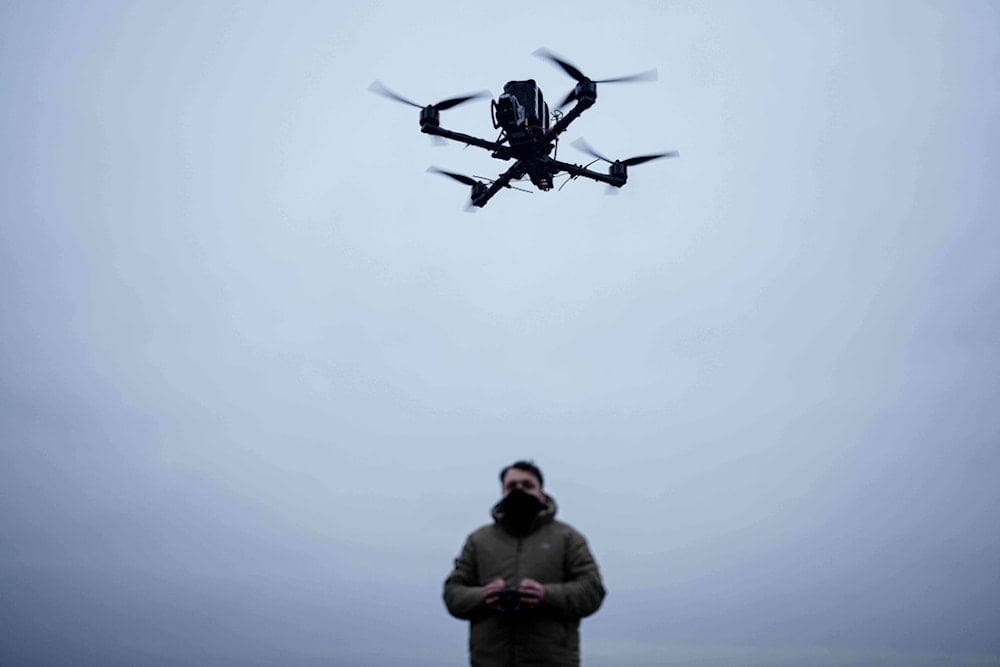
A Ukrainian serviceman controls an FPV drone of "General Cherry" company at the polygon in Ukraine, on December 4, 2025. (AP Photo/Evgeniy Maloletka)
Israeli occupation authorities are considering imposing strict new restrictions on civilian drone use amid concerns that first-person view (FPV) attack drones could be launched from neighboring countries or the occupied West Bank, Israeli officials told Ynet on Saturday.
A senior Israeli official said the proposal was discussed extensively by the occupation's War Cabinet, with officials arguing that restricting drone activity would make it easier for security forces to identify and respond to potential threats.
Occupation officials acknowledged that there is currently no intelligence indicating that FPV attack drones, particularly fiber-optic-guided models, are operating in the occupied West Bank. "This is a very serious threat for which we do not have a solution," one official told Ynet. "It has to be said honestly, this is a very serious threat."
Officials said they are particularly concerned about the potential fear in which drones could be used to target senior occupation officials or Israeli institutions.
Read more: Hezbollah's FPV drones expose Israeli military crisis: Israeli media
FPV drones emerge as regional battlefield concern
The discussions come as FPV drones have become increasingly prominent in conflicts across the region and beyond, offering low-cost precision strike capabilities against military positions and infrastructure.
In light of these concerns, occupation forces adopted a preventive policy of confiscating any drones found in the occupied West Bank.
FPV drones are controlled through a live video feed transmitted from an onboard camera, allowing operators to guide them directly toward targets with high precision while carrying explosive payloads weighing several kilograms.
Fiber-optic variants, which have been used by Hezbollah to combat "Israel's" attempts to invade and occupy Lebanon and are widely deployed in the Russia-Ukraine war, are connected to operators through thin fiber-optic cables that can extend for dozens of kilometers.
Since they do not rely on radio signals, they are largely resistant to the electronic jamming that "Israel" depends on, making them more difficult to counter than conventional drones.
In May, an Israeli military officer admitted that the occupation forces lack an effective operational means to counter FPV drones launched by Hezbollah.
The officer added that the Israeli Air Force conducted tests on a newly developed system designed to combat such FPV drones, but came back with "unsatisfactory" results.
Occupation forces expand drone seizures in occupied West Bank
Israeli occupation military officials have raised concerns about FPV drones as a concern for forces operating in the occupied West Bank. Under a military order issued in 2017, policing potential dual-use materials, occupation forces confiscate equipment they claim could be used for armed attacks, including civilian drones.
IOF officials said after the launch of the war on Gaza on October 7, 2023, occupation forces shifted from responding only to what they claim to be direct threats toward preventing access to capabilities they consider potentially dangerous. As a result, occupation authorities have confiscated items for which there is no evidence that they were intended for military use.
Officials said the possibility of FPV drones being launched from the occupied West Bank represents a particular concern due to the territory's proximity to major illegal Israeli settlements.
Unlike rockets, FPV drones can be guided with precision over relatively short distances, raising concerns among occupation officials that they could be used against senior political figures. Several Israeli Cabinet ministers and Knesset members live in illegal settlements across the occupied West Bank, some of which are located near Palestinian communities.
Read more: 'Israel' reveals Gaza outposts, West Bank settlement expansion scheme


