
'Not a single drop': PM Modi orders water flow halt to Pakistan
 3 Min Read
India intensifies its stance on Pakistan by seeking to restrict water flow after suspending the Indus Water Treaty, escalating regional tensions over shared rivers.
-
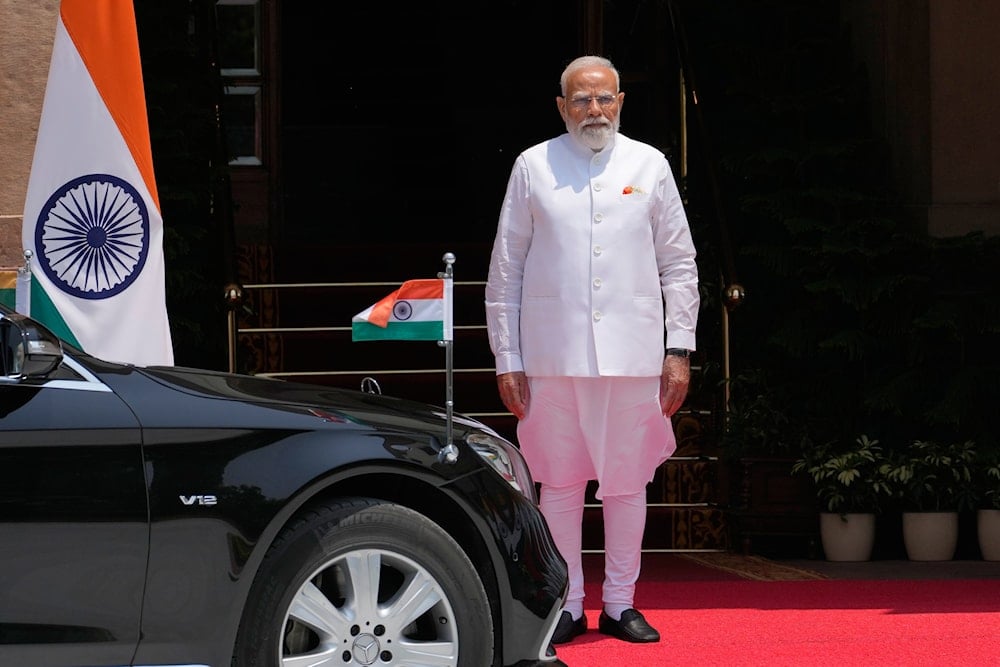
Indian Prime Minister Narendra Modi stands to welcome Myanmar President Min Aung Hlaing ahead of their meeting in New Delhi, India, Monday, June 1, 2026 (AP)
India is moving to halt the flow of water to Pakistan following its suspension of a major river-sharing treaty between the two rival nations, a senior Indian minister said Tuesday, escalating a long-running diplomatic standoff over terrorism and cross-border violence, The Independent reported.
India formally suspended the 1960 Indus Water Treaty last year after a deadly attack in Kashmir that killed 26 people. Now, according to federal water minister CR Patil, the government is working to ensure “not a single drop of water” reaches Pakistan.
Islamabad said the treaty remains in force as there is no mechanism permitting India to unilaterally withdraw from it.
“It still stands; rather, the treaty has been kept in abeyance,” Patil said. “And since Prime Minister (Narendra Modi) took this decision, every effort is being made to ensure not a single drop flows there. Under the prime minister's directives, Home Minister Amit Shah is also personally monitoring the matter, and we are actively working on it.”
Indus water treaty at a glance
The Indus Water Treaty, brokered by the World Bank, governs the use of water from six rivers whose headwaters originate in India but flow into Pakistan as part of the shared Indus basin. The treaty allocated the three western rivers, Indus, Jhelum, and Chenab, to Pakistan, and the three eastern rivers, Ravi, Beas, and Sutlej, to India.
Under the agreement, India is required to allow approximately 43 million acre-feet of water to flow into Pakistan each year, accounting for roughly 80% of Pakistan’s total surface water. That supply is a lifeline for millions of Pakistanis, supporting hydropower generation, drinking water systems, and irrigation for the country’s agriculture-dependent economy.
While the treaty permitted India limited, non-consumptive use of the western rivers, such as for hydropower, it explicitly prohibited India from altering flows in a way that could harm Pakistan’s access.
Pakistan has previously accused India of “weaponising water” and warned that any attempt to change the flow of cross-border waterways would be considered an “act of war.”
Tensions between the nuclear-armed neighbors have remained high for more than a year, fueled by cross-border clashes and Pakistani accusations of Indian state-sponsored terrorism, claims India denies.


