
AfD wins Saxony-Anhalt election, falls short of majority
 6 Min Read
Germany's AfD has won a commanding victory in Saxony-Anhalt, dealing a major blow to Chancellor Friedrich Merz's CDU.
-
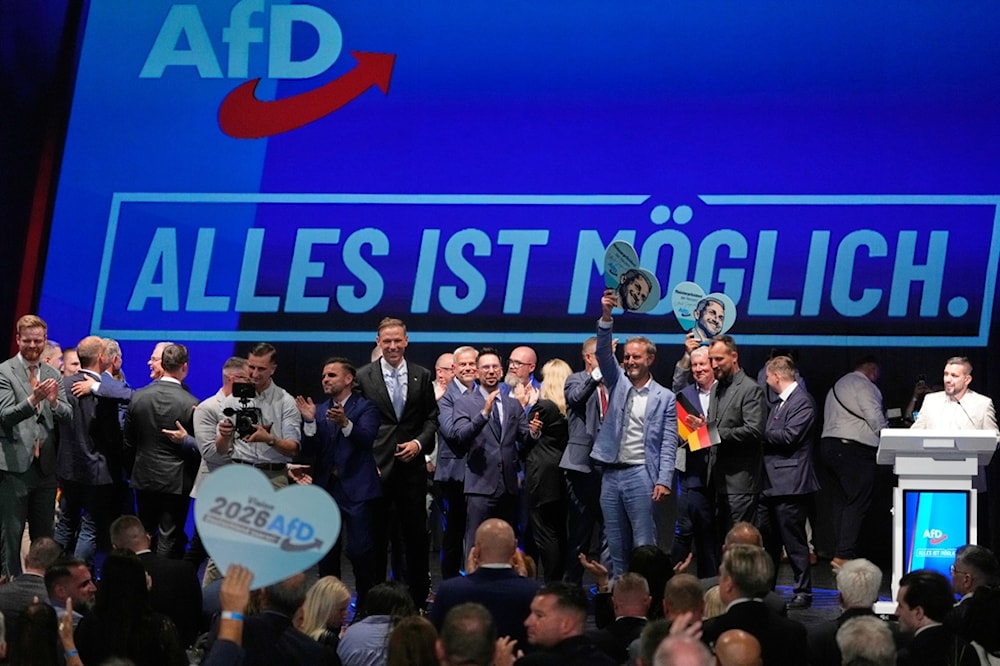
AfD party members celebrate in front of a sign reading "everything is possible" after the first results at an election party of the "Alternative for Germany" (AfD) after the Saxony-Anhalt state elections in Magdeburg, eastern Germany, Sunday, Sept. 6, 2026 (AP)
Germany’s far-right Alternative für Deutschland has surged to a commanding victory in Saxony-Anhalt, according to initial exit polls, delivering a major blow to Chancellor Friedrich Merz’s Christian Democrats while leaving open the question of whether the party will actually be able to govern, The Guardian reported.
Early projections put the AfD on 44.5% of the vote, far ahead of the CDU on 18.5%. Die Linke followed with 9.5%, the Greens with 9%, and the Social Democrats with 8%, while the BSW appeared to clear the 5% threshold required to remain in the state parliament.
Turnout reached a record 76.5%, reflecting the unusually high stakes surrounding the election.
AfD victory may not translate into power
Despite the scale of the AfD’s lead, the party may still fall short of an outright parliamentary majority, which its lead candidate, Ulrich Siegmund, has repeatedly described as a prerequisite for taking office.
Siegmund has ruled out entering government with another party, while the CDU and Germany’s other mainstream political forces continue to uphold the so-called Brandmauer, or firewall, against cooperation with the AfD.
The Saxony-Anhalt branch of the AfD has been classified as “rightwing extremist” by Germany’s domestic intelligence agency.
AfD falls short of stated 45% target
Around 1.7 million people were eligible to vote in the eastern state, which has a population of roughly 2.1 million.
Polling stations opened at 8 am local time and closed at 6 pm, with exit polls released immediately afterward.
Surveys conducted in the final days before the election had placed AfD support at around 40-41%, meaning the party appears to have outperformed expectations.
However, the initial result remained slightly below the level Siegmund had publicly sought.
Ahead of the vote, he said he expected the party to secure “45%, and some”, insisting that only an absolute majority would allow the AfD to implement its program without obstruction.
At a final campaign rally on Saturday, Siegmund told supporters, “No matter the outcome of tomorrow’s election, we have already made history.”
The election also produced unusually strong participation throughout the day. By 2 pm, turnout had reached 54%, compared with 27% at the same point in the previous state election, according to the election commissioner.
Heavy setback for Merz and CDU
The result represents a serious defeat for Merz and the CDU, which has governed Saxony-Anhalt since 2002 alongside smaller coalition partners.
The vote had been widely viewed as a major test of Merz’s leadership amid dissatisfaction with his federal coalition with the Social Democrats, continued economic weakness, and the sustained rise of the AfD.
Although irregular migration has declined since Merz took office, the decrease has not been sufficient to stem support for the AfD.
AfD gains ground beyond Saxony-Anhalt
The party has also gained ground nationally and, according to recent polling, has overtaken the CDU in some surveys as it looks toward the 2029 or 2033 federal elections.
A victory of this scale in Saxony-Anhalt is expected to intensify pressure on Merz while strengthening the AfD’s claim that it can move beyond opposition and challenge for executive power.
Siegmund pushes hardline domestic agenda
If the AfD ultimately secures enough seats to govern alone, Siegmund has pledged to move quickly on a series of controversial measures.
He has promised to launch what he describes as a remigration and deportation offensive and stop the construction of new wind farms.
Siegmund has also proposed replacing Saxony-Anhalt’s “Think Modern” slogan with “Think German” and restoring the singing of the German national anthem in schools.
East German discontent shapes Siegmund campaign
Throughout the campaign, he sought to tap into resentment among eastern German voters while drawing on “ostalgie”, or nostalgia for aspects of life in the former East Germany.
He also repeatedly highlighted what he described as growing foreigner-related crime, despite broader statistics showing a substantial decline in crime.
On election day, Siegmund arrived at his polling station with his wife on an East German-era moped painted in AfD colours, an image that had featured prominently during the campaign.
Speaking outside the polling station, he said he wanted to “build bridges”.
Protests and warnings over AfD advance
The election took place amid heightened political tension and an increased police presence.
Thousands of AfD opponents gathered in Magdeburg on Saturday for what organizers described as a “festival of democracy."
A projection on the facade of Magdeburg Cathedral declared, “We do not abandon what we love. True love of the homeland is not the AfD.”
The bishop of Magdeburg, Gerhard Feige, also warned against political forces “that want to sow discord, stoke mistrust and fear."
Drawing on Germany’s historical experience, Feige cautioned that democratic systems can ultimately dismantle themselves.
“Not everyone who votes or is elected democratically is a democrat,” he said.
Economic and security concerns grow over AfD rise
Economic institutions have also raised concerns over the implications of an AfD-led government.
The German Economic Institute warned that the party’s immigration policy would be “calamitous” for Saxony-Anhalt, pointing to the state’s ageing population, demographic decline, and reliance on foreign labor.
Opponents have additionally raised security concerns over the AfD’s comparatively Russia-friendly foreign policy positions, warning that sensitive information could be exposed if the party gains control of state institutions.
The AfD has rejected those allegations and has instead called for changes to Germany’s domestic intelligence services, accusing them of political bias.
Whether the party will be able to convert its election victory into control of the state government will now depend on the final distribution of seats.
Read more: Germany's Conservatives win elections, AfD ranks second


