
AI supercharges Trump’s propaganda machine: FT
 3 Min Read
A Financial Times analysis reveals Donald Trump’s escalating use of AI-generated content to amplify propaganda, glorify his image, and attack opponents across social media.
-
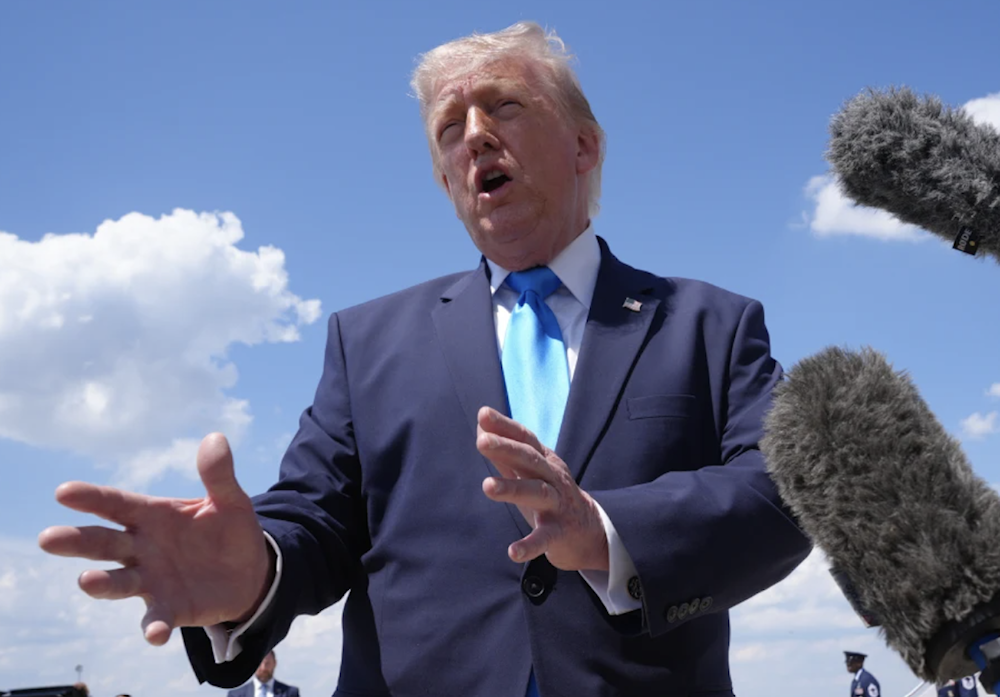
President Donald Trump speaks to the press after returning and stepping off Air Force One, Wednesday, May 20, 2026, at Joint Base Andrews, Md., after speaking at the U.S. Coast Guard Academy commencement. (AP)
US President Donald Trump’s use of AI-generated images and videos on his Truth Social platform has experts warning that artificial intelligence is becoming a central tool in his expanding propaganda strategy.
According to a Financial Times report, Trump’s account has increasingly turned into a stream of AI-generated content depicting imaginary military victories, religious symbolism, futuristic infrastructure projects, and exaggerated portrayals of political opponents.
The newspaper’s analysis found that the number of AI-generated posts on Trump’s account increased sevenfold during May alone, with at least 75 posts identified as AI-generated this year under what the paper described as a conservative estimate likely below the real figure.
More than 57 of those posts were published within the first three weeks of May, compared with only eight throughout April.
Trump has posted over 2,700 times on Truth Social in 2026, averaging more than 19 posts per day, with nearly half containing images or videos designed to dominate online attention cycles outside traditional media platforms.
AI-driven “chaos propaganda”
Henry Ajder, an expert in artificial intelligence and deepfakes, told the Financial Times that Trump has fully embraced what is increasingly known as “chaos propaganda”, describing it as a systematic adoption of AI-generated media as a political communication tool.
Experts cited in the report said AI now allows Trump and his team to rapidly produce highly emotional visual content that glorifies his leadership, dramatizes political messaging, and dehumanizes opponents.
Kathleen Hall Jamieson, director of the Annenberg Public Policy Center at the University of Pennsylvania, said the imagery acts as an extension of his verbal rhetoric, amplifying both self-promotion and attacks on critics.
Research expert Henk van Ess compared the style of the posts to propaganda techniques traditionally associated with authoritarian state media.
Religious imagery and fabricated realities
The report also highlighted several controversial AI-generated posts shared by Trump in recent months, including a racist video portraying Barack and Michelle Obama as monkeys, later deleted following backlash.
Trump also sparked outrage among Christian conservatives after posting an image depicting himself in a Christ-like form. Previous posts similarly portrayed him dressed as the pope or embracing Jesus Christ.
Beyond political attacks, Trump has repeatedly shared fabricated visuals promoting futuristic projects and fantasy-style political promises, including AI-generated images of a “Trump Tower” on the moon and massive ethnic cleansing concepts for Gaza.
Experts warned that such content reflects a growing effort to shape political narratives through emotionally charged artificial realities before any tangible policy or project exists.
As AI-generated media becomes more sophisticated and widespread, analysts say Trump’s online strategy marks a new phase in digital propaganda, one where visual fiction increasingly blurs with political messaging.


