
AIPAC-backed PAC pours millions into Michigan Democratic Senate race
 4 Min Read
Campaign finance records show Republican-aligned donors are among the largest contributors backing an AIPAC-affiliated super PAC active in Michigan's Democratic Senate primary.
-
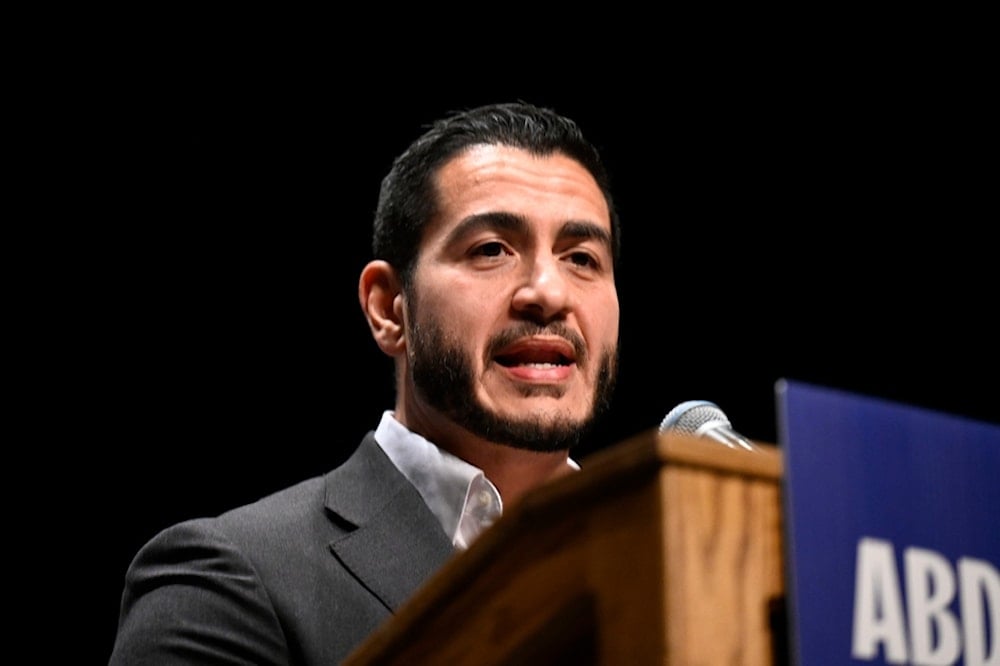
Michigan Democratic US Senate primary candidate Abdul El-Sayed addresses the crowd during a campaign rally on July 18, 2026, in Detroit. (AP Photo/Jose Juarez)
The Democratic primary for Michigan's open US Senate seat has become a focal point in the growing debate over Washington's support for the Israeli occupation, with an American Israel Public Affairs Committee (AIPAC)-backed political action committee spending nearly $15 million to support Representative Haley Stevens against progressive challenger Abdul El-Sayed.
The race, set for August 4, pits Stevens, a staunch supporter of continued US military aid to the Israeli occupation, against El-Sayed, who has described the Israeli war on Gaza as a "genocide" and criticized what he called "the impact of AIPAC in our politics" in shaping US policy toward the occupation and its confrontation with Iran.
Read more: US rep. slams Israeli lobbying group over New Jersey primary spending
AIPAC-backed spending boosts Haley Stevens' campaign
Stevens has received substantial backing from the United Democracy Project (UDP), a super PAC affiliated with AIPAC.
According to campaign finance records cited in the report, UDP has spent nearly $15 million supporting Stevens' campaign, despite polling showing widespread dissatisfaction with "Israel" among Democratic voters.
A Pew Research Center survey found that 80% of Democrats and Democratic-leaning independents hold an unfavorable view of "Israel", reflecting growing discontent over the occupation's war on Gaza and continued US military support.
El-Sayed: Whatever you think about the right of Israel to exist, I wonder if they have a right to our tax dollars. Every time I come on CNN, you guys ask me the same questions.
— Acyn (@Acyn) July 19, 2026
I'm running for senate in Michigan and in Michigan, people can't afford their basic needs. I want… pic.twitter.com/MDxP5isvkk
The shift in public opinion has increasingly been reflected in Congress. Last week, an amendment introduced by Republican Representative Thomas Massie to reduce US military aid to "Israel" received support from roughly half of House Democrats, but ultimately failed by a vote of 314 to 104.
Stevens voted against the amendment, aligning herself with the majority supporting continued military assistance.
Republican megadonors bankroll Democratic primary effort
Much of the financial support for UDP has come from wealthy Republican-aligned donors rather than Democratic contributors.
Among the largest contributors is billionaire Paul Singer, a longtime Republican donor and former board member of the Republican Jewish Coalition, who contributed $2.5 million to the super PAC during the current election cycle.
Another major donor is Jan Koum, co-founder of WhatsApp, whose linked political organization contributed $1.6 million to UDP. Koum also donated $5 million worth of Meta stock to a pro-Trump super PAC during the 2024 election cycle.
Excluding direct AIPAC contributions totaling $30 million, the report found that 22% of large UDP donations came from predominantly Republican donors, while 36% came from Democratic-aligned contributors. Another 26% had mixed political giving records.
Despite focusing overwhelmingly on Democratic primaries, with 87.5% of its spending directed toward Democratic races, only 1.7% of UDP's funding originated from donors based in Michigan.
Read more: Party rift grows as North Carolina Dems call 'Israel' 'apartheid'
Support for 'Israel' increasingly divides Democratic Party
Although UDP describes its mission as supporting candidates committed to strengthening the relationship between the US and "Israel", the report notes that the organization's campaign advertisements have largely avoided mentioning "Israel".
Instead, recent advertisements have sought to link Stevens to former US President Barack Obama through messaging that implied his endorsement, while criticizing El-Sayed over past remarks about former First Lady Michelle Obama.
The report argues that the decision to avoid highlighting "Israel" reflects its declining popularity among Democratic voters, particularly as opposition to the occupation's war on Gaza has grown.
It also points to a contradiction in UDP's messaging after the organization accused El-Sayed of benefiting from Republican support while itself relying on millions of dollars from Republican-aligned donors to influence the Democratic primary.
Read more: Trump plans funding for MAGA-aligned initiatives across Europe


