
AIPAC spending tests Democratic Party divide over 'Israel'
 5 Min Read
Michigan and Missouri Democratic primaries have become a major test of AIPAC's influence as progressive candidates challenge the party's stance on "Israel".
-
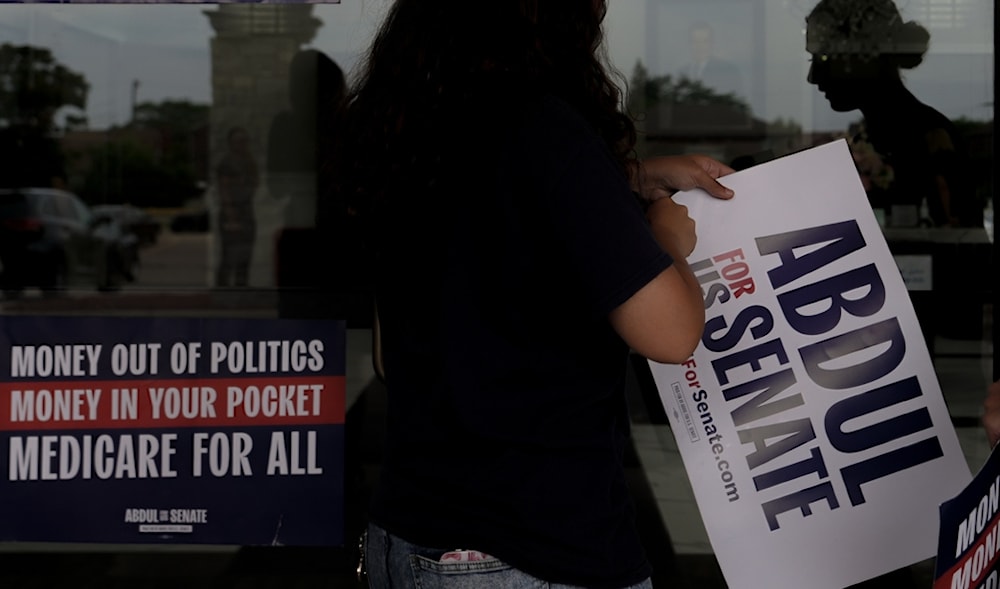
Volunteers tape a sign to a door before a campaign event for Abdul El-Sayed, a progressive candidate in the Democratic primary for U.S. Senate in Michigan, Friday, July 31, 2026, at Bint Jebail Cultural Center in Dearborn, Mich., US (AP)
The Democratic Party's divisions over its stance toward "Israel" are set to face a major test in upcoming primary elections in Michigan and Missouri, where progressive candidates critical of the Israeli occupation are challenging rivals backed by pro-"Israel" organizations.
According to a POLITICO report, the contests have emerged as a key battleground over the future influence of pro-Israeli Democrats within the party, with the American Israel Public Affairs Committee (AIPAC) playing a central role through unprecedented campaign spending.
AIPAC ramps up record spending in key primaries
In Michigan, AIPAC's main super PAC, the United Democracy Project, has invested roughly $30 million to support Representative Haley Stevens and prevent progressive candidate Abdul El-Sayed from securing the Democratic Senate nomination. POLITICO highlighted the effort as the organization's largest-ever spending campaign in a single election.
In Missouri, AIPAC is spending an additional $2 million to block former Representative Cori Bush's bid to return to Congress after previously allocating $9 million to defeat her during the last election cycle.
The report stated that the Michigan and Missouri contests are the latest chapter in the Democratic Party's long-running debate over support for "Israel", a divide that has widened considerably following the occupation's war on Gaza.
Progressive candidates critical of the Israeli occupation have gained ground in several Democratic primaries, winning races in New York, New Jersey, Colorado, Pennsylvania, and Illinois, where some defeated long-serving lawmakers regarded as more supportive of "Israel".
The Michigan and Missouri primaries are among the final opportunities this election cycle for progressive candidates to build on that momentum before November's general elections.
Progressive gains raise concerns among pro-'Israel' Democrats
Supporters of pro-"Israel" candidates have warned that defeats for Stevens in Michigan or Representative Wesley Bell, who is challenging Bush in Missouri, could reshape the Democratic Party's political landscape.
According to POLITICO, the possibility of such outcomes has also prompted concern among some Jewish Democrats over their future role within the party.
Sam Lauter, a founding member of Democratic Majority for Israel, which endorsed Stevens and Bell without purchasing advertising, said victories by El-Sayed or Bush would require a reassessment of the group's political strategy.
"If El-Sayed and Bush score victories, my community is going to have to reassess how we're approaching this battle, reassess our role in the party itself," Lauter said.
Michigan state Representative Noah Arbit similarly expressed concern over the increasing prominence of debates surrounding "Israel" within Democratic politics, saying the issue raises broader questions about the political space available for Jewish Democrats.
Gaza genocide reshapes Democratic attitudes
The report further linked the growing Democratic Party divide to changing voter attitudes following the war on Gaza.
Citing an AP-NORC survey, POLITICO reported that nearly 60% of Democrats now believe the party is too supportive of "Israel", compared with 45% who held that view in January 2024.
The Michigan Senate race has consequently become a significant political test in a swing state that could influence the Democratic Party's future direction, particularly after the Democratic National Committee proposed adding Michigan to the early 2028 presidential primary calendar.
Progressive candidates have centered their campaigns on Palestinian rights, opposition to unconditional US support for "Israel", and criticism of the influence of political spending in elections.
El-Sayed's campaign rejected claims that his positions reflect hostility toward Jewish people, stressing that he distinguishes between criticism of the Israeli government and Judaism while opposing both antisemitism and Islamophobia.
El-Sayed: Whatever you think about the right of Israel to exist, I wonder if they have a right to our tax dollars. Every time I come on CNN, you guys ask me the same questions.
— Acyn (@Acyn) July 19, 2026
I'm running for senate in Michigan and in Michigan, people can't afford their basic needs. I want… pic.twitter.com/MDxP5isvkk
Pro-'Israel' groups vow to maintain influence
Patrick Dorton, a spokesperson for the United Democracy Project, insisted that pro-"Israel" Democrats would continue to play an active role in Democratic primaries, while Dennis Bernard, national chair of government relations at the Jewish Federations of North America, argued that an El-Sayed victory would signal a growing anti-"Israel" trend within the Democratic Party.
At the same time, POLITICO highlighted divisions within the Jewish community itself, noting that several progressive Jewish activists, including former Representative Andy Levin, have endorsed El-Sayed.
Levin said El-Sayed views his campaign as an opportunity to become a leading figure in the US movement supporting Palestinian rights and has carefully shaped his political positions around the issue.
According to POLITICO, the outcome of the Michigan and Missouri primaries could become an important indicator of how the Democratic Party's internal debate over "Israel" evolves ahead of the 2028 presidential election.
Read more: AIPAC punishes Democrats over 'Israel' vote, ends their fundraising


