
Alarmed by Russia alignment, Washington re-engages Sahel states
 4 Min Read
The US shifts strategy in West Africa, re-engaging with military-led regimes in Mali, Niger, and Burkina Faso.
-
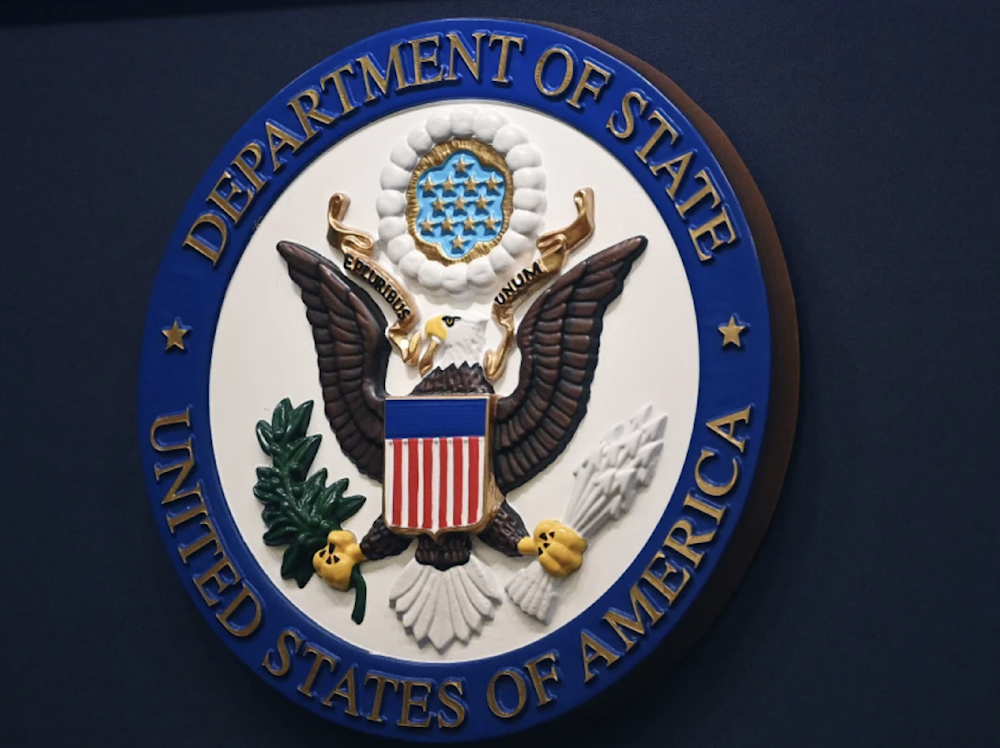
The State Department seal is seen on the briefing room lectern at the State Department in Washington on January 31, 2022 (AP)
The United States has made a sharp turn in its West Africa policy, opting to re-engage with the military governments of Mali, Burkina Faso, and Niger, three nations that have expelled French forces and embraced Russian military partnerships, the BBC reported. The change marks a departure from previous US efforts to promote democratic governance and human rights in the region.
In a significant move, the US State Department announced that Nick Checker, head of its Bureau of African Affairs, will visit Mali’s capital, Bamako, to express “respect for Mali’s sovereignty” and initiate “a new course” in bilateral relations. The visit aims to reset ties that were severed following a series of military coups between 2020 and 2023.
Days after Trump’s inauguration, USAID support to the region was withdrawn, and subsequent statements from US officials have emphasized sovereignty, stability, and economic interests over governance concerns.
The change in tone was reinforced by Massad Boulos, a senior adviser to Trump, who told Le Monde, “Democracy is always appreciated, but our policy is not to interfere in the internal affairs of other countries.”
A strategic recalibration
Analysts suggest that a combination of strategic, economic, and security considerations drives the policy reversal. The Sahel region, a belt stretching below the Sahara, is now regarded as the epicenter of global terrorism, accounting for nearly half of terrorism-related deaths worldwide.
Recently, the presidents of France, Benin, and the Ivory Coast were accused of backing armed groups behind an overnight attack on an Air Force base in the capital, Niamey, that wounded four soldiers and damaged an aircraft.
Meanwhile, the region’s vast mineral wealth, particularly Mali’s lithium, Niger’s uranium, and Burkina Faso’s gold, has become a geopolitical battleground. Niger’s junta recently seized control of its main uranium mine from French company Orano and is reportedly courting Russia as a new partner.
Washington's new stance on Russia
Unlike the EU, France, or ECOWAS, the Trump administration appears unbothered by Russian military involvement in the region, according to the BBC. Russia has deployed over 1,000 contractors to Mali and maintains smaller forces in Burkina Faso and Niger.
US officials, like Rudolph Atallah, a senior counterterrorism envoy, have signaled that Washington is open to coexistence, so long as US influence is not excluded.
General John Brennan of AFRICOM confirmed last month that the US continues to supply intelligence support and may consider limited arms transfers. However, the administration has ruled out troop redeployments or reopening the Agadez drone base in Niger, shut during Biden's era.
Regional shifts and the future of ECOWAS
With Mali, Niger, and Burkina Faso having withdrawn from ECOWAS, the regional bloc is now relieved of responsibility for their governance. The three juntas are instead building their own alliance, the Alliance of Sahel States (AES), focused on mutual security against jihadist insurgents.
As militants increasingly cross borders into Benin, Togo, Ghana, and the Ivory Coast, neighboring governments are cautiously rebuilding cooperation with the AES bloc, prioritizing practical counterterrorism measures over political concerns.
Re-engaging for minerals' sake
As for the US, it is re-engaging Sahel states primarily because the region holds strategic minerals—uranium, gold, lithium, rare earths—vital to energy security, defense, and the green transition. As minerals replace oil as the core geopolitical asset, Washington is seeking to secure future supply chains amid growing competition with China and Russia, both of which have expanded their footprint in Sahel mining through security-for-resources deals.
Coups in Mali, Burkina Faso, and especially Niger exposed how quickly Western access to critical resources can unravel. Re-engagement reflects a shift away from counterterrorism toward resource and economic diplomacy, even if it means softening positions on military rule.
Ultimately, this is about stabilizing extraction rather than transforming governance, managing instability to keep minerals flowing, not addressing the structural causes of Sahelian crises.


