
Aoun: Lebanon will not withdraw from direct talks with 'Israel'
 4 Min Read
Lebanese President Joseph Aoun says Beirut will continue direct talks with "Israel" despite pressure, as he demands withdrawal and an end to attacks.
-
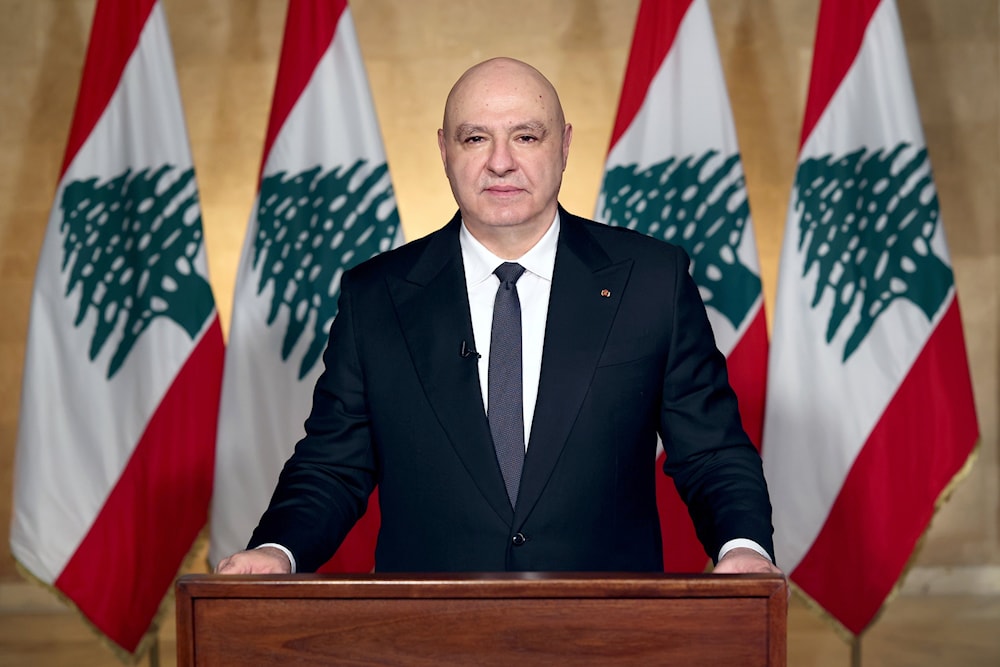
Lebanese President Joseph Aoun in a speech marking a ceasefire in Lebanon, April 17, 2026 (X/ @LBPresidency)
Lebanese President Joseph Aoun said Lebanon will not withdraw from direct negotiations with the Israeli occupation despite pressure to do so, stressing that Beirut would continue the process until reaching an outcome in the country’s interest.
“We will continue the path until reaching conclusions that serve our nation,” Aoun said.
Aoun called for ending the state of hostility with "Israel" based on several points, including the withdrawal of Israeli forces, an end to attacks, the deployment of the Lebanese Army, and the return of displaced people and detainees.
Lebanese authorities have held several rounds of direct negotiations with the Israeli occupation in Washington, while Israeli forces continue their aggression against Lebanon, particularly in southern areas, resulting in civilian casualties and the destruction of infrastructure.
The talks remain deeply unpopular among many Lebanese, who view negotiations with the Israeli occupation as taking place under continued military aggression. As Israeli occupation forces persist in carrying out attacks that have killed civilians, destroyed homes, and devastated infrastructure in southern Lebanon, critics argue that diplomacy risks normalizing relations while violations continue on the ground.
Continued Israeli violations
Meanwhile, Israeli violations of the ceasefire have intensified since April 17, with the Lebanese Ministry of Health reporting that more than 3,500 people have been martyred since the expansion of the Israeli aggression against Lebanon on March 2, 2026.
Israeli occupation forces launched a series of airstrikes and artillery attacks on the Bekaa and southern Lebanon on Thursday, in another blatant breach of the so-called ceasefire.
Al Mayadeen's correspondent in southern Lebanon reported that Israeli warplanes targeted the villages of al-Suwwaneh, Khirbet Selem, Kfratebnit, and Deir Kifa. Additional airstrikes hit the area between Sojod and al-Rayhan, with four separate raids reported in the vicinity.
In the town of al-Shahabiyah, an Israeli drone attack targeted an area near a health authority facility. Meanwhile, Israeli artillery shelled the towns of Qlaileh, Touline, and the outskirts of Kfar Chouba.
Al Mayadeen's correspondent also reported that Israeli warplanes carried out an airstrike on the village of Habboush in the Nabatieh governorate. The area was later targeted again, with the strike reportedly hitting a motorcycle on the main road.
At around 5:00 am, an Israeli drone carried out two strikes targeting a room inside a house and a car parked outside the residence in Nabatieh's al-Maqasid neighborhood. No casualties were reported in those attacks.
In western Bekaa, a drone strike targeted an area near the town of Mashghara. Two additional drone strikes hit Suhmor, followed by three more strikes on the Mashghara plain and orchard areas, bringing the total number of reported strikes to six.
No agreement can bypass the Resistance
In the same context, Hezbollah's Loyalty to the Resistance bloc MP Ali Fayyad told Al Mayadeen on Wednesday that any ceasefire arrangement for southern Lebanon must include the Resistance, warning that excluding it would undermine any agreement. He said Lebanon should view the Resistance as a national asset and urged dialogue to preserve internal stability.
Fayyad said regional developments, particularly Iran’s involvement in supporting the Resistance and Beirut’s Southern Suburb, showed shifting regional dynamics and limits to US influence. He argued that Washington’s remaining option is to reach an agreement with Tehran.
Lebanese government's approach
On Lebanon’s internal situation, Fayyad criticized the government’s approach, warning that current policies risk deepening divisions and pushing the country toward internal confrontation. He said the state should use all sources of national strength rather than sideline the Resistance.
Fayyad also rejected claims that the Resistance’s popular base has weakened, saying supporters remain committed despite the costs of the war. He added that the Resistance maintains significant capabilities and is prepared to continue confronting the Israeli enemy.
Regarding regional relations, Fayyad said Hezbollah received assurances from Turkey that Syria does not intend to act against the Resistance, while noting shared concerns among Turkey, Egypt, and Saudi Arabia over "Israel’s" regional expansion.
Read more: Israeli war on Iran, battle with Hezbollah proven irresponsible gamble


