
Exclusive | MP Ali Fayyad: No agreement can bypass the Resistance
 4 Min Read
Fayyad outlined the bloc's redlines on any ceasefire deal, criticised President Aoun's political direction as driven by US pressure, and said Washington now has "no viable option other than reaching an agreement with Iran."
-
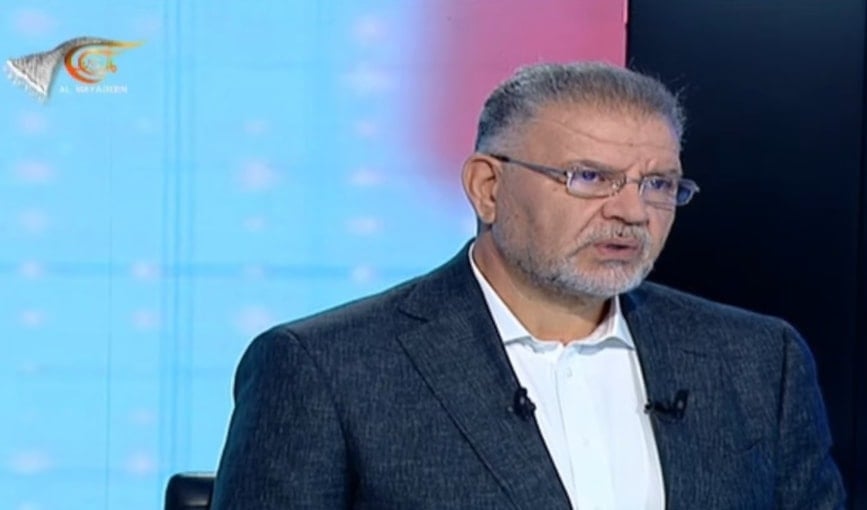
Member of the Loyalty to the Resistance bloc Ali Fayyad speaks to Al Mayadeen, October 18, 2025 (Screengrab)
Hezbollah's Loyalty to the Resistance bloc MP Ali Fayyad said in an interview with Al Mayadeen that no ceasefire framework for South Lebanon can sideline the Resistance, warning that Lebanon's current political trajectory risks internal rupture and calling on the government to treat the Resistance as a national asset rather than a liability.
Fayyad said the regional landscape is shifting in ways that expose the limits of US power. "There are limits to the United States' ability to reshape regional equations," he explained, pointing to Iran's role in the recent conflict as a turning point.
"Iran's direct involvement in defending the Resistance and Beirut's Southern Suburb was the embodiment of the unity of the battlefields," he said.
He stressed Washington's room to maneuver has narrowed to a single option. "The United States no longer has any viable option other than reaching an agreement with Iran," he said.
Ceasefire conditions
Fayyad affirmed that the Resistance holds the final word on any arrangement for the South.
"No agreement can bypass the Resistance, which holds the final word regarding South Lebanon," he said, adding that any initiative failing to deliver a comprehensive ceasefire and prohibit Israeli "operational freedom" is meaningless.
He expressed full confidence in Speaker Nabih Berri's conduct of negotiations, asserting that the Resistance has "complete trust in Speaker Nabih Berri when it comes to the fundamental principles."
Internal Lebanese affairs
Fayyad sharply criticized the current government's political direction. "President Joseph Aoun came to office under American pressure and has pursued political choices that have come at a high cost to Lebanon," he said, warning that the authorities are "attempting to undermine the country's political balance and overturn the sensitive internal balance in Lebanon."
He stressed that the stakes of the current approach are serious, explaining that "the authorities' current approach risks pushing the country toward a moment of internal confrontation, and such a scenario must be avoided."
Fayyad drew a clear line between demanding state alignment with the Resistance and calling for a more coherent national posture. "We are not calling on the Lebanese state to align itself with the Resistance; rather, we urge it to make use of all available sources of national strength," he said, adding a call for "dialogue aimed at building a consensual national vision that both leverages the role of the Resistance and Lebanon's relationships."
Alternatively, he praised the Lebanese Army's leadership for "acting wisely and managing the situation with a deep understanding of Lebanon's sensitive fabric."
The Resistance's popular base
Fayyad rejected any suggestion that the Resistance's constituency has been eroded by the costs of the conflict.
"Despite the immense sacrifices and heavy costs borne by its supporters, the Resistance's popular support has not grown weary," he said. "On the contrary, they have strengthened their resolve and determination." Supporters in Beirut's Southern Suburb, he added, "stand alongside the Resistance's other arenas and fronts."
In an apparent rebuke to President Aoun's recent remarks downplaying the Resistance's popular standing, Fayyad stressed that Sheikh Naim Qassem is "the political figure with the strongest popular support in Lebanon."
The Resistance's capabilities
Fayyad underscored that the Resistance's military capacity scales with the breadth of any confrontation. "The Resistance possesses significant capabilities, and the wider the battlefield becomes, the greater its ability to inflict losses on the Israeli enemy," he affirmed.
He maintained that "the Resistance remains committed to confronting the Israeli enemy without hesitation and possesses the capability to continue doing so."
Turkey, Syria
Fayyad disclosed that Hezbollah delegations have visited Turkey and received direct assurances regarding Syria.
"We received assurances that Syria has no intention of taking action against the Resistance," he revealed, describing Turkey's position on the Resistance as "particularly noteworthy."
He added that Turkey had affirmed "the Resistance's role and legitimacy in Lebanon."
He also pointed to a convergence of concern among key regional powers, saying Turkey, Egypt, and Saudi Arabia "share concerns about Israel's expansionist project in the region."


