
Aoun welcomes ceasefire between Iran, US, stresses sovereignty
 4 Min Read
Lebanon confirms inclusion in Iran-US ceasefire, as officials warn of violations by "Israel" and intensify diplomatic efforts to secure stability.
-
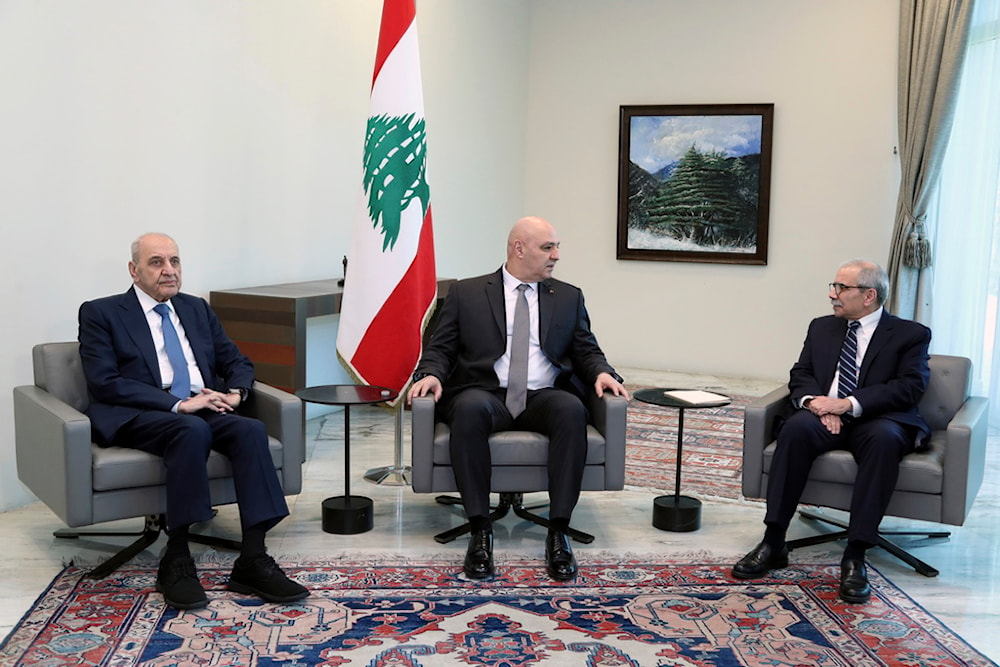
Lebanese President Joseph Aoun, center, meets with Prime Minister-designate Nawaf Salam, right, and Parliament Speaker Nabih Berri, left, in Baabda, east of Beirut, Lebanon, Tuesday, Jan. 14, 2025. (Lebanese Presidency press office via AP)
Lebanese President Joseph Aoun welcomed the announcement of a two-week ceasefire between Iran and the US, hailing the efforts of all parties involved, particularly Pakistan, Egypt, and Turkey.
He said the agreement could mark a turning point for West Asia, expressing hope that it would evolve into a broader and lasting settlement.
According to a statement published by the Lebanese president's office on X, Aoun hopes "that this announcement would be a first step towards a final and comprehensive agreement on the various issues that are destabilizing our region, one that safeguards the sovereignty of each state."
"This is based on the principle that violence is not an effective means of resolving problems between nations, and that the ultimate goal of regimes and governments is to achieve the well-being of their people through a free and dignified life, not to lead them to senseless and gratuitous death," the statement from his office added.
Aoun urged the continuation of Lebanese state efforts to ensure Lebanon is included as part of regional ceasefire efforts in a lasting and stable manner, "in accordance with the principles agreed upon by the Lebanese, namely full sovereignty over all its territory, its liberation from any occupying presence, and the exclusive right to war and peace, as well as the use of legitimate force, being confined to its constitutional institutions alone".
He considered that this “constitutes the sole responsibility of the Lebanese state in any negotiations aimed at achieving the national interest.”
رحب رئيس الجمهورية بالإعلان الأميركي الإيراني عن وقف إطلاق النار لمدة 15 يوماً. ونوّه بمساعي جميع الأطراف الذين ساهموا في التوصل إلى هذا الاتفاق. خصوصاً جهود كل من باكستان ومصر وتركيا. كما أمل في أن يكون هذا الإعلان خطوة أولى نحو اتفاق نهائي وشامل لمختلف القضايا التي تشكل عوامل…
— Lebanese Presidency (@LBpresidency) April 8, 2026
Berri: Contact with Pakistan to pressure 'Israel'
Lebanon's Parliament Speaker Nabih Berri confirmed that the nation is included in the ceasefire agreement between Tehran and Washington, stating that “this is what should happen.”
One of the conditions Iran put forward to the United States before the announcement of the ceasefire was the ending of the war on all fronts, including Lebanon.
Berri noted that “the Israelis have so far adhered to it across Lebanon, except in the south, and this constitutes a violation of the agreement.”
He revealed that he had contacted the Pakistani side to inform them of "Israel’s" non-compliance with the ceasefire, requesting that Islamabad engage with the United States to pressure "Israel" on this matter.
Berri added that he remains in contact with multiple parties involved in the negotiation process, with confirmations that Lebanon is part of the agreement, while not ruling out that "Israel" may attempt to “undermine the agreement as the party most affected by it.”
Lebanese government intensifies diplomatic efforts
Lebanese Prime Minister Nawaf Salam stated that “no one negotiates on behalf of Lebanon except the Lebanese state,” emphasizing that efforts are being intensified politically and diplomatically to secure a ceasefire in Lebanon.
Salam thanked Pakistan’s role in facilitating the ceasefire, noting that “since the outbreak of this war imposed on us, our primary concern has been to stop it.”
The Lebanese prime minister has played an active role in anti-Resistance activity since taking office. Following the initial Israeli aggressions on Lebanon at the beginning of March, Salam announced that the Cabinet approved the immediate prohibition on the Lebanese Resistance's military and security activities, as well as a directive limiting the group's role to political work.
The decision came after the Lebanese Resistance decided to retaliate after a 15-month onslaught by the Israelis against Lebanon, which caused the martyrdom of hundreds. Salam also ordered the Lebanese Army to withdraw following "Israel's" attacks on March 2 rather than defend the border.
This prompted Hezbollah's parliamentary chief, Mohammad Raad, to address the contradiction directly. While he acknowledged the state's authority over war and peace, Raad argued that such authority cannot be meaningfully exercised against an enemy that has spent over a year violating national sovereignty with impunity.
"There is no justification," he said, "for President Salam and his government to take bold and confrontational measures against Lebanese citizens who reject occupation," while the enemy itself refused to uphold any semblance of calm.
Following these comments, "Israel" launched a series of airstrikes across Lebanon.
Reports indicate that the airstrikes targeted Beirut and its southern suburbs, Saida, South Lebanon. The Israeli occupation states that it targeted over 100 sites across the country.


