
Arab American voters favor Democrats as Trump faces backlash
 5 Min Read
Arab American voters favor Democrats ahead of the 2026 midterms amid growing dissatisfaction with Trump’s handling of the economy and wars on Gaza and Iran.
-
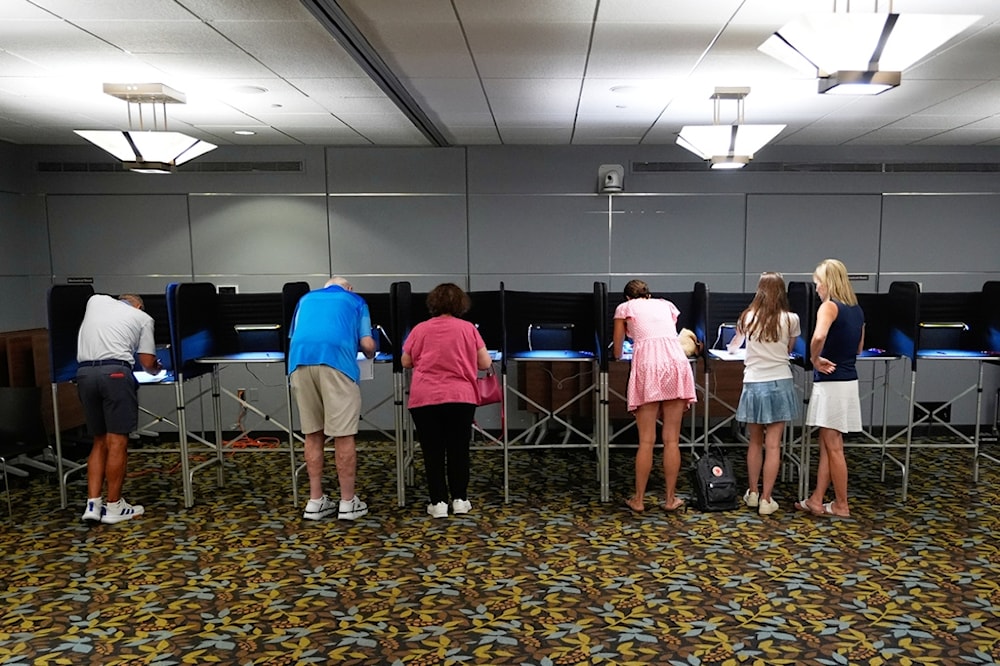
Voters fill out their ballots on primary election day at the Baldwin Public Library, Tuesday, Aug. 4, 2026, in Birmingham, Mich. (AP)
Anger over Washington’s Middle East policies and mounting pressure on household budgets are weighing on Republican support among Arab Americans, giving Democrats a substantial advantage with the community ahead of November’s congressional elections, a Washington Post-Schar School poll has revealed.
The survey puts Democratic support among registered Arab American voters at 58%, compared with 34% for Republicans. Among respondents who backed Donald Trump in 2024, 26% now intend to vote for Democratic congressional candidates.
The findings mark a departure from the last presidential election, when the community was closely divided. In the survey, 41% recalled voting for Kamala Harris and 39% for Trump.
Gaza, Iran policies draw widespread disapproval
Disapproval is particularly pronounced over US policy toward the Middle East, where Trump had promised Arab American voters they were “going to have peace in the Middle East” if he won the presidency.
According to the poll, 80% now disapprove of his handling of the war on Gaza, while 75% disapprove of his approach to Iran. Nearly eight in 10 favor reducing US military assistance to "Israel", including six in 10 who want that assistance stopped altogether.
Those positions extend into the president’s own electoral base. Among Arab Americans who voted for him in 2024, 54% disapprove of his handling of "Israel’s" war on Gaza and 48% disapprove of the war on Iran.
Living costs weigh on voters
Economic dissatisfaction is another major challenge for Republicans. Seven in 10 Arab American voters reject Trump’s management of the economy, including nearly four in 10 of his previous supporters.
Brandy Benevides, a 27-year-old Michigan store manager and mother of three, told The Washington Post that Trump’s economic promises persuaded her to cast her first presidential ballot for him in 2024. She now regrets that decision and plans to support Democrats.
“A couple of years ago, I was able to afford things. But now I’m going paycheck to paycheck,” Benevides said. “I’m going to food pantries and I’m grateful, but they give me two boxes and sometimes it’s still not enough.”
Affordability also shapes the priorities of voters who have remained opposed to Republicans despite their own frustrations with Democrats.
Joshua Kassab, a 30-year-old Georgia resident whose grandfather immigrated from Iraq, said the Biden administration’s support for Israeli attacks on Gaza led him to stop identifying as a Democrat in 2024. Kassab, who is Jewish, nevertheless intends to vote for the party’s candidates in November, with healthcare expenses among his immediate concerns.
“I’m a Type 1 diabetic,” he said. “There’s several hundred dollars a month that I need to pay in pharmaceutical bills to not die.”
Democratic lead comes with reservations
The Democratic advantage does not amount to an unqualified endorsement of the party. Some 45% of Arab Americans describe its attitude toward their community in neutral terms.
Republicans face more openly negative perceptions: roughly half of respondents regard the party as unfriendly toward Arab Americans, while about six in 10 hold that view of Trump.
The report also highlighted anti-Muslim rhetoric from Republican figures, including Trump’s description of Michigan Democratic Senate candidate Abdul El-Sayed as a “radical jihadist".
Most Arab American Trump voters still back Republicans
Still, Republicans retain most of their Arab American support from the previous presidential election. Among those who voted for Trump, 73% plan to back Republican candidates this year, and about two-thirds approve of his overall performance.
Moe Eldessouky, 34, of California, said he favors Republicans on crime and homelessness despite opposing Trump’s continued backing of "Israel".
“It’s not an easy thing to do, end a war as president, but I would like to see less favoritism to one country, which is Israel,” he said.
The community’s electoral choices could carry particular weight in Michigan, where Arab Americans account for about 2% of the adult population. El-Sayed, the son of Egyptian immigrants, faces Republican former congressman Mike Rogers in a contest that could help determine control of the Senate.
The poll surveyed 358 Arab American adults nationwide between August 20 and September 7, 2026, including 325 registered voters. The margin of sampling error is seven percentage points for registered voters and 13 points for the subgroup of 99 respondents who reported voting for Trump.
Read more: Mamdani backs El-Sayed in competitive Michigan Senate race


