
Iran Army: Arash 2 drones used to strike Ben Gurion Airport
 4 Min Read
Iran confirms the use of its advanced Arash 2 drone in a strike on Ben Gurion Airport, highlighting growing drone capabilities amid ongoing tensions with the US and "Israel".
-
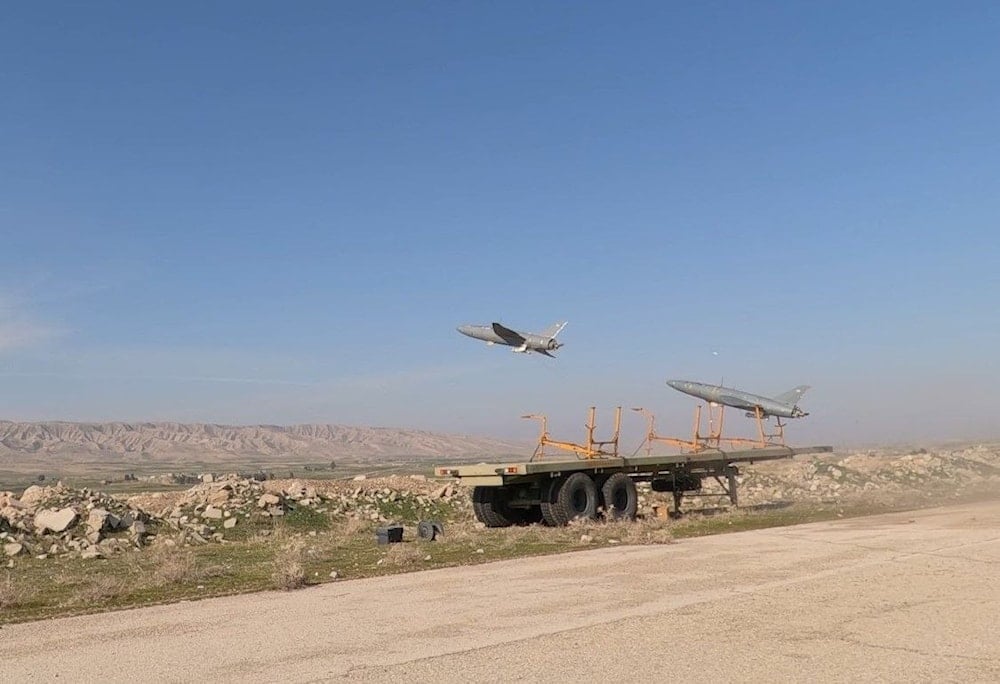
An Arash 2 drone being launched during a military exercise showing new drone capabilities, in an undisclosed location in Iran, January 28, 2025. (Tasnim News Agency)
The Iranian military confirmed that the recent attack on Ben Gurion Airport was carried out using the advanced Arash 2 drone, according to a statement by the army spokesperson, Mohammad Akrami Nia.
Akrami Nia emphasized that Iran is rapidly producing the Arash 2 drone and possesses the capability to launch large numbers of the drones at any time with ease. He added that the drone has an extremely small radar cross-section, enabling it to bypass enemy radar systems, and highlighted its high endurance for sustained flight.
The strike comes amid ongoing Iranian operations targeting US bases and "Israel" as defensive measures in response to the aggression against it, in which Washington and Tel Aviv have struck residential neighborhoods, civilian infrastructure, and natural resources since February 28.
Iran Army announces new phase of drone ops targeting Ben Gurion
The Iranian Army announced a new phase of precision drone operations targeting Israeli military infrastructure at Ben Gurion Airport on March 21, describing the attack as a direct response to the ongoing US-Israeli war on Iranian territory.
According to the army's 37th statement, early morning strikes hit key logistical and operational nodes, including fuel depots and refueling systems used to support Israeli fighter jets. The operation specifically targeted assets sustaining ongoing air assaults against Iran and its regional allies.
The statement stressed that the attacks caused “significant damage” to Israeli military infrastructure, disrupting refueling networks and airport operations. Israeli authorities have reportedly been forced to rely on alternative transport methods, such as railways, for military movements, a shift that could increase risks to settlers.
Recent reports indicate mounting pressure on "Israel’s" main airport. Damage to aircraft at Ben Gurion has been confirmed following Iranian strikes, with operations severely constrained and air traffic limited. Broader aviation activities have also been affected, with flight suspensions and operational disruptions continuing amid the escalating conflict.
Iran’s military affirmed that the operation is part of a sustained campaign enabled by a “comprehensive and multi-layered target bank,” allowing for continued, calibrated strikes. Officials emphasized that drone use reflects a deliberate strategy to target military infrastructure while maintaining pressure on adversaries across multiple fronts.
The Arash-2 Drone at a glance
The Arash‑2 is an advanced Iranian long‑range attack drone first revealed publicly in 2022, though its prototypes appeared in military drills as early as 2020. Iranian military officials have repeatedly highlighted the system in strategic demonstrations and press announcements.
Developed by Iran’s Defense Industries Organization as a successor to the earlier Arash‑1, the Arash‑2 is a large, propeller‑driven loitering munition (suicide drone) with a wingspan of about 4 meters and a length near 4.5 meters.
One of its most notable features is its long operational range, estimated at up to roughly 2,000 kilometres, which places targets deep inside regional territories within striking distance.
Iranian commanders have said the drone combines precision guidance systems (such as GPS/INS) with improved autonomous navigation, allowing it to re‑acquire its target during flight and evade radar detection by flying low or using advanced electronics.
What makes the Arash‑2 particularly significant is its role in Iran’s expanding unmanned arsenal: it bridges the gap between tactical UAVs and strategic strike capability, giving Tehran a long‑range, relatively low‑cost weapon that supports asymmetric deterrence and deep‑strike missions.


