
Ben-Gvir slams Lebanon-'Israel' ceasefire agreement as 'big mistake'
 3 Min Read
Israeli Police Minister Itamar Ben-Gvir slams the US-brokered "Israel"-Lebanon ceasefire as a "big mistake", warning it could backfire by strengthening the Resistance.
-
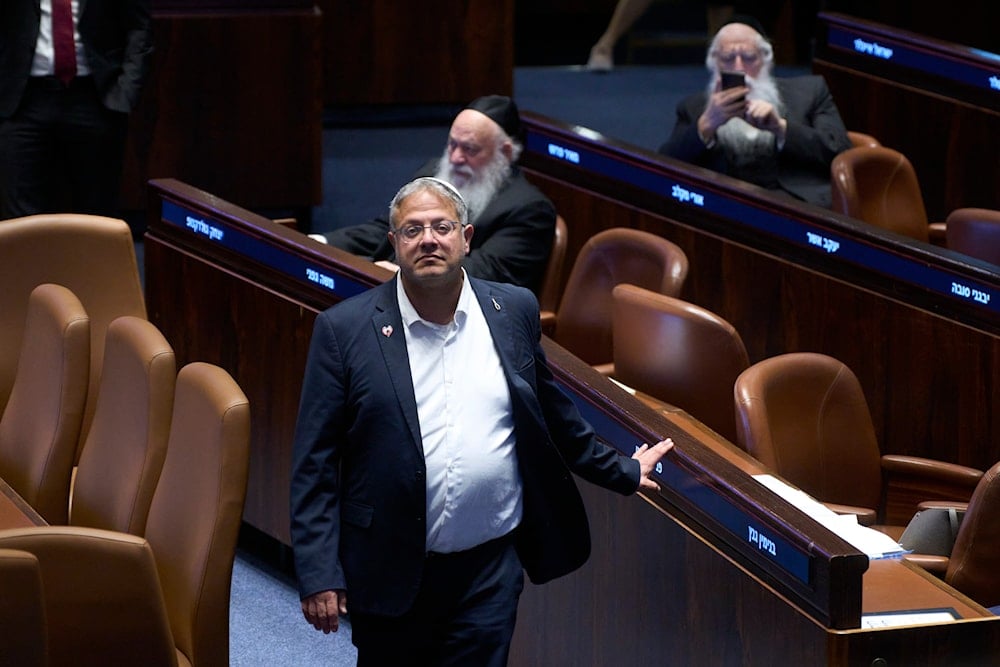
Israeli Police Minister Itamar Ben-Gvir, in the Israeli parliament, during a session considering a bill to dissolve the government in occupied al-Quds on May 20, 2026. (AP Photo/Ohad Zwigenberg)
Israeli Police Minister Itamar Ben-Gvir sharply criticized the conditional ceasefire agreement between “Israel” and Lebanon, brokered by Washington on Wednesday, describing it as "a big mistake".
In a statement on X, Ben-Gvir said the agreement reflected poor strategic judgment and warned that it could undermine "Israel’s" security position, accusing Israeli Prime Minister Benjamin Netanyahu’s advisors of pushing policies that lead the government toward "wrong choices".
הפסקת האש עם לבנון היא טעות חמורה וחלומות באספמיה של יועצים שגוררים את ראש הממשלה להחלטות לא נכונות.
— איתמר בן גביר (@itamarbengvir) June 4, 2026
חיזבאללה לא יצא מהאזור שמדרום לליטני, ולצבא לבנון אין שום דרך לכפות עליו את הפינוי.
מדינת לבנון היא שותפה של חיזבאללה. יש שרים בממשלה שלה מטעם חיזבאללה, ובצבא לבנון משרתים קרובי…
Ben-Gvir argues that the ceasefire agreement is effectively unenforceable, stating that the Lebanese state lacks the capacity and credibility to ensure compliance.
It is noteworthy that "Israel" has broken all ceasefire agreements with Lebanon in the past 20 years, recording tens of thousands of violations.
He claimed that Hezbollah remains active south of the Litani River and questioned whether the Lebanese army can implement the terms of the agreement, further describing Lebanon as aligned with Hezbollah, raising doubts about the viability of the ceasefire framework.
Criticism of US involvement and Netanyahu’s strategy
The minister also criticized Prime Minister Netanyahu, accusing him of yielding to pressure from the United States to secure the agreement. He argued that “Israel” should maintain a more independent position in negotiations, even when dealing with close allies.
Ben-Gvir stated that leadership sometimes requires rejecting external pressure, including from US President Donald Trump, to avoid future security risks.
Despite announcements of a ceasefire framework, tensions on the ground remain high, with continued military activity and confrontations reported in southern Lebanon amid ongoing Hezbollah operations in parallel with diplomatic efforts.
Analysts view the agreement as part of broader attempts to contain escalation, though political divisions within "Israel" highlight disagreement over its long-term effectiveness.
Israeli occupation, Lebanon agree to 'conditional ceasefire'
As a result of US-led negotiations, the Israeli regime and the Lebanese government agreed to implement a ceasefire, which would be conditional on a “complete halt of hostilities” from the Lebanese Resistance, as well as the withdrawal of all its forces from southern Lebanon south of the Litani River.
The US State Department published a joint statement issued by the United States, Lebanon, and the Israeli occupation following the fourth high-level trilateral meeting held on June 2 and 3.
According to the statement, the United States hosted Israeli and Lebanese representatives in Washington, where discussions focused on advancing a ceasefire framework and broader security arrangements.
The statement also said the agreement remains dependent on security developments on the ground, amid continued Israeli military activity in Lebanon despite ongoing diplomatic efforts. It further outlined plans to establish so-called “pilot zones,” in which the Lebanese army would assume exclusive control over the territory, excluding all non-state actors.
These arrangements were presented as part of steps toward a "potential comprehensive peace and security agreement", according to the US statement.


