
Bennett-Lapid alliance trailing Netanyahu's Likud by just one seat
 3 Min Read
A new poll shows the Likud narrowly ahead of a Bennett-Lapid alliance amid coalition tensions and the Haredi draft dispute.
-
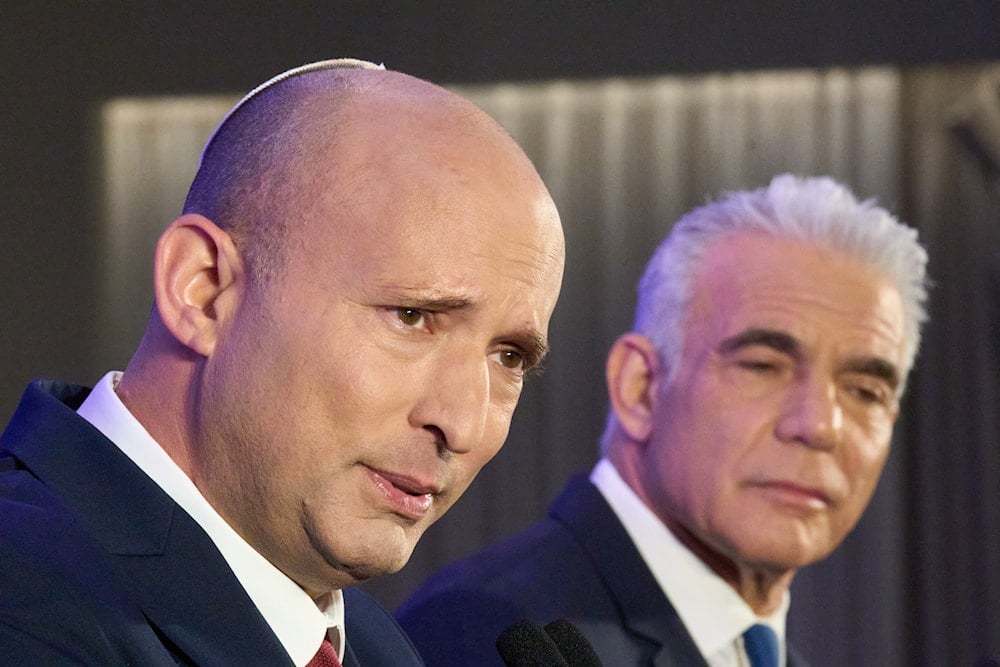
Former Israeli prime ministers Naftali Bennett, left, and Yair Lapid hold a joint press conference announcing that their parties will run together in the upcoming elections, in Herzliya, occupied Palestine, Sunday, April 26, 2026 (AP)
A new poll shows a notable narrowing of the gap between Israeli Prime Minister Benjamin Netanyahu’s Likud party and a potential political alliance between former Prime Ministers Naftali Bennett and Yair Lapid, amid rising political and security tensions linked to the war on Iran.
The survey, published Tuesday by Israeli Channel 11, indicates that the Likud would secure 26 seats in the Knesset, compared to 25 seats for the “Beyachad” alliance led by Bennett and Lapid, positioning it as the main challenger to Netanyahu’s political bloc.
The poll also highlights former Israeli Chief of Staff Gadi Eisenkot as a potential kingmaker, with efforts reportedly underway by Bennett and Lapid to bring him into their alliance.
The survey comes amid a political crisis within the governing coalition, after Netanyahu was accused of pushing forward legislation to extend military service without making progress on a controversial draft exemption law for Haredi communities. The dispute has sparked anger among religious parties, which have threatened to bring down the government.
Furthermore, this comes as "Israel" moves toward its next parliamentary elections, expected by October 27, 2026, unless the Knesset is dissolved earlier under the country’s electoral rules.
The upcoming election is expected to be highly competitive, with Prime Minister Benjamin Netanyahu’s Likud party facing a strengthened opposition led by former Prime Ministers Naftali Bennett and Yair Lapid. With no party likely to secure an outright majority in the 120-seat Knesset, coalition-building is expected to be decisive in determining who forms the next government.
Netanyahu's ratings plummet in 3 years
A series of surveys conducted in "Israel" between 2023 and 2025 indicates a sustained decline in public favorability toward Prime Minister Benjamin Netanyahu, with disapproval consistently outweighing approval since "Israel" launched its war on Gaza on October 7, 2023.
According to Pew Research Center polling, Netanyahu’s favorable ratings among Israelis dropped sharply after the war began, with support weakening significantly across centrist and left-leaning segments of the electorate and broader approval eroding amid the prolonged war.
By 2024, multiple surveys showed that Netanyahu’s popularity remained under sustained pressure, with disapproval becoming the dominant view among the Israeli public. Pew Research Center data from that period indicated that a majority of Israelis held an unfavorable view of him, marking one of the highest recorded levels of negative sentiment since tracking began in 2013.
Polling trends in early 2025 reinforced this downward trajectory. Compilations of Israeli survey data through March 2025 showed that a clear majority of the public disapproved of Netanyahu’s performance as prime minister, while approval remained largely confined to his core political base, reflecting continued disillusionment following the events of late 2023 and ongoing wartime governance challenges.
At the same time, confidence metrics collected over 2025 showed volatility but no clear recovery, with public trust in Netanyahu fluctuating at comparatively low levels amid persistent political and security crises. Renewed declines during periods of escalation or domestic political controversy offset short-term improvements in some polls.


