
Israeli gov. under pressure as wars on region fail to meet objectives
 3 Min Read
"Israel" is facing rising internal pressure after its wars in the region failed to achieve stated objectives, undermining Prime Minister Benjamin Netanyahu ahead of elections.
-
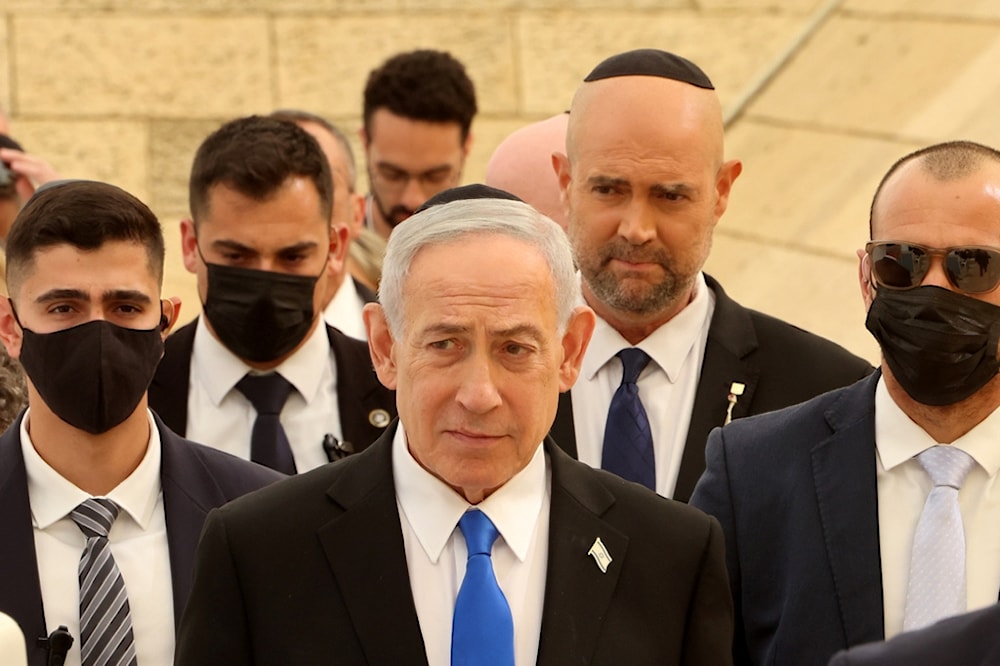
Israeli Prime Minister Benjamin Netanyahu attends a Memorial Day opening ceremony at the Yad LaBanim House in occupied al-Quds, Monday, April 20, 2026 (Pool Photo via AP)
"Israel" is facing mounting internal strain after its multi-front wars in the region failed to achieve their stated objectives, the Associated Press reported, placing Prime Minister Benjamin Netanyahu under increasing pressure ahead of upcoming elections.
Despite sustained attacks on Iran and Resistance movements in the region, including Hezbollah and Hamas, the overall balance on the ground points to continued resilience across these fronts. Iran remains operational despite strikes on its infrastructure, while Hezbollah and Hamas continue to function militarily and politically, underscoring the limits of the aggression.
No decisive victory achieved
Netanyahu had framed the confrontation with Iran as an effort to dismantle its military capabilities and create conditions for "regime change". However, the announcement of a ceasefire earlier this month came without those objectives being realized, reinforcing perceptions of an inconclusive outcome.
In Lebanon, "Israel’s" confrontation with Hezbollah continues without a decisive result. Netanyahu acknowledged that the truce was accepted following a request from Donald Trump, while insisting that operations are not over. Israeli forces continue to occupy areas of southern Lebanon, reflecting a situation that remains unresolved rather than concluded.
The Gaza front presents a similar picture. More than two years after the war began, Hamas remains in place despite extensive destruction and losses, adding to a broader perception that "Israel" has not secured a clear victory on any front.
“After 925 days of fighting since October 7, Israel has failed to achieve decisive victory on any front,” wrote Yoav Limor, a prominent military affairs commentator. “At the end of yet another war, it is perceived as a country whose decisions are not made in Jerusalem, but in Washington.”
Netanyahu has rejected such assessments, portraying the confrontation with Iran as a strategic success. “We crushed the Iranian regime’s destruction machine in advance,” he recently claimed.
Public support begins eroding
However, domestic sentiment appears to be shifting. While initial support for the aggression was strong, particularly at its outset, recent polling indicates growing dissatisfaction with the government’s handling of the war following the ceasefire. Analysts attribute this to the gap between declared objectives and actual outcomes. “People were disappointed because it hadn’t achieved the goals,” said Dahlia Scheindlin, a political analyst in Tel Aviv.
The developments have also brought renewed attention to "Israel’s" reliance on Washington. Although Trump has continued to publicly praise "Israel", reported divergences in priorities, particularly regarding ceasefire arrangements, have fueled perceptions that key decisions are shaped externally rather than domestically.
These dynamics are being closely watched within "Israel" as political pressure mounts ahead of elections due by the end of October. Opposition figures, including Naftali Bennett and Yair Lapid, have announced plans to run on a joint list, while former military chief Gadi Eisenkot is also expected to align with them.
With ceasefires in place but underlying tensions unresolved, the situation remains volatile. As one commentator noted, “With unstable ceasefires that can lapse at any given point, voters will be not happy about it.”
Read more: Eisenkot to Netanyahu: You've failed, time for elections


