
China, EU choose dialogue amid Brussels pressure over trade deficit
 4 Min Read
Beijing warns that Brussels' concerns over its trade deficit risk turning economic competition into protectionist confrontation.
-
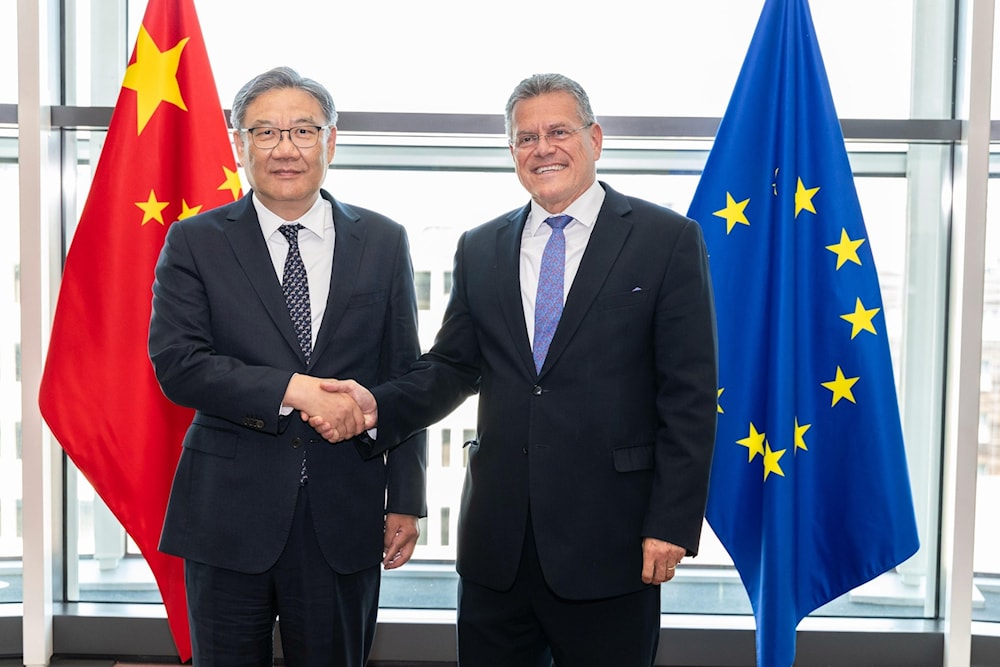
Chinese Commerce Minister Wang Wentao and EU Trade Commissioner Maroš Šefčovič shake hands in Brussels after China and the EU agreed to launch trade consultations aimed at easing tensions over their widening trade imbalance (X, @MarosSefcovic)
China and the European Union have agreed to enter a new round of trade consultations, signaling a shared effort to manage economic tensions through dialogue rather than allow Brussels’ growing protectionist pressure to push relations toward a trade war, The Guardian reported.
The agreement followed talks in Brussels between Chinese Commerce Minister Wang Wentao and EU Trade Commissioner Maroš Šefčovič, resulting in the first joint statement issued by the two sides in seven years. The move comes after weeks of European warnings over the bloc’s trade deficit with China, which EU officials say has reached around €360 billion annually.
For Beijing, the talks offer a chance to address disputes through established channels and prevent trade frictions from being politicized. China has repeatedly stressed that economic ties with Europe should be based on openness, mutual benefit, and respect for global supply chains, rather than accusations aimed at justifying tariffs or restrictive measures.
In their joint statement, the two sides said, “The EU and China as key trade partners, agree that the main objective of the TIC [trade and investment consultations] is to strengthen dialogue at ministerial level on trade and investment policies with the view to stabilise and make our bilateral relationship more balanced.”
Progress is built one conversation at a time.
— Maroš Šefčovič🇪🇺 (@MarosSefcovic) June 29, 2026
With Minister Wang Wentao, we've launched the 🇪🇺🇨🇳 Trade and Investment Consultations to tackle priority issues: trade and investment balancing, export controls, IPR.
The work intensifies. I'll be in Beijing in October to assess it. pic.twitter.com/jpGAG9HaWO
Beijing favors talks over confrontation
The consultations will continue for three months and are expected to address four main issues: trade and investment balance, export controls including rare earths, intellectual property rights, and World Trade Organization reform.
Šefčovič said the EU wanted progress before the next meeting in Beijing in October, arguing that Europe could not continue with the current deficit.
“We simply cannot afford to continue in the unsustainable growth of the trade deficit from the European perspective,” said Šefčovič. “We just didn’t want to wait too long. You hear it from European leaders, you heard it from the president of the European Commission, that what is very important for us is engagement, it’s dialogue. But it has to bring tangible results, and we believe that we can achieve them by October.”
While Brussels has framed the issue as a matter of industrial protection, China is likely to view the EU’s concerns as an attempt to blame Chinese competitiveness for Europe’s own structural economic challenges. Chinese exports remain central to European supply chains, supporting manufacturers, lowering production costs, and offering consumers affordable goods.
The EU’s statistics agency, Eurostat, said on June 15 that Chinese exports to the bloc exceeded European exports to China by around €1 billion a day. But from Beijing’s perspective, such figures reflect market demand, industrial efficiency, and the depth of China-Europe trade integration, not unfair practice.
Concerns over 'China Shock 2.0'
European leaders have increasingly warned of what they describe as “China Shock 2.0,” a phrase used to suggest that Chinese exports pose a growing threat to European industries and jobs. The concern has moved beyond electric vehicles and green energy, extending into components and industrial goods used by European factories.
Industry groups, including the European Chambers of Commerce in China, have warned that Chinese exports could “cannibalize” EU factories that depend heavily on Chinese components.
However, Beijing has long argued that such claims risk turning normal trade competition into a political confrontation. China’s position is that Europe should improve its own competitiveness and innovation capacity instead of moving toward restrictions that could disrupt supply chains and harm both sides.
Read more: China calls on countries to 'oppose decoupling' amid economic pressure


