
China, Russia: Destructive external interference undermines Eurasia
 3 Min Read
China and Russia say destructive external interference is the main source of instability in Eurasia, and condemn external coercion by force, Xinhua reports.
-
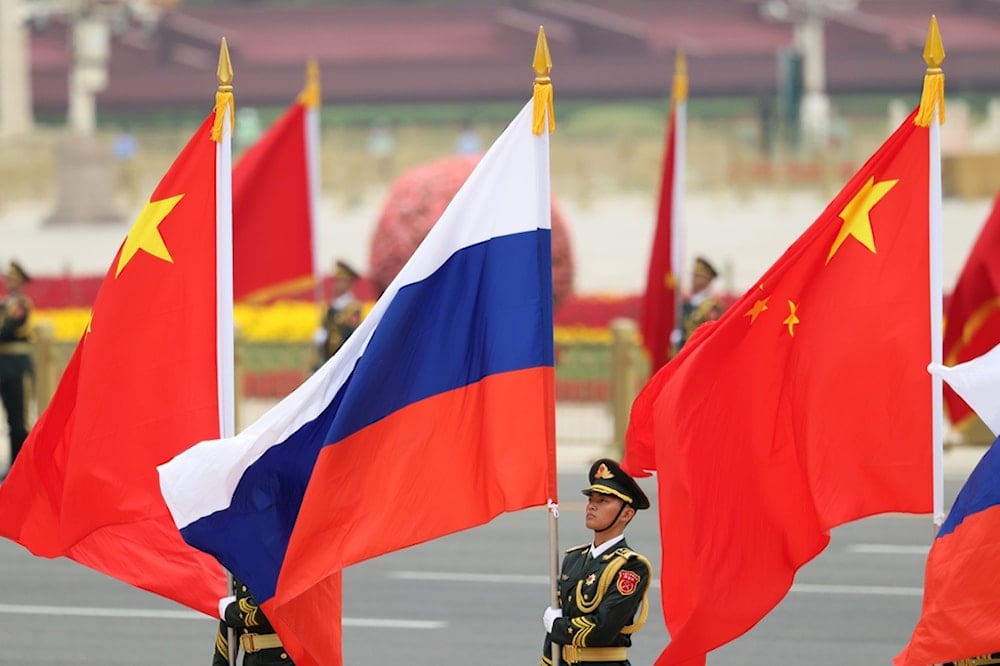
China's People's Liberation Army (PLA) honor guards hold Chinese and Russian flags ahead of a welcoming ceremony for Russian President Vladimir Putin at the Great Hall of the People in Beijing, China, on May 20, 2026. (Pool Photo via AP)
China and Russia said destructive external interference is the main source of instability across Eurasia, and strongly condemned any act of external coercion through the use of force, Xinhua reported.
The statement came in a joint communique issued on Wednesday, October 21, after the 31st regular meeting between the two countries’ heads of government in St. Petersburg. Chinese Premier Li Qiang and Russian Prime Minister Mikhail Mishustin co-chaired the meeting at the Boris Yeltsin Presidential Library.
The communique said both sides uphold the United Nations-centered international system and the international order based on international law. They also said they support building fair international relations on mutually beneficial cooperation among sovereign states, and oppose dividing the world into rival regions or blocs.
Mutual support on core interests
According to AFP, the two sides pledged to firmly support each other on issues affecting their core interests and main concerns. China said it supports Russia in protecting its security, stability, national unity, development, sovereignty and territorial integrity, and opposes interference by outside forces in Russia’s internal affairs.
Putin meets Li
Li also met Russian President Vladimir Putin at the Constantine Palace in St. Petersburg on Wednesday. He said Beijing is ready to strengthen coordination with Moscow on major international issues, including within the Shanghai Cooperation Organization and BRICS, and to work with Russia to unite a broader coalition of the Global South. Putin said Russia-China relations do not depend on the international situation and are not directed against any party.
Putin had also met US envoy Steve Witkoff at the same palace earlier that day. Kremlin aide Yuri Ushakov said a possible first-ever meeting of the leaders of China, Russia and the United States is being prepared, with the aim of including it in next month’s Asia-Pacific summit in Shenzhen, China.
Trade, energy and new agreements
The two sides signed a package of cooperation documents covering trade, aerospace, science, technology and education. They also agreed to promote high-quality trade growth, to expand cooperation in artificial intelligence, biotechnology and the digital economy, and to increase freight on Arctic shipping routes, Xinhua reported.
Bilateral trade exceeded $185 billion in the first eight months of 2026, up 28.4% from a year earlier, according to the Chinese embassy in Russia. Mishustin said the share of national currencies in bilateral trade is approaching 100%.
Russia remains China’s leading supplier of oil and natural gas, Mishustin said, and the Power of Siberia pipeline is operating stably. Deputy Prime Minister Alexander Novak said Russia and China could finalize agreements on the new Power of Baikal gas pipeline, previously called Power of Siberia 2, by the end of the year, once their companies complete commercial negotiations.
Read more: China’s strategic vision sets it apart from the West: Zakharova


