
China's US ambassador notes four red lines ahead of Xi visit
 5 Min Read
Chinese Ambassador Xie Feng says Xi Jinping's US state visit could mark a milestone in ties as Beijing and Washington navigate trade tensions and mistrust.
-
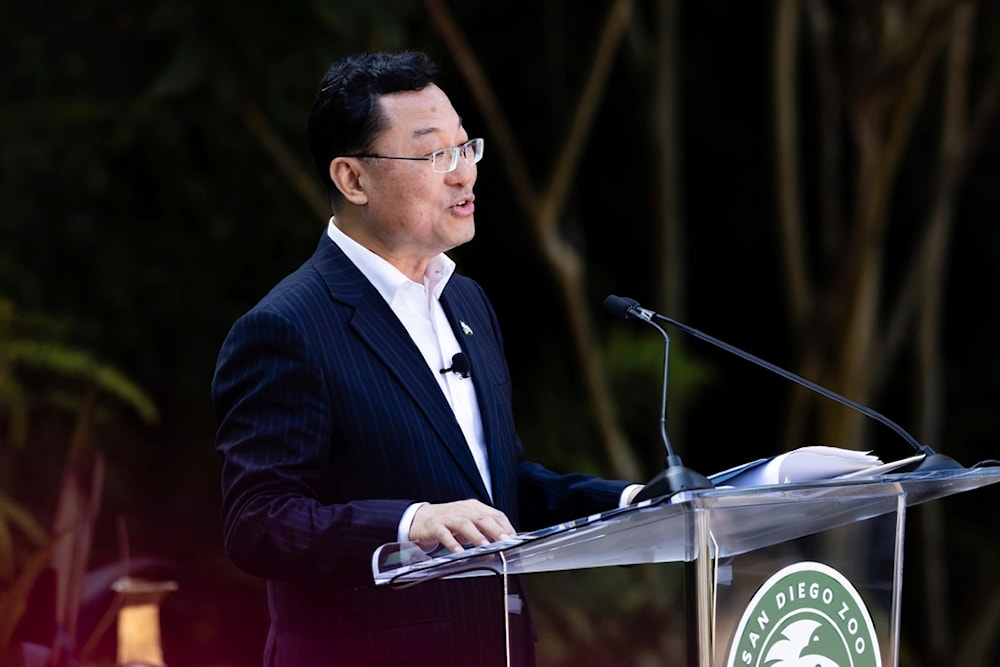
Chinese Ambassador to the United States Xie Feng speaks at the grand opening ceremony for Panda Ridge at the San Diego Zoo Thursday, Aug. 8, 2024, in San Diego. (AP Photo/Derrick Tuskan)
China's Ambassador to the United States, Xie Feng, wrote in the People's Daily newspaper on September 23 that Chinese President Xi Jinping, for the first time in 11 years, will pay a state visit to the United States.
The meeting, coming at the invitation of US President Donald Trump, is set to be a milestone in Sino-US relations, per the ambassador.
"For 11 years, China-US relations have weathered storms, fully demonstrating that decoupling and severing ties are impossible, a condescending approach is not feasible, and conflict and confrontation are unacceptable," Xie said. "For 11 years, the once-in-a-century changes have accelerated, and the international situation has become increasingly complex and volatile, making a stable, healthy, and sustainable China-US relationship more necessary than ever."
Xie praised Xi's work in charting a new course and writing a new chapter in China-US relations; he further hailed the May meeting for establishing a "new positioning for a constructive, strategic, and stable relationship between China and the United States."
"The common interests between China and the United States far outweigh their differences; win-win cooperation is the mainstream and the general trend," Xie wrote. "Both sides should implement the important consensus reached by the two heads of state, give full play to the roles of the two major mechanisms of political diplomacy and economic and trade consultations, expand exchanges in various fields such as the military, law enforcement, health, agriculture, tourism, science and technology, and culture, continuously lengthen the list of cooperation and shorten the list of issues, and work together to accomplish more major and beneficial things for both countries and the world."
He stated that competition between Beijing and Washington is inevitable but should be good-natured. stating that the two nations' goals in the global market should be that of prosperity and progress in tandem.
"Artificial intelligence concerns the well-being of all humanity," he said. "The competition between China and the US should focus on how to better drive innovative development, ensure safety and controllability, promote mutual learning among civilizations, improve global governance, and advance artificial intelligence towards good and for the benefit of humanity."
Read more: China urges EU to avoid trade war, calls for dialogue
China-US ties hinge on respect
Xie stated that managing the difference between the two nations should be done in good faith, with agreements put into action rather than exchanging baseless promises.
"The US should cease fabricating pretexts such as 'national security,' 'economic imbalances,' and 'forced labor' to abuse its containment and suppression tactics against China," the ambassador said.
He further added that upholding the bottom line is crucial for maintaining prolonged peace and stability, noting that confrontation between Beijing and Washington harms the pair.
"We must overcome the 'Thucydides Trap,' avoid the'"tragedy of great power politics,' and adhere to the bottom line of non-conflict and non-confrontation," he said.
Xie emphasized in his note that "China's sovereignty, security, and development interests are inviolable," highlighting four red lines: the Taiwan issue, democracy and human rights, political system and path, and the right to development.
These points "are not to be challenged," he said. "China is committed to the path of peaceful development and hopes the US will meet it the same way, promoting world peace and tranquility through peaceful coexistence between China and the US."
Chinese-US tensions at the backdrop
The two superpowers have been dealing with heightened trade tensions since Trump began his second term as president.
The current trade arrangement between Beijing and Washington is expected to expire on November 10, with US Trade Representative Jamieson Greer stating that an extension is unlikely.
"We will continue to have discussions about that. Our sense is we aren't going to have the extension today, but again, we still have some time before that happens," Greer told Bloomberg on Monday.
When he was asked why Washington would not extend the deal through the end of Trump’s second term to reduce uncertainty, the trade representative stated that while both Trump and Xi have a positive relationship, there still remains a degree of mistrust between the two nations.
The upcoming summit will therefore test whether Beijing and Washington can translate renewed high-level engagement into a more stable relationship despite persistent strategic and economic differences.
Read more: Saudi Arabia withdraws from China-led mBridge digital currency project


