
US admits space weapon deployment, China warns against militarization
 4 Min Read
The US has confirmed for the first time that it deployed a weapon in orbit, expanding its military capabilities amid growing rivalry with Russia and China.
-
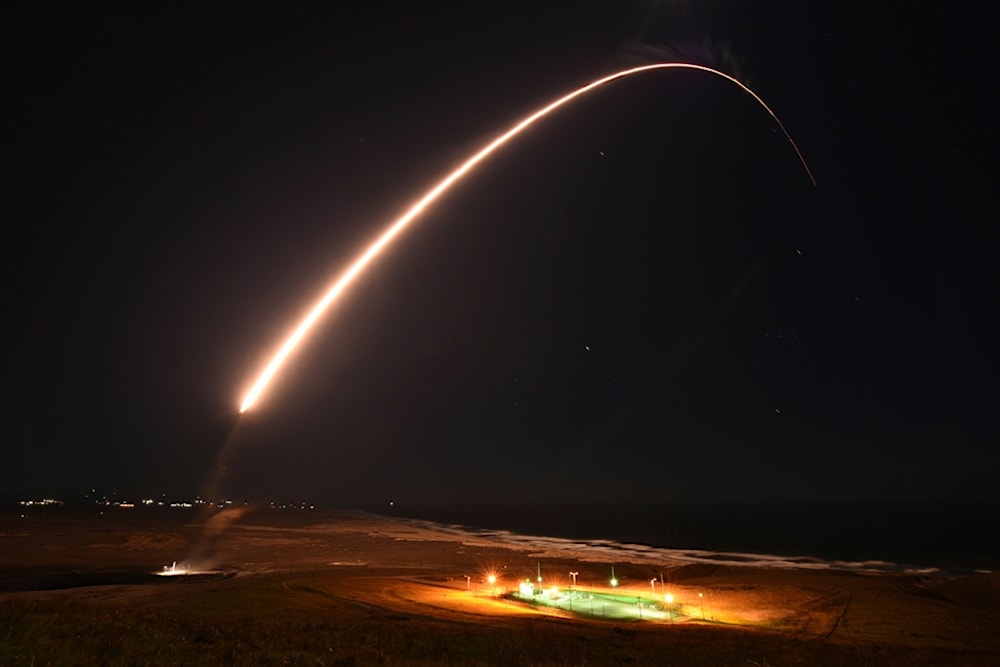
In this photo provided by US Army Space and Missile Defense Command, an unarmed Minuteman 3 intercontinental ballistic missile launches during an operational test at Vandenberg Air Force Base on Feb. 23, 2021 (US Army Space and Missile Defense Command via AP)
The United States has acknowledged for the first time that it has placed a weapon in Earth's orbit, signaling a further expansion of Washington's military capabilities in space amid growing competition with Russia and China.
US Secretary of the Air Force Troy Meink disclosed the deployment while speaking at the Air, Space and Cyber Conference on Monday. He said the orbital weapon was needed to "protect US forces from hostile actions," as carried by the BBC.
Meink said the system is necessary to respond to “evolving threats” but did not disclose what type of weapon had been deployed, when it was launched, or what capabilities it possesses.
The admission marks a significant development in US military policy, as Washington has increasingly emphasized the need to defend its satellites and develop capabilities that could target those of "potential adversaries", as per the reports.
Washington expands military role in space
The Trump administration has also incorporated space-based capabilities and interceptor missiles into its planned “Golden Dome” missile defense architecture, which is intended to protect the US from missile and other airborne threats.
The US Space Force, established in 2019 as the first new US military branch in more than seven decades, is responsible for protecting US space assets, including hundreds of satellites used for communications, surveillance, and other military functions.
Its role has increasingly extended beyond protection. A Space Force spokesperson told the BBC that “space control” involves the ability to contest and control the space domain through both kinetic and non-kinetic measures, including disrupting, degrading, and potentially destroying adversary capabilities.
The spokesperson added that such capabilities can be used for both offensive and defensive purposes when directed by US combatant commands.
Russia, China develop counterspace capabilities
The US has repeatedly accused Russia and China of expanding their ability to operate against satellites.
The US Space Force singled out China as a threat in its announcement, saying Beijing “develops and operates space and counterspace capabilities as part of a military modernization strategy."
It also named Russia, another geopolitical rival, which it said “believes space supremacy will be a decisive factor in future conflicts."
China to US: 'Stop preparing for war in outer space’
Commenting on the report, China urged the United States to “stop preparing for war” in space.
The Chinese Foreign Ministry opposed the move, warning against the “weaponization of outer space, turning it into a battlefield, as well as an arms race there."
“We urge the US side to stop expanding its military capabilities and preparing for war in outer space,” Ministry spokesman Guo Jiakun told a news briefing.
Space weapons raise questions over international law
The deployment comes against the backdrop of longstanding international restrictions on weapons in space.
The 1967 Outer Space Treaty prohibits placing weapons of mass destruction in orbit, but it does not impose a blanket ban on all conventional weapons in space. Major military powers have therefore continued developing systems designed to interfere with, disable, or destroy satellites.
The US move also follows a broader shift in Washington's approach to space warfare. Trump issued an executive order last year emphasizing the Space Force's role not only in defending US assets but also in maintaining offensive capabilities.
The Pentagon's acknowledgment of an orbital weapon could therefore mark a new phase in the militarization of space, as major powers increasingly prepare for the possibility that future wars could extend beyond Earth and directly target the satellites on which modern military operations depend.


