
Denmark, Greenland PMs had 'constructive' meeting with Rubio in Munich
 5 Min Read
A trilateral meeting was held on the sidelines of the Munich Security Conference to discuss Greenland's status amid an ongoing sovereignty dispute with Washington.
-
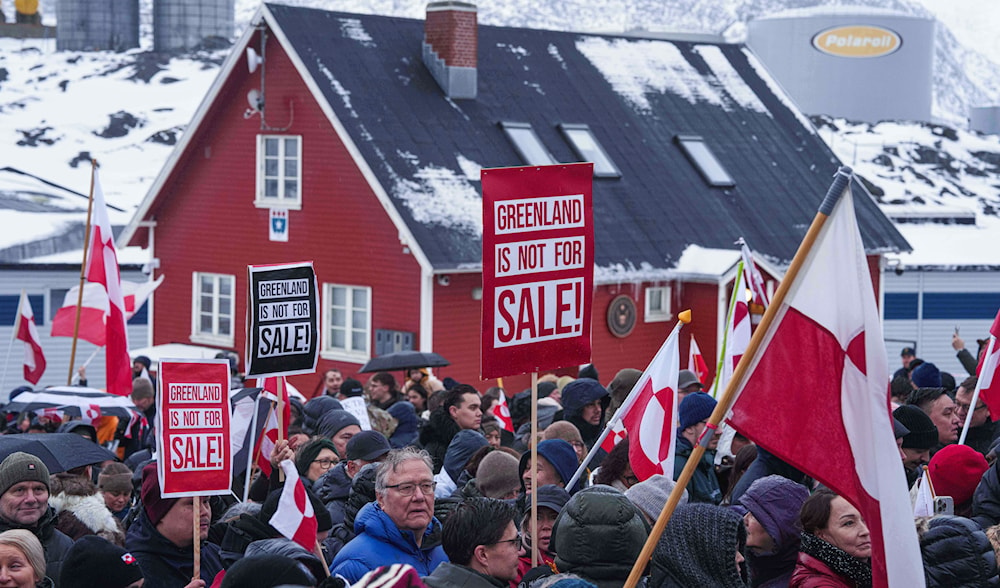
People protest against President Donald Trump's policy toward Greenland in front of the US consulate in Nuuk, Greenland, Jan 17, 2026 (AP)
Danish Prime Minister Mette Frederiksen and Greenlandic Prime Minister Jens-Frederik Nielsen held a "constructive" meeting with US Secretary of State Marco Rubio on Friday on the sidelines of the Munich Security Conference, according to Frederiksen.
"Constructive talk with Secretary of State Marco Rubio together with Jens-Frederik Nielsen, Chairman of Naalakkersuisut, at the Munich Security Conference," Frederiksen said on X. "Work will continue as agreed in the high-level working group."
PM Frederiksen: “Constructive talk with Secretary of State Marco Rubio together with Jens-Frederik Nielsen, Chairman of Naalakkersuisut, at the Munich Security Conference. Work will continue as agreed in the high-level working group.” pic.twitter.com/NLMnOJVhRq
— Statsministeriet (@Statsmin) February 13, 2026
Nielsen said on Instagram that Greenland's interests were "again clearly highlighted" in the meeting. "It was emphasised that the talks being held are the right way forward," he said. He has previously stated that if Greenlanders were forced to choose between the US and Denmark, they would choose Denmark.
View this post on Instagram
The meeting represented the latest diplomatic effort to address US President Donald Trump's insistence that Washington must control the Arctic territory, an autonomous part of Denmark, for alleged national security reasons.
Trump told reporters at the White House on Friday, "I think Greenland's going to want us, but we get along very well with Europe. We'll see how it all works out. We're negotiating right now for Greenland."
Danish Foreign Minister Lars Løkke Rasmussen, speaking to Danish media upon arrival in Munich, had expressed cautious optimism, saying he hoped the meeting would affirm that the diplomatic track launched after earlier White House talks "is a good one and should continue," adding that "it could well be difficult, but it's important to pursue that course."
Diplomatic channel takes shape after White House talks
The Munich discussions built on a high-level meeting held at the White House last January, where Vice President JD Vance and Rubio met with Rasmussen and Greenlandic Foreign Affairs Minister Vivian Motzfeldt.
Those talks, described by officials as "frank", ended without resolving the fundamental disagreement over Greenland's political status but did produce a new mechanism for continued engagement: a tripartite US-Denmark-Greenland working group tasked with addressing Washington's Arctic security concerns.
According to Rasmussen, the working group has already convened once, with a second session expected soon, though details of the discussions have not been made public. The group's mandate is to explore avenues for expanded security and military cooperation while respecting existing sovereignty arrangements, a framework Danish officials have characterized as a way to de-escalate the crisis rather than negotiate territorial concessions.
Copenhagen, Nuuk hold firm on sovereignty red lines
Throughout the standoff, Denmark and Greenland have maintained a united front on "non-negotiable principles." Both governments have made clear that while enhanced US military presence and Arctic security cooperation are open to discussion, sovereignty and territorial integrity over Greenland cannot be traded, sold, or transferred.
Greenland's Motzfeldt has stressed that her government seeks a "normal relationship" with Washington and rejects any framing of the island as a commodity. Nielsen struck a similar tone ahead of the Munich meeting, confirming to Danish television TV2 that "we have planned a meeting with Marco Rubio." He added that Greenland has been "at the heart of a major debate on security in our region," stressing that his government has been ready from the outset to "assume our share of responsibility in this regard."
Frederiksen, for her part, used her arrival at the conference to call on Europe to bolster its own defense capabilities at a time when Washington appears to be pulling back. Citing everything from Trump's inauguration speech to new security and defense strategies and the threats against Greenland, she warned that "everything points in one direction, namely that the US, unfortunately, is moving away" from Europe.
Read more: Exclusive: Trump threats push Greenland closer to Denmark, ex-MP says
NATO steps up Arctic posture
The Greenland dispute has prompted a significant military response from Denmark and its NATO allies. Copenhagen launched "Operation Arctic Endurance" in January, a yearlong series of exercises in and around Greenland involving troops from France, Germany, Sweden, Norway, and the Netherlands, according to the Danish Armed Forces.
In a further step announced on Friday, Denmark confirmed it would contribute four F-35 fighter jets to NATO's newly launched "Arctic Sentry" mission, which aims to strengthen the alliance's presence in the region. Defence Minister Troels Lund Poulsen said the contribution "underscores Denmark's role as an active ally in the Arctic and North Atlantic," Reuters reported.
Trump had previously softened his threats of unilateral seizure after striking what he called a "framework" agreement with NATO Secretary General Mark Rutte. However, US officials have signaled they continue to seek expanded military access and basing rights, while exploring arrangements for American access to Greenland's natural resources, including rare earth minerals.


