
Democratic lawmakers probe Iranian drone strike that killed US troops
 5 Min Read
Democratic lawmakers launch an investigation into the Iranian drone strike in Kuwait that killed six US soldiers, citing concerns over the military’s review.
-
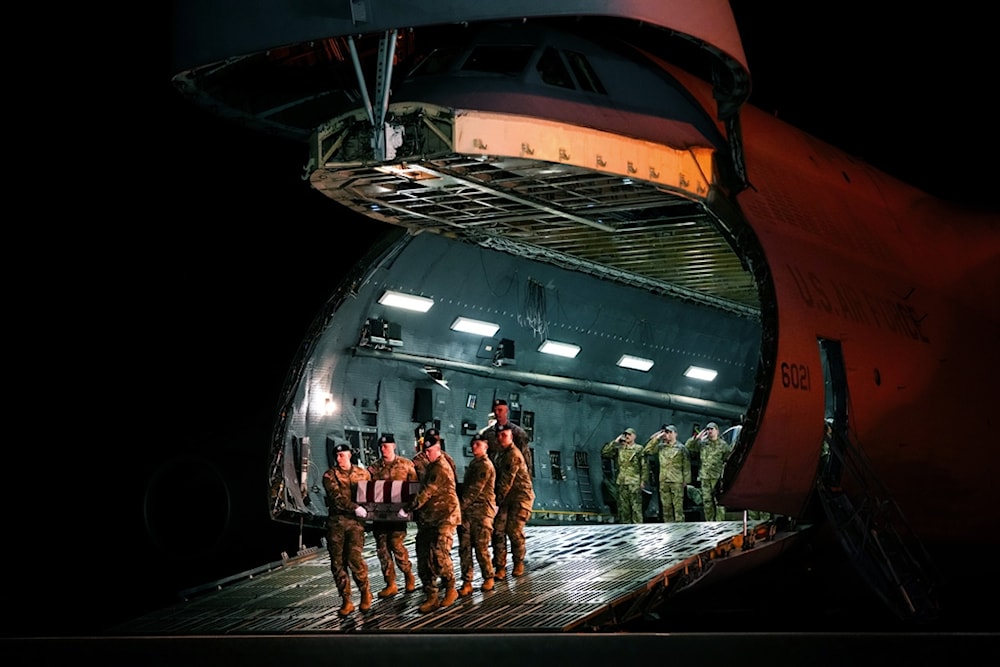
An Army carry team moves the flag-draped transfer case containing the remains of US Army soldier killed in Kuwait, during a casualty return, Monday, March 9, 2026, at Dover Air Force Base, Delaware (AP)
Democratic lawmakers announced Thursday that they are launching an investigation into the Iranian drone strike that killed six US soldiers at Port Shuaiba in Kuwait earlier this year, citing concerns over the independence and transparency of the military’s internal review.
In a letter addressed to Defense Secretary Pete Hegseth, Sen. Elizabeth Warren (D-Massachusetts), Rep. Pat Ryan (D-New York), and nearly a dozen other Democratic lawmakers questioned whether the US military had sufficient protections in place before the March 1 attack and whether injured troops received adequate medical care afterward.
“The need for this investigation goes beyond the Shuaiba attack — it’s about taking accountability and protecting our service members,” Ryan, an Army and Iraq War veteran, said in a statement to The Washington Post. He was referring to Port Shuaiba, a facility located along the Persian Gulf where the strike took place.
“It’s our job as members of Congress to force [Hegseth] to give us real answers and make sure something like this never happens again,” Ryan added.
The Pentagon did not immediately say whether it would provide lawmakers with a briefing on the attack, but said in a statement that “as with all Congressional correspondence, we will respond directly to the sender.”
Lawmakers question Army review of Port Shuaiba attack
The strike occurred on the second day of Operation Epic Fury, the name given by the Trump administration to the war, when an Iranian Shahed drone struck the center of an Army operations facility at Port Shuaiba.
The attack killed six service members and injured dozens more. In the months since, survivors have accused military leaders of failing to respond adequately to warnings that the facility lacked sufficient defenses.
Some troops have also alleged that those wounded in the attack faced difficulties receiving medical treatment for their injuries. Military officials have disputed both claims.
According to The Washington Post, several soldiers who survived the attack have expressed doubts that the Army’s internal review will result in accountability. The newspaper also reported, citing a US official familiar with the process, that initial findings did not assign responsibility for the strike or recommend disciplinary action.
The Army has provided findings from the review to some families of fallen service members but has not publicly released the report.
Democrats raise concerns over independence of investigation
In their letter to Hegseth, lawmakers challenged the credibility of the Army’s review process, citing reports that the investigation was initially assigned to a mid-ranking officer within the affected unit rather than an independent investigator.
The review was later transferred to a more senior officer at US Army Central, the command overseeing the affected unit. Outside observers questioned whether the investigation could be considered independent while remaining within the same chain of command.
Warren said the lack of an outside investigator, combined with concerns over Pentagon transparency and recordkeeping, raised questions about “whether investigations into service member casualty incidents will be conducted objectively.”
The lawmakers said their investigation would focus on whether the War Department failed to adequately protect service members and whether officials provided accurate information about the consequences of the war.
“Failures to provide service members that sustained injuries in this war with adequate care and its inability to honestly and openly inform the American people about the consequences of this war,” the lawmakers wrote in their letter, were among the reasons they decided to seek answers independently.
Deadliest attack on US soldiers
A March drone attack launched by Iran against a US military installation in Kuwait in the early hours of the war inflicted far greater casualties than Pentagon officials initially acknowledged.
The strike targeted a tactical operations center at Shuaiba port, near Kuwait City, killing six US soldiers and wounding dozens more. Survivors described a chaotic scene as smoke rapidly engulfed the building, hampering rescue efforts. Two personnel were initially unaccounted for before their remains were recovered from the rubble.
More than 30 military personnel were hospitalized with battle wounds from the Kuwait strike alone. One soldier is being treated at Brooke Army Medical Center in San Antonio, 12 at Walter Reed Medical Center outside Washington, DC, and roughly 25 at Landstuhl Regional Medical Center in Germany.
A running toll the Pentagon was slow to release
The Pentagon's initial March 1 statement characterized the damage as five seriously wounded and "several others" sustaining minor injuries, a description that significantly understated what sources say actually occurred.
The Kuwait strike figures sit within a broader casualty picture that has emerged only gradually. Reuters, citing two sources familiar with the matter, reported on March 10 that up to 150 US troops had been wounded across the first 10 days of fighting, a figure not previously disclosed publicly. The Pentagon later confirmed approximately 140 service members were wounded, insisting most injuries were minor and that 108 had already returned to duty.
CENTCOM confirmed the six Kuwait fatalities on March 2, and a seventh American was announced killed in a separate strike in Saudi Arabia the same day.
War Secretary Pete Hegseth described the Kuwait strike as an instance of air defenses intercepting most incoming threats but failing to stop one, what he called a "squirter," that broke through and hit the fortified operations center.


