
Democrats now hold five-point advantage in support for Congress
 6 Min Read
Poll shows deep dissatisfaction with Trump’s leadership, with rising disapproval over the war on Iran, economic strain, and cost of living.
-
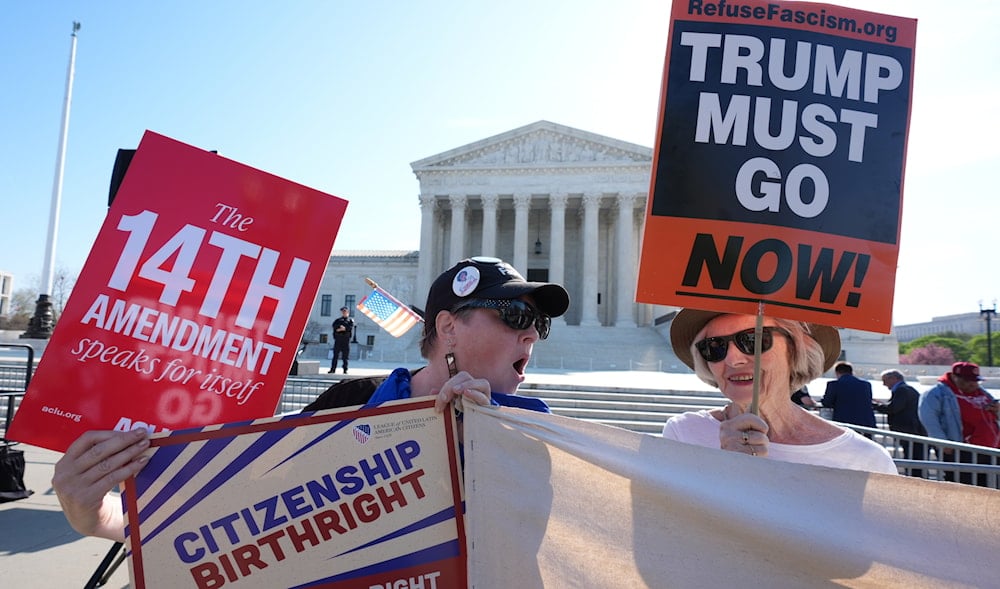
Anti-Trump demonstrators rally outside the US Supreme Court, before justices hear oral arguments on whether President Donald Trump can deny citizenship to children born to parents who are in the United States illegally or temporarily, on Capitol Hill, in Washington, April 1, 2026. (AP)
Six months before the November midterm elections, the Republican Party is confronting a worsening political environment. Public dissatisfaction with President Donald Trump’s handling of the war on Iran and other major issues is widespread, while Democratic voters appear significantly more energized, according to a Washington Post-ABC News-Ipsos survey.
Trump’s ratings on economic matters, central to his 2024 political resurgence, have dropped since the launch of the war on Iran in late February.
A majority of Americans disapprove of Trump’s management of the Iran situation, with 66 percent expressing disapproval compared to 33 percent approval. His economic approval rating has fallen seven points to 34 percent, coinciding with rising fuel prices. Approval on inflation has also slipped five points to 27 percent, while only 23 percent approve of his handling of overall living costs, against 76 percent who disapprove.
Trump’s overall approval rating stands at 37 percent, largely unchanged from 39 percent in February. However, disapproval has climbed to 62 percent, the highest level recorded during his two terms. While 85 percent of Republicans continue to support him, his approval among Republican-leaning independents has dropped to 56 percent, and just 25 percent of independents overall approve of his performance.
Immigration remains relative strength
Trump receives his strongest marks on immigration at the US-Mexico border, with 45 percent approval and 54 percent disapproval. Broader immigration handling fares slightly worse, at 40 percent approval and 59 percent disapproval, figures largely unchanged since February.
Low presidential approval ratings are putting Republicans’ narrow majority in the House at risk and could also jeopardize their Senate control. Among registered voters, Democrats hold a five-point lead in congressional preference, an increase from a two-point advantage earlier this year.
The Democratic lead widens to nine points among voters certain to participate. Additionally, 73 percent of Democrats say voting this fall is more important than in previous midterms, compared with 52 percent of Republicans, a reversal from 2022, when enthusiasm levels were similar.
Differences within the Republican base help explain the enthusiasm gap. Among MAGA-aligned Republicans, 77 percent say they are certain to vote, compared with 59 percent of non-MAGA Republicans. Meanwhile, 79 percent of Democrats report strong certainty about voting.
Perceptions of the election’s significance also diverge. Around 60 percent of Democrats view the upcoming midterms as “much more important” than past ones, compared with 35 percent of Republicans. Among MAGA Republicans, 41 percent share this view, while only 20 percent of non-MAGA Republicans agree.
Uncertainty surrounds electoral outcomes
The findings do not guarantee election results, as multiple factors could influence the political landscape. Ongoing redistricting battles remain a key variable. A recent Supreme Court ruling that race cannot be considered in drawing district lines could reshape representation and potentially benefit Republican-led states seeking to redraw boundaries.
Democrats have made modest gains in public trust on major issues, signaling shifting political dynamics. On the economy, public opinion is now nearly evenly divided, with 34 percent trusting Republicans and 33 percent trusting Democrats. This marks a significant change from 2022, when Republicans held a clear advantage.
Public trust on inflation is also evenly split, contrasting with a previous Republican advantage during Joe Biden’s presidency. Meanwhile, the Republican lead on immigration has narrowed to five points.
Republicans continue to hold a strong advantage on crime, while Democrats are more trusted on healthcare, education, and the broader cost of living.
Public skepticism toward both parties
A significant portion of Americans expresses little confidence in either party. About 23 percent trust neither on immigration, 27 percent on the economy, 28 percent on crime and 33 percent on inflation. A slight majority, 51 percent, say neither party can effectively handle artificial intelligence.
Among voters without strong party alignment on key issues, Democrats lead Republicans by 49 percent to 32 percent in congressional preference, though only about half of these voters are certain to vote.
Democrats face concerns about being perceived as too liberal, with 53 percent of Americans holding that view, an increase from 2013. Nearly half of Americans also consider the Republican Party too conservative, a rise of six points over the same period.
Trump himself is viewed as too conservative by 46 percent of Americans, slightly higher than before the 2024 election.
Some of Trump’s policy proposals face strong resistance. His call to end birthright citizenship is opposed by 65 percent of Americans. Similarly, 78 percent oppose cuts to federal medical research funding, while 65 percent reject a proposed increase in defense spending. Nearly 59 percent also oppose ending temporary legal protections for migrants from war zones.
Despite broader challenges, Trump maintains considerable influence within the Republican Party. About 65 percent of Republicans believe the party should follow his leadership, compared with 34 percent who prefer a different direction.
An increasing number of Americans question Trump’s fitness for office. Around 59 percent say he lacks the mental sharpness required, and 55 percent believe he is not physically fit to serve effectively.
Large majorities also express concerns about his character and decision-making. About 71 percent say he is not honest or trustworthy, 67 percent believe he does not carefully consider major decisions, and 54 percent do not see him as a strong leader.
Administration officials receive low ratings
Senior administration officials also receive negative evaluations. Health Secretary Robert F. Kennedy Jr. and FBI Director Kash Patel each have net negative ratings of 19 points, followed by War Secretary Pete Hegseth at minus 17, Vice President JD Vance at minus 13, and Secretary of State Marco Rubio at minus seven.
In contrast, Federal Reserve Chair Jerome H. Powell is viewed more favorably, with a net positive rating of seven points.
It is worth noting that the Washington Post-ABC News-Ipsos poll was conducted online from April 24 to 28 among 2,560 US adults using the Ipsos KnowledgePanel. The margin of error is approximately two percentage points, with results adjusted to reflect demographic and political characteristics of the population.


