
Divided and distant: The Iranian dissidents' struggle for relevance
 4 Min Read
Amid foreign-backed unrest in Iran, dissidents like Reza Pahlavi's monarchists and the MEK remain divided, limiting their political influence inside the country.
-
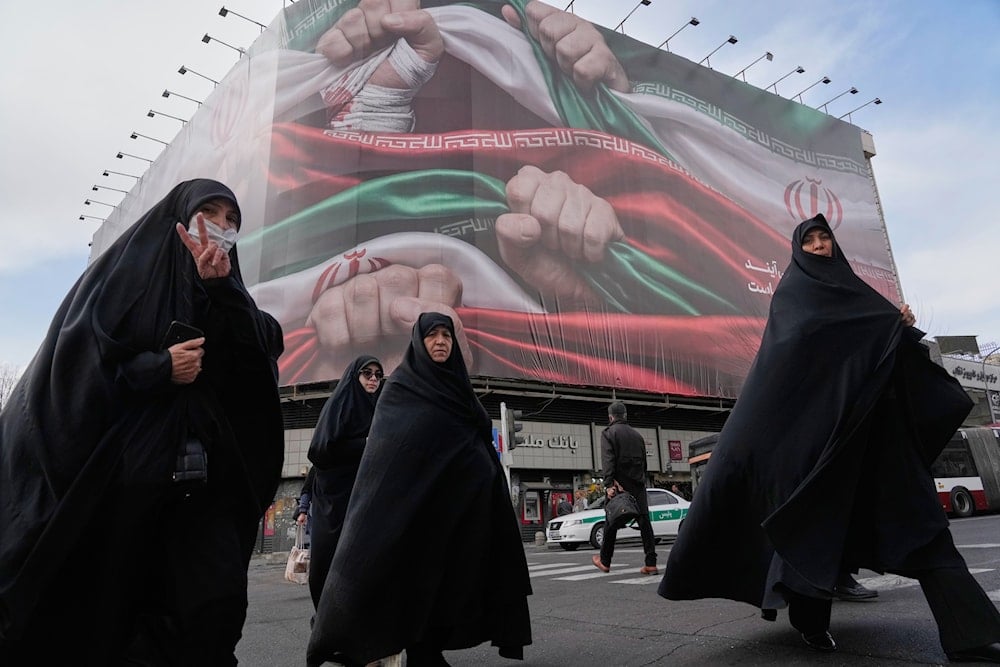
Women cross a street under a huge banner showing hands firmly holding Iranian flags as a sign of patriotism, as one of them flashes the victory sign, in Tehran, Iran, Wednesday, Jan. 14, 2026 (AP)
Armed riots in Iran have provided a political boost to opponents of the Iranian authorities living abroad, but a deep and longstanding divide continues to fragment the opposition, dating back to before the 1979 Islamic Revolution, Reuters reported.
The report highlighted a rift between monarchists supporting Reza Pahlavi, the son of Iran’s last Western-backed shah who was deposed following a an Islamic Revolution, and Mujahedin-e-Khalq (MEK), which Reuters described as a "leftist-Islamic group" despite it being designated in Iran as "terrorist", noting that it remains difficult to gauge the level of support either faction enjoys inside Iran or their ability to influence future events.
Analysts and diplomats, Reuters added, have long observed that both groups enjoy far greater popularity among Iranians abroad than within the country. Nevertheless, many expatriate Iranians remain skeptical of both factions, despite the absence of an organized alternative opposition.
The report noted that the lack of consensus around a unifying opposition movement or leader has complicated international responses to the situation in Iran. Even US President Donald Trump reportedly questioned the level of support for Reza Pahlavi, despite exploring military options against Tehran at the time.
While some video footage captured chants in support of the monarchy and the late shah’s son, who has for so long resided in the United States and says he seeks a “democratic system” for Iran, Western diplomats remain divided over whether these chants reflect genuine support inside the country.
MEK remains unpopular in Iran
In contrast, the MEK rejects the notion that Pahlavi enjoys significant popularity within Iran and opposes both the current government and the former monarchy.
Reuters noted that the organization, which carried out terrorist attacks before and after the revolution, remains widely unpopular in Iran, particularly due to its role during the Iran-Iraq War, claiming that its presence within the country has been negligible for decades.
The report concluded that the divisions between the government, monarchists, and the MEK have become largely irrelevant to many Iranians, stating that “most major political movements inside Iran after 1979 sought either to strengthen the Islamic Republic or reform it, rather than overturn it entirely, until the waves of unrest in recent years.”
Trump questions Pahlavi's popularity in Iran
Meanwhile, US President Donald Trump has expressed skepticism over the political viability of Pahlavi, suggesting that while he “seems very nice,” he may lack sufficient support within Iran to assume leadership if the current government collapses, echoing the case of Machado in Venezuela.
In an exclusive interview for Reuters, Trump said he does not currently endorse any individual to "lead Iran" but described Pahlavi as “very nice", adding, “I don’t know how he’d play within his own country. I don’t know whether or not his country would accept his leadership, and certainly if they would, that would be fine with me.”
Trump also commented on the situation in Iran more broadly, noting, “Any regime can fail… whether or not it falls or not, it’s going to be an interesting period of time.”
According to Axios, Pahlavi held a confidential meeting over the weekend with White House envoy Steve Witkoff to discuss the ongoing 2026 Iran riots. This marked the first high-level engagement between the Trump administration and the Iranian opposition figure since demonstrations began more than two weeks ago.
Pahlavi has been positioning himself as a potential transitional leader in the event of a regime change in Iran, appearing on US television in recent days to call for stronger American support for rioters. However, Trump confirmed last week that he has no plans to meet with Pahlavi.


