
DPRK tests cluster Hwasong-11 variant, Kim Jong Un supervises launch
 3 Min Read
The DPRK tests an upgraded Hwasong-11 missile with cluster and fragmentation warheads under Kim Jong Un’s supervision.
-
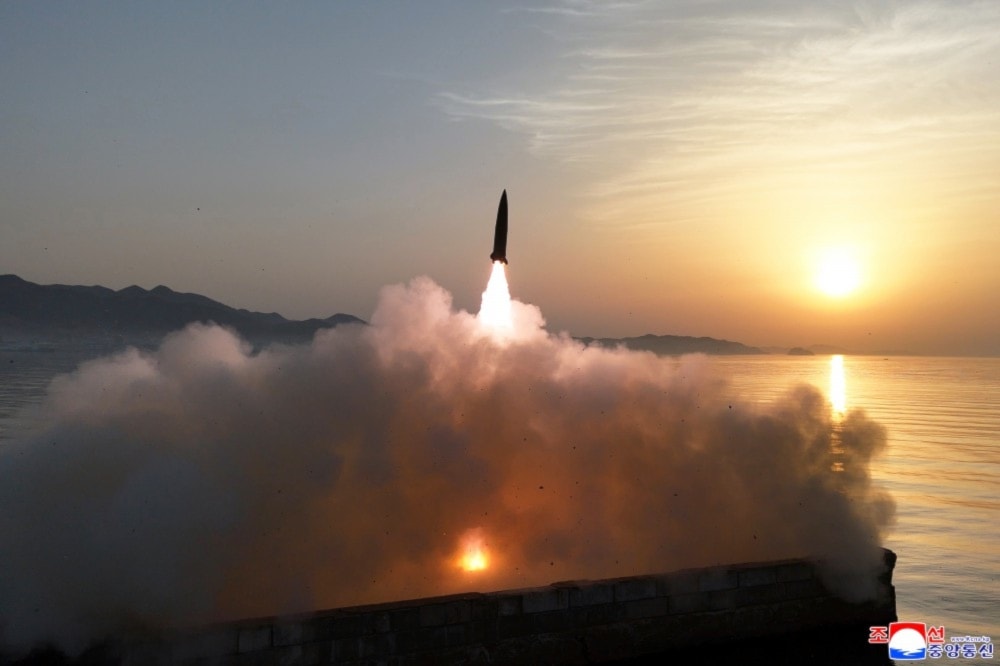
A Hwasong-11 variant, the Hwasongpho-11 Ra cluster warhead equipped tactical ballistic missile, is fired at a target in the East Sea, on April 19, 2026. (KCNA)
The Democratic People’s Republic of Korea (DPRK) conducted a test-fire of an upgraded surface-to-surface tactical ballistic missile, identified as the Hwasongpho-11 Ra tactical ballistic missile, to assess the effectiveness of newly developed warheads, state media reported.
The test, carried out on Sunday under the supervision of DPRK Leader Kim Jong Un, focused on evaluating the power and operational characteristics of cluster bomb and fragmentation mine warheads integrated into the missile system.
According to details released, five tactical ballistic missiles were launched toward a target area approximately 136 kilometers away, striking a zone measuring between 12.5 and 13 hectares with high-density impact, demonstrating the system’s strike capability.
Warhead development and battlefield application
The test aimed to verify the performance of different warhead configurations designed to enhance the Korean People’s Army’s (KPA) ability to conduct precision strikes over concentrated target zones. The evaluation marks a continuation of Pyongyang’s efforts to diversify its tactical missile payloads and improve battlefield effectiveness.
Kim Jong Un expressed satisfaction with the results, stating that the introduction of various cluster-type warheads would better meet operational requirements and strengthen both high-density area strikes and precision targeting capabilities. He highlighted the importance of such systems in modern warfare, particularly in neutralizing designated targets efficiently.
The DPRK leader also emphasized that the progress reflects years of dedicated research, noting that the establishment of specialized warhead development units and sustained investment over five years had yielded significant technological gains.
Part of broader testing cycle
The latest test follows a series of recent missile launches reported by South Korea’s military earlier the same day, which indicated that multiple short-range ballistic missiles were fired into waters off the Korean Peninsula.
Those launches, detected from the Sinpo area, traveled roughly 140 kilometers before landing in what is also known as the Sea of Japan. In response, Seoul convened an emergency security meeting and reaffirmed its joint defense posture with the United States, which maintains a military presence in South Korea.
Pyongyang has consistently stressed that its expanding missile and weapons programs as a necessary deterrent against US military pressure and regional deployments.
Expanding tactical capabilities
The April 19 test builds on earlier developments unveiled this month, including cluster-warhead systems and electronic warfare capabilities. The Hwasong-11 family of missiles, produced in multiple variants, has become central to the DPRK’s short-range strike doctrine, offering adaptable configurations for different combat scenarios.
Alongside missile advancements, the DPRK has continued to pursue broader military modernization efforts, including naval expansion and the integration of advanced weapons technologies, as part of its strategy to enhance deterrence and operational readiness.
Read more: IAEA chief claims 'very serious' expansion in DPRK nuclear activity


