
Egypt security delegation meets Hezbollah in Beirut
 3 Min Read
An Egyptian delegation in Beirut consults Hezbollah on de-escalation proposals.
-
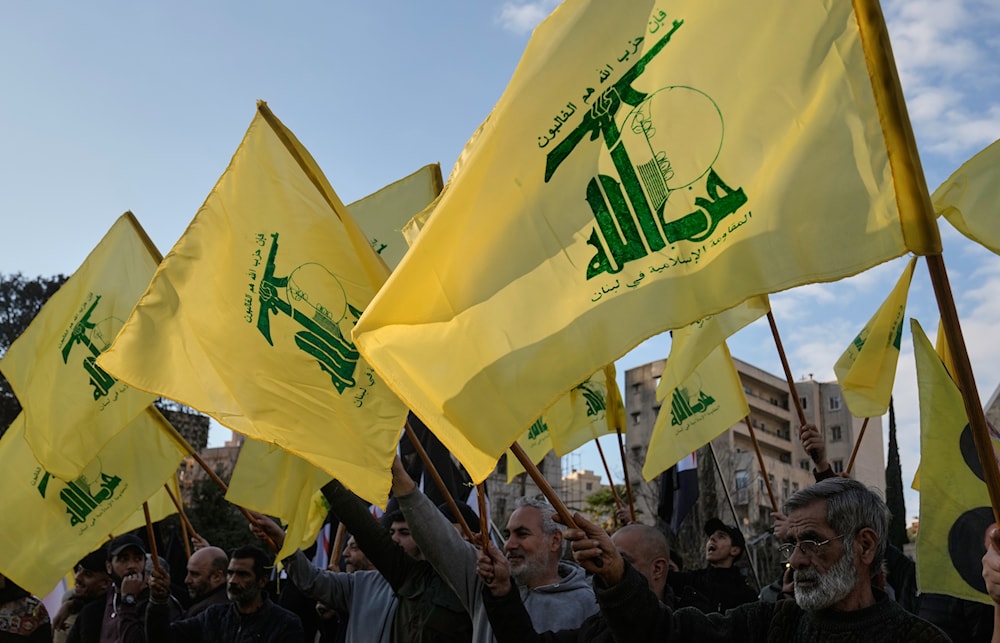
Hezbollah supporters raise the movement's flags during a protest condemning Israeli aggressions, in Beirut, Lebanon, Wednesday, Feb. 4, 2026 (AP Photo/Bilal Hussein)
Sources told Al Mayadeen that, on Wednesday, an Egyptian security delegation had arrived in Beirut, where it is holding consultations with Hezbollah to assess its position on a set of proposed ideas, as regional actors seek to manage the consequences of ongoing Israeli aggression on Lebanon.
According to the sources, Hezbollah confined its role to listening to the proposals presented by the Egyptian side, recommending that any further discussions be conducted through Speaker of Parliament Nabih Berri. The approach reflects an insistence on handling political tracks through official Lebanese institutions, even as the country remains under sustained attack.
The Egyptian outreach comes amid intensifying efforts to contain a situation driven by repeated Israeli violations of the 2024 ceasefire agreement. Lebanese officials and resistance leaders have stressed that these breaches have rendered diplomatic arrangements ineffective, as the occupation continues to impose its terms through force.
Ceasefire violations continue
In parallel, Hezbollah Deputy Secretary-General Sheikh Naim Qassem said on Wednesday that the Israeli occupation has not adhered to the ceasefire, stressing that it has “continued its aggression continuously over a period of fifteen months.”
He stated that the US-Israeli aggression has deliberately targeted civilians and critical infrastructure, citing the destruction of homes, the displacement of entire communities, and attempts to devastate livelihoods and future generations. He further described the aggression as “cowardly,” noting that Israeli forces avoid direct confrontation with resistance fighters.
Sheikh Qassem’s remarks align with statements by Lebanese President Joseph Aoun, who said the war on Lebanon could have been avoided had "Israel" respected the ceasefire and withdrawn from occupied territories. Aoun characterized the attacks as violations of international law and a form of collective punishment targeting the Lebanese population.
Resistance confronts aggression
The ongoing aggression unfolds within a broader regional escalation following the US-Israeli war on Iran, which has further exposed a coordinated campaign aimed at reshaping the region through military pressure and destabilization.
Within this context, Hezbollah has framed its operations as a defensive response to sustained Israeli aggression, pointing to more than 15,000 documented ceasefire violations that have left hundreds martyred and entire areas devastated.
As diplomatic contacts continue, resistance officials maintain that any political process must be grounded in an end to aggression and full respect for Lebanon’s sovereignty, warning that proposals detached from realities on the ground cannot produce a viable outcome.
Read more: Hezbollah hits 8 Merkava tanks in intense clashes in Al-Taybeh


