
EU deadlocked on plan to turn Russian assets into Ukraine aid
 5 Min Read
EU leaders are locked in a dispute over whether to use Russia's frozen assets to finance Ukraine's defense, with Belgium and Italy warning of legal risks.
-
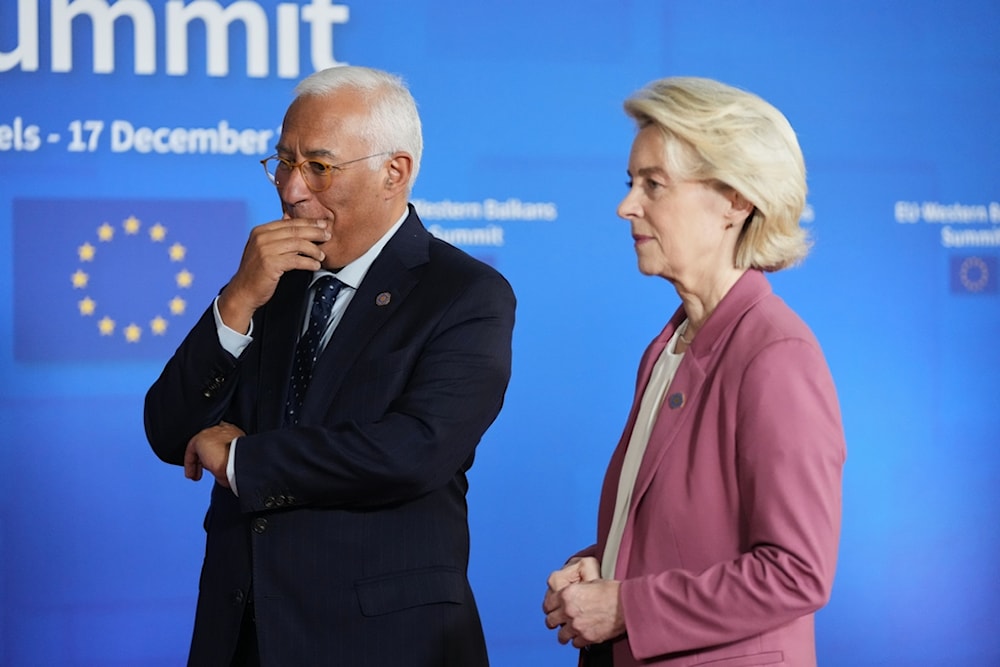
European Commission President Ursula von der Leyen, right, speaks with European Council President Antonio Costa during an EU-Western Balkans Summit at the European Council building in Brussels, on December 17, 2025. (AP Photo/Virginia Mayo)
European leaders are gathering in Brussels this week for a summit dominated by one question: whether the EU should convert Russia’s immobilized central bank reserves into a massive new source of financing for Ukraine’s war effort. The decision comes as the bloc faces pressure from Washington and growing battlefield setbacks in Ukraine, even as critics argue that Western policies, from decades of NATO expansion to continuous political engineering in Kiev, helped create the crisis that Russia ultimately reacted to.
On the eve of the meeting, European Commission President Ursula von der Leyen delivered her strongest message yet. "There is no more important act of European defence than supporting Ukraine’s defence," she told the European parliament, adding that "the next days will be crucial in securing this." She warned that the international climate had become "dangerous and transactional", insisting that deeper militarisation "is no longer an option. It is a must."
Her rhetoric reflects an EU leadership increasingly committed to a hardline approach that sidelines diplomatic alternatives in favor of long-term confrontation with Moscow.
We know the urgency of funding Ukraine's fight.
— Ursula von der Leyen (@vonderleyen) December 17, 2025
But Russia does not have just Ukraine in its sights.
Its full war-time economy is a direct threat to our national and economic security.
Russian assets immobilized indefinitely in the EU can be a game changer for Ukraine and… pic.twitter.com/mNzk1mGDIE
A loan built on Russia's immobilized reserves
Von der Leyen has proposed two funding models for Ukraine’s 2026-27 needs: joint borrowing across the EU or a "reparations loan" backed by the €210 billion in Russian central bank assets frozen in the bloc. The second option is gaining momentum because it does not require unanimity, a key factor as Hungary threatens to veto any use of the EU budget for Ukraine.
To shield these funds from political obstruction, the EU last week invoked emergency powers to indefinitely freeze the entire €210 billion, preventing pro-Russia governments from lifting sanctions through procedural vetoes. The move signals a strategic turn: Europe intends to keep these assets immobilised for years, potentially until a legal basis emerges to convert them into financing for Kiev.
Under von der Leyen’s proposal, the EU would borrow against revenue generated by these frozen assets, with Kiev repaying the loan only if and when Russia is compelled to pay reparations.
Belgium, Italy fear legalities amid German push for weaponization
Belgium, home to Euroclear, the institution that holds most of the frozen Russian reserves, has expressed the strongest reservations. Brussels fears being left to absorb the financial and legal fallout if the scheme triggers retaliation or court rulings abroad.
Those anxieties intensified after Russia’s central bank filed a $230bn lawsuit against Euroclear in Moscow, with the first hearing scheduled for January 16, 2026. Belgian officials also worry that courts in jurisdictions close to Russia might seize Western assets to enforce claims.
Aligning with Belgium's stance, Prime Minister Giorgia Meloni warned Italian lawmakers that using Russian assets without watertight legal guarantees would hand Moscow "the first victory since the start of the war". She added, "Italy, of course, considers sacred the principle that Russia should primarily pay for the reconstruction of the nation it attacked, but this result must be achieved with a solid legal basis."
Financial markets have also begun flashing warnings. Credit rating agency Fitch recently placed Euroclear on "rating watch negative", citing growing uncertainty over the EU’s asset-backed funding plans and the legal exposure stemming from Russia’s lawsuit. The rating action reflects concerns that the unprecedented scheme could undermine the financial stability of one of Europe’s core settlement systems.
Despite the risks, Germany is pushing hard for the plan to proceed. Chancellor Friedrich Merz told reporters he would continue fighting to make up to €90 billion of the frozen Russian assets "usable for Ukraine’s defence", adding that securing agreement among member states was "50/50", telling lawmakers the funds would support the Ukrainian army for "at least another two years".
He added that he took Belgium’s objections seriously: "That is why I am trying with our partners to alleviate them," insisting the commission’s plan was "in perfect compliance with international law and international obligations."
Brussels rejects unanimity as Hungary digs in
EU diplomats preparing the summit say that any financing mechanism requiring unanimous backing, such as using the EU budget as collateral, is effectively dead, as Hungary maintains its promise to veto it, leaving the reparations-loan model as the only politically viable path.
"A very large majority of member states favour the reparations loan," one senior EU official said, as quoted by The Guardian. "Any solution that would require unanimity, I don’t think is realistic, so we are back into the reparations loan."
Belgium has floated the idea of using the same emergency powers that froze Russia’s assets indefinitely to create an EU-backed loan without unanimity, but other capitals have dismissed the suggestion.
The EU is now edging toward a decision that would set a global precedent: transforming sovereign assets frozen under sanctions into war financing without a peace settlement or reparations agreement. That said, Moscow has already warned that such a move amounts to outright theft and would trigger sweeping retaliation, including seizures of Western corporate holdings in Russia.
For EU leaders, the summit represents a moment of strategic choice, whether to escalate Europe’s direct financial role in the war or to avoid a step that could reshape global norms around sovereign immunity and spark tit-for-tat seizures worldwide.
Read more: US, Russia expected to hold talks on Ukraine settlement in Miami


