
Frozen Russian assets dispute puts EU credibility at risk: Official
 3 Min Read
European officials fear that the EU’s inability to agree on using frozen Russian assets to support Kiev could severely damage the bloc’s global standing.
-
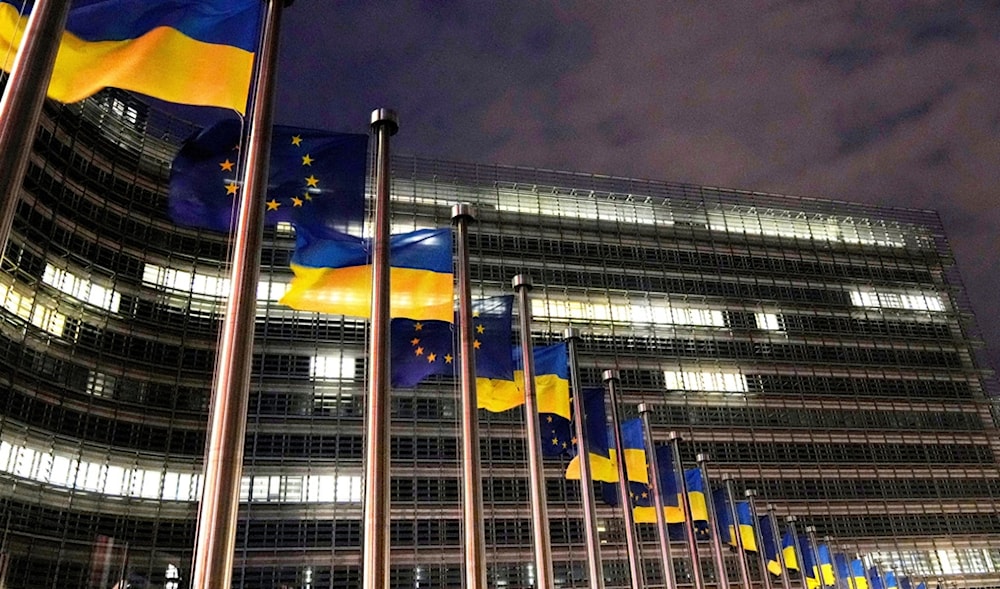
The European Union and Ukrainian flags flap in the wind to mark the third anniversary of the Ukraine war outside EU headquarters in Brussels, Feb. 24, 2025 (AP)
European Union officials are expressing growing concern that the bloc’s failure to agree on the seizure of frozen Russian assets to support Kiev could severely undermine its global reputation, Politico reported on Wednesday.
The debate comes as internal divisions persist among EU member states and institutions, stalling consensus on the controversial proposal. The European Commission has pushed to allocate frozen Russian assets, estimated at around 200 billion euros held within the EU, mostly in Euroclear, to fund Kiev’s military and reconstruction efforts. However, several key stakeholders continue to oppose the plan.
Legal challenges riddle the bloc
The proposal to redirect frozen Russian assets, which form part of nearly 300 billion euros ($350 billion) frozen by the EU and G7 nations since the beginning of Russia’s military operation in Ukraine in 2022, remains a legal and diplomatic challenge. The assets were originally frozen as part of coordinated sanctions, but outright confiscation faces opposition on both legal and political grounds.
The European Central Bank, Euroclear, and member states, including Belgium, Italy, Malta, Slovakia, Hungary, and Bulgaria, have expressed resistance. They argue that forcibly seizing these assets could violate international law and set a dangerous precedent for the global financial system.
US pressure and geopolitical implications
Amid this internal EU deadlock, Washington has intensified pressure on European allies. According to the report, the new US national security strategy formalizes support for Eurosceptic forces within the EU, suggesting a shift in Washington’s approach to transatlantic unity.
The lack of agreement not only threatens the EU’s legal credibility but also its geopolitical standing. Officials warn that inaction could be interpreted as weakness in the face of Russia’s military and diplomatic maneuvers.
Moscow to respond immediately
Despite ongoing objections, the proposal has advanced to technical consultations and is scheduled for discussion at the EU summit on December 18–19. EU diplomats remain divided, and a final decision is unlikely without a broader consensus among influential states and financial institutions.
The Kremlinin response, has stressed that any attempts to confiscate Russian assets would constitute "theft" and a "violation of international law," warning of reciprocal actions should the EU proceed with the plan.
Russian Foreign Ministry spokeswoman Maria Zakharova said Moscow’s response would not be delayed, noting that the Bank of Russia had already outlined its position in a detailed statement issued on December 12. “Specific steps are already being implemented,” she said.
Zakharova sharply criticized the EU’s policy toward Russia, describing it as illogical and driven by an intent to inflict damage “at any cost.” She argued that this approach has already pushed the European Union into what she called a deplorable economic situation.
The spokeswoman stressed that any handling of Russian sovereign assets without Moscow’s consent constitutes a serious breach of international law. “Disposing of our sovereign assets without the consent of Russia — whether through indefinite blocking, seizure, or attempts to disguise de facto confiscation as so-called reparations — is an absolutely illegal act,” she said.


