
EU freezes Russian assets indefinitely to 'limit economic damage'
 4 Min Read
The EU says its decision to indefinitely freeze Russian assets is to allegedly "limit economic damage" while keeping funds blocked until Russia compensates Ukraine.
-
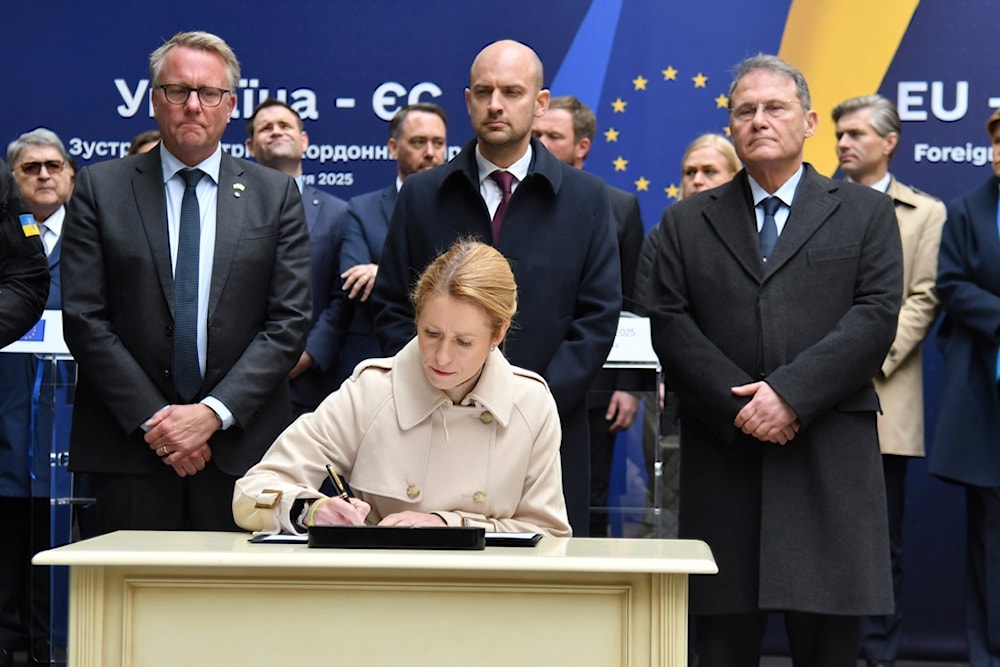
High Representative of the EU for Foreign Affairs and Security Policy Kaja Kallas signs an agreement to transfer to Ukraine a tranche of proceeds from frozen Russian assets during UA-EU foreign ministers' meeting in Lvov, Ukraine, on May 9, 2025 (AP)
The Council of the European Union said on Friday that its decision to indefinitely freeze Russian assets was taken to “limit damage” to the EU economy, amid ongoing debates over the future use of those funds in relation to the war in Ukraine.
In a statement, the Council said it had decided to temporarily prohibit any transfers of assets belonging to the Central Bank of Russia that are immobilised within the EU back to Russia. “This decision was taken as a matter of urgency to limit damage to the Union’s economy,” the statement said.
Earlier on Friday, European Council President Antonio Costa said Russian assets held in the EU would remain frozen until Moscow pays compensation to Ukraine. EU foreign policy chief Kaja Kallas said the total volume of Russian assets frozen indefinitely in the bloc stood at 210 billion euros, or about $246.7 billion, as of December 12.
Legal and economic concerns over confiscation
Following the start of the Ukraine war in 2022, the EU and other G7 countries froze nearly half of Russia’s foreign currency reserves, estimated at around 300 billion euros. Of that total, roughly 200 billion euros are held in European jurisdictions, mainly through Euroclear, a Belgium-based securities depository.
The future of the frozen assets has become a contentious issue within the EU, with discussions focusing on whether and how the funds or their proceeds could be used to support Ukraine, while seeking to avoid legal and financial risks to the bloc.
The Kremlin has repeatedly warned that any attempt to confiscate Russian assets would amount to theft and a violation of international law, and has said such moves would carry serious consequences.
EU leaders urge use of frozen Russian assets
Leaders from seven EU member states on Monday urged the European Union to expedite plans to use frozen Russian assets to provide financial support for Ukraine.
In a joint letter addressed to European Council President Antonio Costa and European Commission President Ursula von der Leyen, the heads of Estonia, Finland, Ireland, Latvia, Lithuania, Poland, and Sweden stressed that backing Kiev remains both a moral duty and a strategic necessity.
"Supporting Ukraine in their fight for freedom and independence is not only a moral obligation, it is also in our own self-interest," the leaders wrote.
They called on the EU to move rapidly to adopt the Commission’s proposals, saying, "We must therefore move ahead quickly on the Commission's proposals to use the cash balances from Russia's immobilized assets for a reparations loan to Ukraine."
Russia warns of global financial turmoil caused by Western asset seizures
The Russian Foreign Ministry has repeatedly cautioned that Western efforts to seize sovereign assets carry broad risks for countries holding reserves in Western financial systems.
In a statement released after a UN General Assembly meeting marking the International Day Against Unilateral Coercive Measures, the ministry said, “Attempts to expropriate the sovereign assets of central banks create risks for all states that have funds in Western jurisdictions.”
Moscow argued that such moves, driven by Western governments, undermine international legal norms and set a “dangerous precedent” that could affect not only Russia but any nation with reserves held in the West.
It added that for states across the Global South and other non-Western economies, the “weaponization” of global financial systems raises new concerns about the neutrality and security of international economic institutions.
The ministry said Russia would continue working with what it called the “global majority” to counter what it views as illegitimate unilateral coercive measures imposed by Western powers.


