
EU launches $1bln Gaza 'recovery plan' amid hypocrisy claims
 4 Min Read
The European Commission and international partners have launched a $1 billion initiative to restore essential services in Gaza amid criticism of Europe’s failure to hold “Israel” accountable for the territory’s destruction.
-
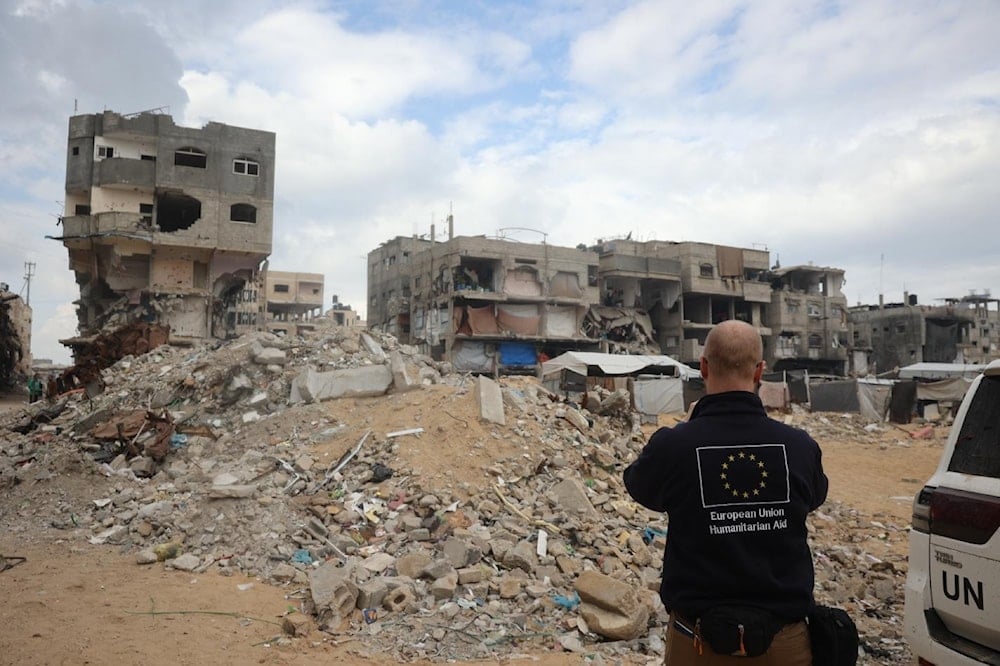
An EU humanitarian aid official surveys widespread destruction in the Gaza Strip, where homes and civilian infrastructure have been severely damaged (European Commission / © EU, 2025)
The European Commission and a coalition of international donors have launched an €883.6 million initiative, equivalent to around $1 billion, to support Gaza’s early recovery from the widespread destruction inflicted by the Israeli war, Reuters reported.
The “Team Gaza Initiative” was announced during a donors’ meeting in Brussels and will fund projects intended to restore essential services across the besieged Palestinian territory.
The European Commission said the programme would prioritize repairing water and sanitation systems, removing massive quantities of rubble, and re-establishing Gaza’s devastated healthcare infrastructure.
Spain, Denmark, Britain, Germany, Norway, Finland, Italy, the Netherlands, France, Japan, Switzerland, Sweden, and Belgium are participating alongside the World Bank, the European Investment Bank, and the Commission. Australia and Canada are also expected to join.
However, the Commission did not disclose how much each participating country or institution would contribute.
“Our objective is clear: to help build hope, resilience and a better future for the Palestinian people,” European Commissioner for the Mediterranean Dubravka Suica said.
Questions over European responsibility
The announcement comes against the backdrop of mounting criticism of European governments over what rights groups describe as a contradictory policy toward Gaza: financing humanitarian relief and reconstruction while failing to hold the Israeli occupation accountable for destroying Palestinian civilian infrastructure.
An EUobserver investigation published in June found that Israeli forces had damaged or destroyed at least €150 million worth of European-funded buildings and projects in Gaza and the occupied West Bank, without paying compensation.
The affected projects reportedly included schools, community facilities, water infrastructure, healthcare institutions, and other development projects financed by European taxpayers. Critics argue that without accountability or guarantees against renewed Israeli attacks, European governments could once again pay to rebuild infrastructure that the occupation may later destroy.
Médecins Sans Frontières has previously accused the European Union of hypocrisy over Gaza, arguing that expressions of humanitarian concern were not accompanied by sufficient political measures to stop the destruction of homes, hospitals, water systems, roads, and power networks.
The criticism has also focused on European states that maintained arms exports, military cooperation, or extensive commercial relations with “Israel” during the war. Rights advocates say humanitarian financing cannot substitute for an arms embargo, sanctions, reparations, or measures preventing further attacks on Palestinian infrastructure.
The EU has also faced criticism for delaying action against trade with illegal Israeli settlements, despite growing demands from member states and legal experts for measures targeting economic activity that sustains the occupation.
Aid represents fraction of reconstruction needs
The United Nations has estimated that rebuilding Gaza will require around $70 billion and could take decades, meaning the newly announced initiative accounts for only a small portion of the territory’s overall recovery requirements.
Gaza remains largely devastated more than two and a half years after the beginning of the Israeli war. Nearly the entire population of approximately two million Palestinians has been displaced, with many families continuing to live in tents, damaged buildings, and overcrowded areas lacking basic services.
Israeli forces continue to control nearly 70% of the Gaza Strip, patrolling areas described by Israeli Prime Minister Benjamin Netanyahu as a buffer zone. Netanyahu has said the occupation will not withdraw from the territory.
Critics therefore argue that reconstruction cannot proceed meaningfully while “Israel” retains military control over most of Gaza and continues to determine the movement of people, aid, equipment, and construction materials.
Read more: Israeli war cost Gaza's agricultural sector $3.5bln: Ministry


