
EU lifts sanctions on Syrian security agencies, including interim MoD
 2 Min Read
The European Union has lifted sanctions on several Syrian security agencies, including the interim Defense Ministry and intelligence bodies, according to an official EU journal document released on Tuesday.
-
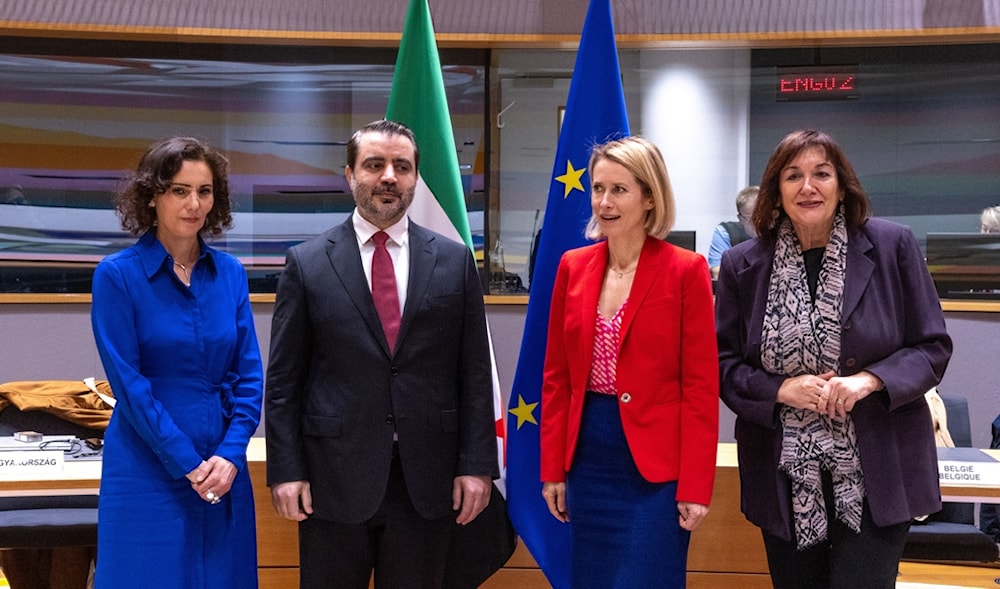
Syria's interim FM Asaad al-Shaibani, European Commissioner for the Mediterranean, right, European Commissioner for Preparedness and Crisis, left, and EU foreign policy chief at the European Council building in Brussels, May 11, 2026. (AP)
The European Union has lifted sanctions on several Syrian security agencies, according to a document published Tuesday in the EU’s official journal.
The decision removes a number of institutions from the EU sanctions list as part of an updated regulatory act.
According to the document, the following entries have been deleted from the sanctions list:
- Political Security Directorate
- General Intelligence Directorate
- Military Intelligence Directorate
- Air Force Intelligence Agency
- Ministry of Defense
- Ministry of Interior
- Higher Institute for Applied Sciences and Technology
Exactly one year ago, European Union countries agreed to lift all economic sanctions on Syria in an effort to support the country’s recovery following the ouster of former President Bashar al-Assad.
Alignment with West did not help
Despite the interim government's pivot to the West and the subsequent lifting of sanctions on Syria, Russia emerged as the leading supplier of oil to the country, Reuters reported, underscoring the economic constraints facing Damascus.
Oil shipments from Russia to Syria have surged by approximately 75% this year, reaching around 60,000 barrels per day, based on Reuters calculations using official data and ship-tracking platforms. While these volumes remain a small fraction of Russia’s global oil exports, they are significant for Syria, where domestic production continues to fall far short of demand.
Despite the new government’s Western-leaning stance and lingering distrust of Moscow due to its military backing of al-Assad, analysts and Syrian officials say the continued oil trade reflects economic necessity. Russia also retains strategic leverage in Syria through its naval and air bases in the country.
Syria’s limited integration into the global financial system has constrained its ability to secure alternative energy supplies, even after the United States and Europe lifted sanctions last year. Officials warned that reliance on Russian oil could strain relations with Western partners, but acknowledged that viable alternatives remain scarce.
Syrian economist Karam Shaar cautioned that the arrangement leaves Syria vulnerable to geopolitical developments, particularly tensions between Russia and the United States over Ukraine.
Read more: Syria, UAE leaders discuss regional security, economic cooperation


