
Syria, UAE leaders discuss regional security, economic cooperation
 3 Min Read
Syrian President Ahmad al-Sharaa and United Arab Emirates President Sheikh Mohammed bin Zayed Al Nahyan held talks in Abu Dhabi on Wednesday, focusing on regional security challenges and strengthening bilateral economic ties.
-
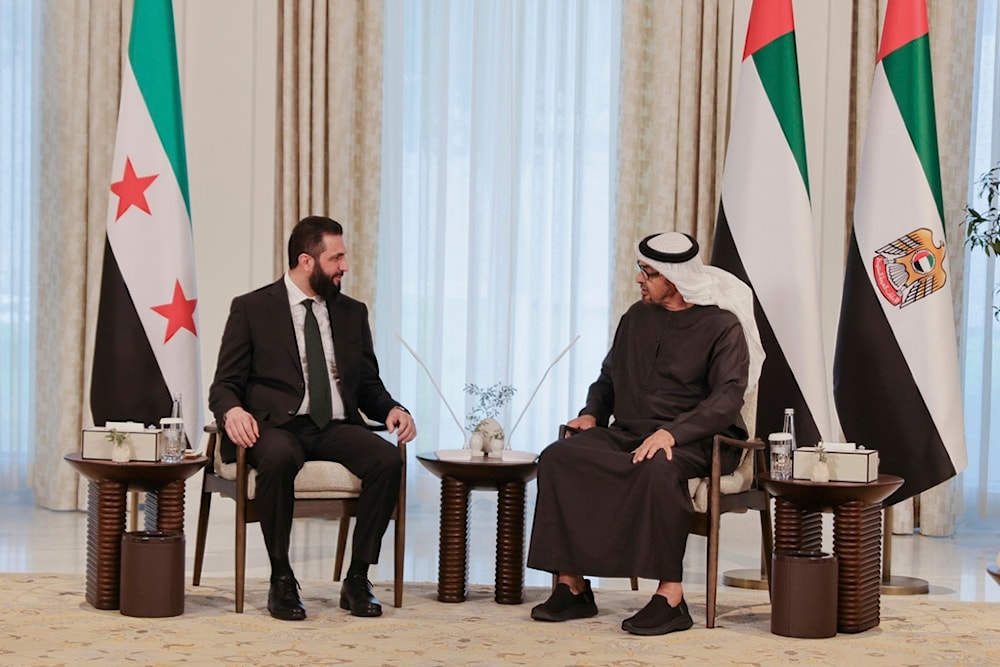
United Arab Emirates President Sheikh Mohammed bin Zayed Al Nahyan, right, meeting with Syrian President Ahmad al-Sharaa in Abu Dhabi, United Arab Emirates, Sunday, April 13, 2025. (AP)
Syrian President Ahmad al-Sharaa and United Arab Emirates President Sheikh Mohammed bin Zayed Al Nahyan discussed regional security and ways to enhance economic cooperation during their meeting on Wednesday in Abu Dhabi, according to the Syrian presidency.
The two leaders reviewed developments and challenges facing the region while also exploring avenues to expand economic partnerships and support development efforts, the statement said. They also emphasized the importance of coordination to preserve regional stability.
Sharaa expressed Syria's solidarity with the UAE and added that he condemned the recent retaliatory strikes from Iran on US targets in the Gulf.
Third stop on Gulf tour
The UAE's state news agency WAM reported that both sides reaffirmed their commitment to advancing bilateral relations in a manner that supports development and long-term growth in both countries.
The visit marks the third stop in Sharaa's Gulf tour, following previous meetings in Saudi Arabia and Qatar. In Doha, Sharaa held talks with Qatari Emir Sheikh Tamim bin Hamad Al Thani, focused on bilateral relations and regional developments.
A day earlier, the Syrian president met with Saudi Crown Prince Mohammed bin Salman, with discussions centering on strengthening economic cooperation and regional connectivity projects.
The Gulf tour comes amid broader regional shifts following the US-Israeli war on Iran, with Arab states increasingly engaging with Damascus following years of isolation during the previous Syrian government's conflict with armed opposition groups.
Recent developments shape Syria reconstruction and integration talks
Recent months have seen accelerated diplomatic and military efforts shaping the agenda of the trilateral meeting, particularly regarding Syria’s reconstruction and the integration of its northeastern regions.
In late January 2026, Damascus reached an agreement with Kurdish-led forces, following bloody confrontations, under the guise of restoring central authority over the northeast after years of fragmentation. The deal included the deployment of state forces in key areas and the gradual incorporation of local forces into national institutions, though key issues remain unresolved.
Parallel to security efforts, reconstruction has emerged as a central priority. European states, including Germany, have recently signaled readiness to support rebuilding efforts, with discussions focusing on the return of Syrian refugees to contribute to national recovery and institutional rebuilding.
At the same time, Syria’s leadership has emphasized avoiding deeper entanglement in the ongoing US-Israeli war on Iran, while strengthening regional partnerships to stabilize the country and advance reconstruction initiatives.
Read More: Syria's al-Sharaa met Israeli security official in UAE


