
Syria’s al-Sharaa declares 'irreversible new phase' after Assad’s fall
 3 Min Read
Syrian interim President Ahmed al-Sharaa marks the first year after Assad’s fall by pledging a full break with the past, a unified army, and a commitment to transitional justice.
-
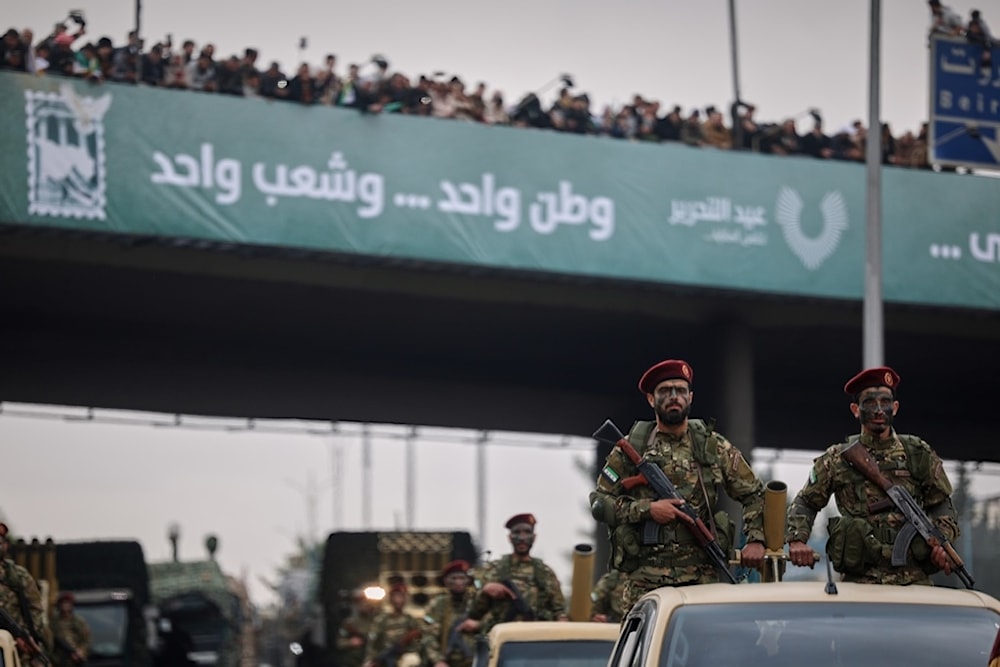
New Syrian army soldiers march during a parade marking the first anniversary of the ousting of former President Bashar Assad in Damascus, Syria, Monday, December 8, 2025 (AP)
Syrian interim President Ahmed al-Sharaa declared on Monday that Syria has entered “a new and irreversible phase,” built on three central pillars: restoring public trust, making a complete break with the legacy of the former regime, and unifying all armed forces under a single national command.
Al-Sharaa made the remarks during a speech marking the first anniversary of the fall of former president Bashar al-Assad’s rule. He said the Syrian people “granted us their trust after decades of oppression and injustice,” adding that the government was now making “a historic rupture with every vestige of the previous regime.”
The interim president emphasized that all military units formed during the conflict have been merged into a unified national army, which he described as essential for long-term stability and the protection of Syrian sovereignty. “We have completed the integration of all military factions into one national army that forms the foundation of stability and safeguards Syria’s sovereignty,” he said.
Addressing human rights accusations and the abuses reported throughout the transition, al-Sharaa underscored his government’s commitment to transitional justice. He pledged that accountability would apply to all parties, stating: “Anyone who committed violations against the Syrian people, from any side, will face justice in accordance with the law.”
Syria marks one year since new rule
Syria’s capital witnessed a large military parade on Monday to mark the first anniversary of the fall of former president Bashar al-Assad’s regime, with official celebrations also planned in the Umayyad Square and several other provinces.
Interim President Ahmad al-Sharaa led commemorations by performing the dawn prayer at the Umayyad Mosque, according to the Syrian Arab News Agency.
“From north to south and from east to west, God willing, we will restore Syria strong with a reconstruction worthy of its present and past… We will rebuild it through obedience to God Almighty, supporting the oppressed, and ensuring justice among people, God willing,” SANA quoted him as saying.
Opposition armed groups declared the overthrow of al-Assad’s regime on December 8, 2024, after advancing into Damascus following a sustained offensive against loyalist forces.
Syria faces mounting challenges
However, several regions have since experienced severe sectarian violence, particularly in the coastal areas in the west and in Sweida in the south, where thousands of government-backed militants attacked and killed hundreds of civilians.
Eastern and northeastern Syria, areas with a Kurdish majority, continue to witness recurring clashes between fighters from the transitional government’s Ministry of Defense and the Syrian Democratic Forces (SDF), which has repeatedly rejected a return to centralized rule.
Beyond Syria’s borders, Damascus’ foreign policy has undergone major shifts under the new government, including an opening to the United States and the launch of direct negotiations with the Israeli occupation to reach a security agreement, amid continuous Israeli attacks and refusal to withdraw from territories they occupied after the former regime collapsed.
The occupation had seized large stretches of southern Syrian territory under the pretext of protecting the Druze minority in Sweida, and launched attacks against the new authorities, including a strike on the Ministry of Defense HQs in Damascus.


