
Syria, one year on; mired in sectarian violence, slow justice, reform
 7 Min Read
One year later, post-Assad Syria faces ongoing sectarian violence, slow transitional justice, and uncertain democratic reform.
-
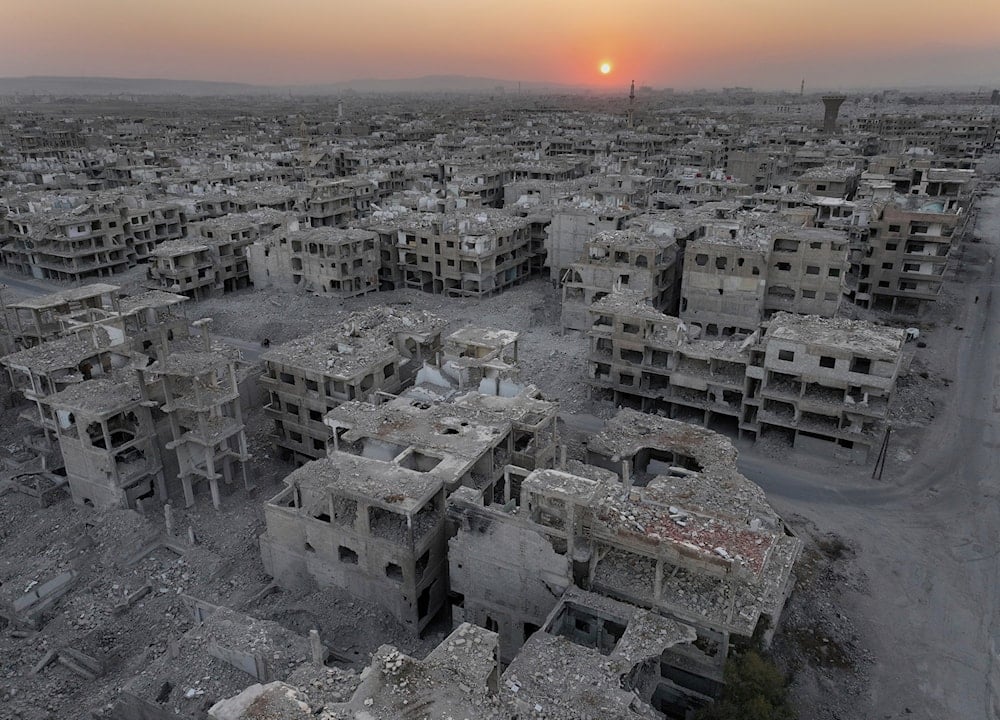
An aerial view of the remaining buildings destroyed by the war in Syria, at the Yarmouk refugee camp, Damascus, Syria, December 14, 2024 (AP)
A year ago on Monday, the 53-year rule of the Assad family came to an abrupt end following an 11-day offensive led by Hay'at Tahrir al-Sham (HTS) that took both Syria and the world by surprise.
In December 2024, former Syrian President Bashar al-Assad and his family were granted asylum in Moscow, where reports suggest they are living in quiet exile under Russian protection. Across Syria, tens of thousands have flocked to the capital to mark the anniversary, but behind the celebrations, many Syrians grapple with lingering fears and unresolved questions about the country’s future.
“We know who committed massacres against us, they’re still present in our homes. But to file a complaint you need evidence, and who has that?” Ali, a digital media worker, told The Guardian.
Killings continue unabated
For some, the dangers remain immediate and deadly. Late last October, Riham Hamouyeh, a 32-year-old Alawite schoolteacher in Homs, was killed when attackers hurled a grenade into her home, in front of her two young children. Her husband, a former army mechanic, had been arrested two months earlier, and the family had long faced harassment.
“None of us are comfortable; we’re all exhausted. My wife has collapsed, she won’t open the door anymore,” said Hamouyeh’s father-in-law, Mohammed Issa Hameidoosh, 63, according to The Guardian.
Her death is part of a series of targeted killings, occurring nearly daily in the multi-sectarian city of Homs, despite a general amnesty issued by the new authorities for those not accused of direct crimes.
While Syria’s new leadership has succeeded in reintegrating the country into the global community, the domestic picture remains fraught, with transitional justice processes slow amid cycles of violence that threaten fragile state-building efforts.
President Ahmad al-Sharaa has drawn global attention for his diplomatic outreach, forging ties with US President Donald Trump, easing sanctions, and appearing at international conferences. Scenes of al-Sharaa in the Oval Office have evoked pride for many Syrians. “Even if I don’t like him, it feels good to see Syria in the White House,” one Alawite activist told The Guardian in November.
For the international community, al-Sharaa represented an opportunity to alleviate the consequences of 14 years of war, as well as the current instability in the region, which Syria remains a victim of.
Yet inside Syria, slow transitional justice continues to fuel violence and deepen sectarian divides, showing that while the country’s global profile has risen, domestic peace remains fragile.
Sectarian violence casts shadow over Syria’s fragile recovery
While Syria has made strides on the international stage under President Ahmad al-Sharaa, deep-seated sectarian tensions continue to challenge the country’s fragile recovery. Four days of massacres in March perpetrated by government and government-affiliated forces and other armed factions against mostly Alawite civilians along Syria’s coast, followed by continued killings, have left the minority community feeling besieged.
Further alarm came in July, when government security forces and allied tribal elements killed Druze civilians in the southern province of Sweida, heightening fears among religious and ethnic minorities. Since the massacres, Sweida has been effectively cut off from the rest of the country, and local residents have rallied around hardline Druze leader Hikmat al-Hijri, who is demanding greater autonomy.
One resident, 33-year-old Bahaa, a former government employee, had initially viewed the new leadership with cautious optimism, but following the July killings, he now carries a gun and refuses to leave Sweida, illustrating how the violence has hardened the positions of many residents across the province.
In response to widespread unrest, the Syrian government has established a council for civil peace and a body tasked with overseeing transitional justice, as in untangling ownership disputes over appropriated property, delivering accountability for war crimes, and maintaining social cohesion in a country scarred by 14 years of war.
As Syria marks a year since the fall of al-Assad, the country’s reintegration into the global community stands in stark contrast to the slow, painful process of domestic reconciliation. For many Syrians, the path forward remains uncertain, as cycles of violence and distrust persist alongside diplomatic successes abroad.
Justice, accountability, and freedom remain limited
Efforts at transitional justice have offered some symbolic relief but remain slow and uneven, highlighting the challenges of reconciling a nation scarred by years of violence. In July, security forces arrested one of the men responsible for the March coastal massacre, Hassan Dawa, and brought him back to the site of the crime. There, Dawa re-enacted the killings and confessed while victims, including Hassan al-Abdallah, watched.
“We felt like we wanted to kill him but the security didn’t let us. I felt much better after that, I felt some relief,” Abdallah said. He and 11 members of his extended family huddled in front of a barrel fire in a single room as they worked to repair their homes. Much of the Karm al-Zaytun neighborhood in Homs had been leveled.
Meanwhile, activists warn that the government has yet to outline a comprehensive national strategy for transitional justice. The bodies responsible for pursuing accountability remain underfunded, and if progress continues at this pace, the narrow window to deliver justice may close.
“After all these months, the state is strengthening, external relations are improving, things are calming,” said Alaa Ibrahim, a civilian activist in Homs who works on social cohesion. “But now we’re a year into the liberation, if assassinations keep happening every day, where will that leave us?”
Freedom remains unattainable for Syrians
For many Syrians, the question of justice is inseparable from a broader debate over the structure and values of the current state.
“A year ago, people wouldn’t dare complain about the price of a kilo of onions. Now they are calling for ministers to resign,” quipped Ayman Ali.
Yet civil society activists warn that democracy remains largely absent from the new Syria. The country’s new constitution vests sweeping powers in the presidency, while parliamentary “elections” were conducted without a popular vote: committees appointed two-thirds of the legislative body, with the president selecting the remaining third.
Activists also criticize the newly established political affairs bureau, which has taken over former Ba’ath party buildings and functions as a de facto political security apparatus. One lawyer running social cohesion workshops said officials required approval of their curricula before permits were granted for their organisation to operate.
Radwan Ziadeh, a Syrian writer close to President Sharaa, warned, “There are some institutions which give you an indication that they are trying to build a more authoritarian system. They don’t allow political parties to operate. No one can organise any political meetings without taking permission from the bureau [of political affairs].”
As Syria marks one year since the fall of al-Assad, the country finds itself at a crossroads: balancing newfound norms with the demands for justice, civil order, and democracy, while a cautious population watches the actions of the new authorities closely, aware that the legacy of fear and repression still lingers.


