
UN warns of persistent abuses in Syria a year after Assad's fall
 6 Min Read
The UN Human Rights Office warns that Syria's post-Assad transition remains fraught with killings, reprisals, and structural instability, as weak institutions, factional security forces, and heavy foreign influence fuel ongoing abuses against civilians and minority communities.
-
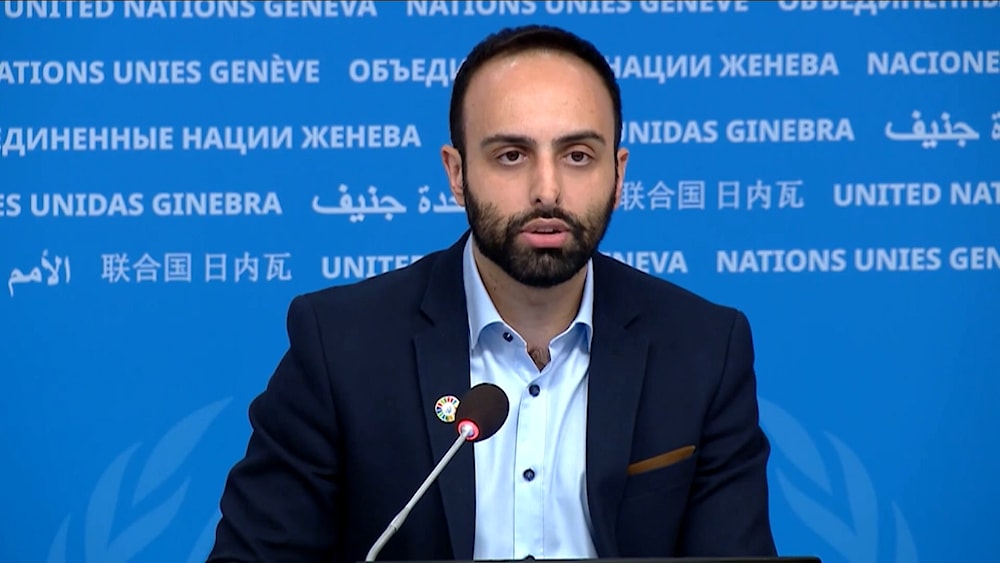
UN Human Rights spokesperson Thameen Al-Kheetan addresses the press in Geneva, outlining ongoing abuses in Syria. (Screenshot, UN website)
The UN Human Rights Office has issued a stark assessment of conditions in Syria as the country approaches the first anniversary of the Assad administration’s collapse, warning that serious violations continue despite early reforms by the interim authorities.
At a briefing in Geneva, UN Human Rights spokesperson Thameen Al-Kheetan said the steps taken so far represent only the earliest phase of what will be a long process. "While the interim authorities have taken encouraging steps towards addressing past violations, these steps are only the beginning of what needs to be done," he told reporters.
Fragile transition
According to Al-Kheetan, the authorities have created new bodies intended to deal with long-standing abuses, including commissions on transitional justice and missing persons, as well as investigative teams examining violence in coastal regions and in Sweida. They have also put forward a draft transitional justice law. "Trials have started against alleged perpetrators of the coastal violence," he noted.
But the spokesperson said the overall situation remains deeply troubling. He described a stream of reports documenting killings and disappearances carried out by a wide array of actors. "Yet, we continue to see distressing accounts of summary executions, arbitrary killings and abductions, mainly targeting members of certain communities and individuals affiliated or accused of affiliation with the former government," he said.
He added that hundreds of people have been killed since Assad’s downfall "including from gun, knife and stone attacks, and as a result of shelling, and hand grenades." The deaths, he said, involved security forces loyal to the interim authorities, groups tied to them, elements linked to the former government, local militias, and unidentified assailants. "We have also documented deaths resulting from explosive remnants of war," he added.
Targeted Suffering
Al-Kheetan said other abuses remain prevalent, including sexual violence, arbitrary detention, house demolitions, forced evictions, looting, and widespread confiscation of property. Restrictions on freedom of expression and protest also persist.
He underlined that much of the violence is directed at specific communities. "In many of these instances, the violence has mainly affected certain communities, including Alawites, Druze, Christians, and Bedouins. It has been fed by rising hate speech, both online and on the streets," he said.
The spokesperson also pointed to intensified foreign military activity. "The past year has also been marked by repeated Israeli military operations, including incursions, and occupation of additional territory," he said, adding that the UN has received accounts of civilian casualties, arrests, and home searches during these operations, including a recent one near Damascus.
Unvetted forces
Al-Kheetan expressed concern that fighters from various armed groups have been absorbed into the new security services without adequate human-rights safeguards. "The integration of former armed groups into the new security forces has so far happened in a hasty manner, without proper human rights-based vetting process," he warned.
He stressed that comprehensive accountability is essential to stabilizing the country. "All violations – past and present – must be independently, thoroughly and transparently investigated, and those responsible held to account," he said.
The interim authorities, he added, must take broader steps to address the roots of ongoing abuses. "We call on the authorities to take action to address the root causes of these violations. Accountability, justice, peace and security of all Syrians are absolute prerequisites for a successful transition. Victims’ rights to effective remedies and reparation must be fulfilled," he stated.
The UN Human Rights Office continues to work through its Damascus program to support transitional justice initiatives and efforts to strengthen the rule of law across the country.
External grip
While the UN has focused on human-rights conditions, Syria’s broader political transition has been shaped by competing external agendas since Assad’s fall. The interim government led by Ahmed al-Sharaa has pursued reforms against the backdrop of heavy US, Gulf, and regional involvement in reconstruction planning and security arrangements.
Investment laws are being rapidly rewritten to attract foreign capital, and economic restructuring has begun to redistribute assets once controlled by Assad-linked networks to new power centers aligned with the transitional leadership. These shifts have created a governance environment in which local grievances, wartime resentments, and unresolved property disputes have escalated rather than subsided.
The surge in reprisals against specific communities, particularly Alawites, Druze, Christians, and Bedouins, reflects the vacuum created by the dismantling of old security structures without the establishment of a credible or unified replacement. With former armed groups absorbed hastily into new security bodies, competing factions now operate with overlapping mandates and limited oversight.
In many areas, the absence of a coherent chain of command has enabled score-settling, armed retaliation, and opportunistic violence, especially where minority communities are perceived, fairly or not, as linked to the former authorities. Rising hate speech, economic desperation, and the struggle for territorial and political influence have further intensified these dynamics, creating conditions in which targeted killings, forced displacement, and sectarian tensions can flourish unchecked.
Diplomatic shifts have also contributed to the volatility. Israeli operations have expanded across multiple regions, while US-mediated security arrangements continue to reshape control over border areas and airspace. Kurdish-led forces are being incorporated into national structures under international sponsorship, and negotiations over sanctions relief and reconstruction financing have created additional leverage points for outside actors.
Analysts say this combination of external pressure, economic liberalization, and evolving regional alignments has created a transition that is formally national but structurally dependent, a dynamic that shapes, and at times constrains, the human-rights landscape the UN is now monitoring.
Read more: White House pushes to repeal US sanctions on Syria: Report


