
Syria marks one year since new rule with military parade in Damascus
 2 Min Read
Syria commemorates the first anniversary of the al-Assad regime's fall with a military parade in Damascus and ceremonies led by interim President Ahmad al-Sharaa.
-
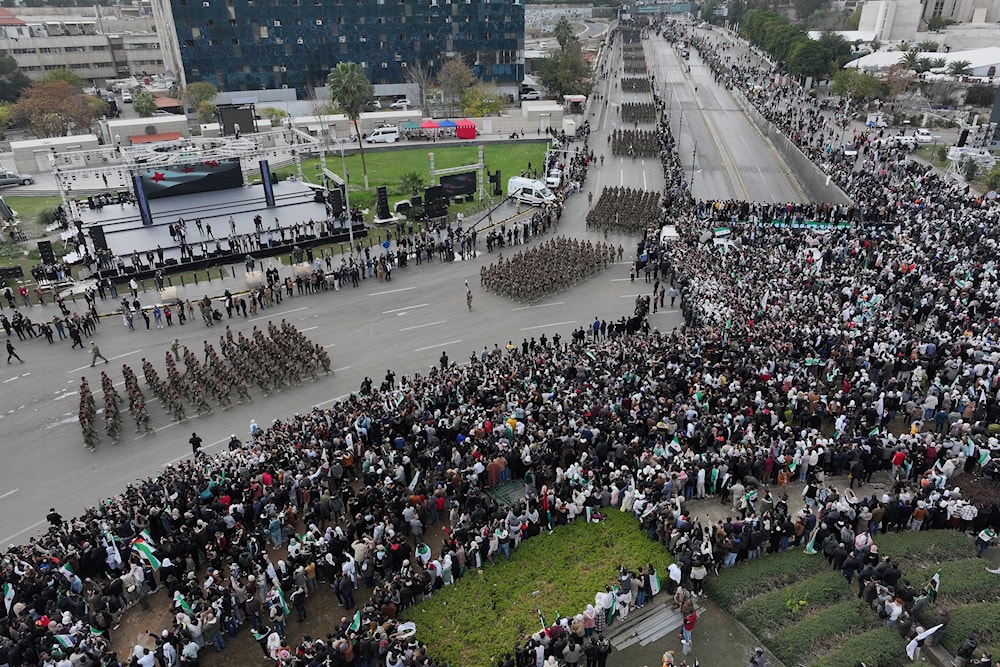
New Syrian army march during a parade marking the first anniversary of the ousting of former President Bashar al-Assad in Damascus, Syria, Monday, Dec. 8, 2025 (AP)
Syria’s capital witnessed a large military parade on Monday to mark the first anniversary of the fall of former president Bashar al-Assad’s regime, with official celebrations also planned in the Umayyad Square and several other provinces.
Interim President Ahmad al-Sharaa led commemorations by performing the dawn prayer at the Umayyad Mosque, according to the Syrian Arab News Agency.
“From north to south and from east to west, God willing, we will restore Syria strong with a reconstruction worthy of its present and past… We will rebuild it through obedience to God Almighty, supporting the oppressed, and ensuring justice among people, God willing,” SANA quoted him as saying.
Opposition armed groups declared the overthrow of al-Assad’s regime on December 8, 2024, after advancing into Damascus following a sustained offensive against loyalist forces.
Syria faces mounting challenges
However, several regions have since experienced severe sectarian violence, particularly in the coastal areas in the west and in Sweida in the south, resulting in hundreds of deaths among civilians and members of the new government’s security forces.
Eastern and northeastern Syria, areas with a Kurdish majority, continue to witness recurring clashes between fighters from the transitional government’s Ministry of Defense and the Syrian Democratic Forces (SDF), which has repeatedly rejected a return to centralized rule.
Beyond Syria’s borders, Damascus’ foreign policy has undergone major shifts under the new government, including an opening to the United States and the launch of direct negotiations with the Israeli occupation to reach a security agreement.
The occupation had seized large stretches of southern Syrian territory under the pretext of protecting the Druze minority in Sweida, and launched attacks against the new authorities, including a strike on the Ministry of Defense HQs in Damascus.
Immediately after al-Assad’s fall, "Israel" occupied Mount Hermon’s summit and, through Security Minister Yisrael Katz, declared it had no intention of withdrawing from the area. It also carried out extensive airstrikes targeting Syrian military assets, including naval and air units, air-defence systems, and other equipment.


