
EU opens new accession negotiation chapter with Ukraine, Moldova
 4 Min Read
The EU has unanimously approved opening cluster six of accession negotiations with Ukraine and Moldova on July 14, while four other clusters remain pending.
-
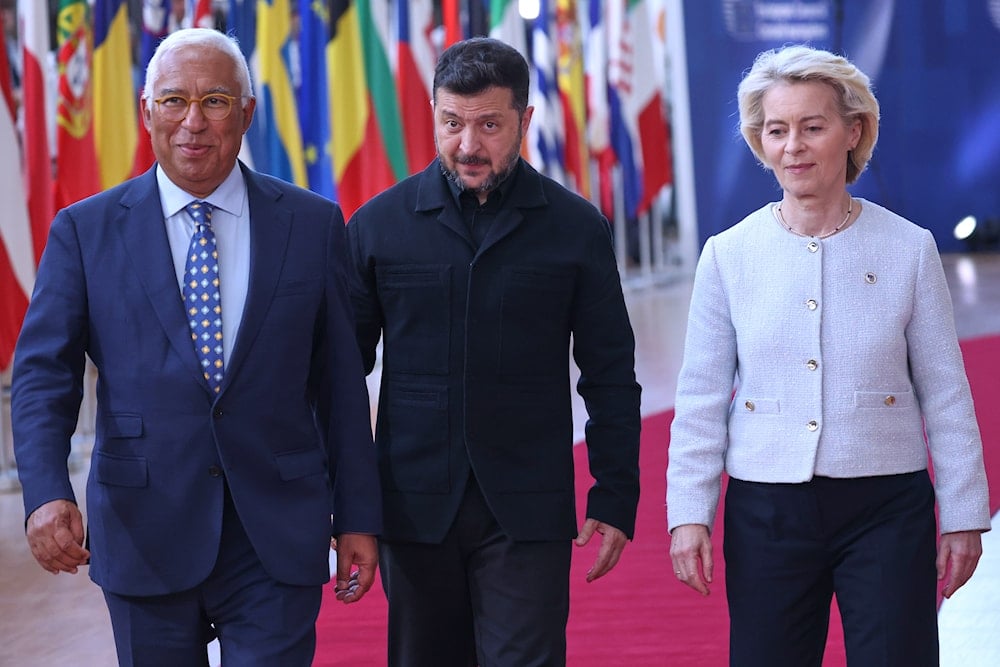
From left, European Council President Antonio Costa, Ukraine's President Volodymyr Zelensky and European Commission President Ursula von der Leyen arrive for the EU summit in Brussels, Thursday, June 18, 2026 (AP)
The European Union has unanimously agreed to advance membership negotiations with Ukraine and Moldova by opening a second policy cluster, although political divisions are expected to slow progress on the four remaining areas.
EU ambassadors approved the bloc’s common negotiating position on Friday, clearing the way for Cluster 6, which covers external relations, to be formally opened during separate accession conferences with Ukraine and Moldova in Brussels on July 14.
The cluster consists of two chapters: external relations, which includes trade and international economic policy, and foreign, security, and defense policy. Its limited scope made it the most likely area to advance after the opening of the fundamentals cluster in June.
Ukraine and Moldova formally launched EU membership negotiations in June 2024. However, detailed talks on the bloc’s policy chapters only began on June 15, 2026, when the EU opened Cluster 1, known as fundamentals, with both candidates.
That cluster covers the rule of law, fundamental rights, democratic institutions, public administration reform, and economic criteria. It is considered the central component of the accession process, remains under review throughout negotiations, and is generally the final cluster to be closed.
Four clusters remain pending
Following the July 14 conferences, Ukraine and Moldova will have formally opened two of the EU’s six negotiating clusters.
The four still awaiting unanimous approval are Cluster 2 on the internal market, Cluster 3 on competitiveness and inclusive growth, Cluster 4 on the green agenda and sustainable connectivity, and Cluster 5 on resources, agriculture and cohesion.
The European Commission has said the two countries have made sufficient technical progress for further clusters to be opened, although each step requires political approval from all 27 EU member states.
Kiev had sought to launch all outstanding areas before the summer recess, a goal supported by the Commission and most EU governments.
"It's important that we keep the momentum up," a diplomat said.
That timetable is now unlikely to be met, with the remaining clusters expected to be examined individually from September onward.
Hungary shifts position but resists rapid process
The breakthrough followed a change of government in Hungary, which ended the broad obstruction imposed under former Prime Minister Viktor Orbán.
Hungarian Prime Minister Péter Magyar’s government supported the opening of the fundamentals cluster after Budapest and Kiev held discussions over protections for the ethnic Hungarian community in Ukraine’s Transcarpathia region.
The new Hungarian government has nevertheless resisted opening all remaining clusters at once. Magyar has argued that moving too quickly would amount to "fast-tracked accession" and could undermine the credibility of membership negotiations with Western Balkan candidates, some of which have remained in the process for considerably longer.
Budapest has said enlargement should remain merit-based and proceed step by step, rather than becoming a competition between candidate countries.
Hungary is therefore no longer blocking Ukraine’s accession process in its entirety, but its reservations continue to prevent the EU from advancing all negotiation areas simultaneously.
Lengthy process remains ahead
Opening a negotiating cluster does not mean Ukraine or Moldova has completed the requirements covered by it.
Instead, it permits detailed negotiations to begin on the individual chapters within that cluster. Both countries must align their legislation, institutions, and administrative practices with the EU’s body of laws and standards, known as the acquis.
The European Commission will monitor the implementation of reforms and recommend whether chapters can be provisionally closed. Member states can delay or block progress at several stages.
Even after all clusters and chapters are provisionally closed, membership is not automatic. Accession requires the unanimous approval of EU governments, the consent of the European Parliament, and the ratification of an accession treaty by every member state and the candidate country.
Neither Ukraine nor Moldova has been given a guaranteed date for joining the bloc, meaning the negotiations could continue for several years despite the latest progress.
Read more: NATO military buildup aims to use Ukraine to 'exhaust Russia': Lavrov


