
EU to launch accession negotiations with Ukraine and Moldova
 3 Min Read
The European Union will begin new accession negotiations with Ukraine and Moldova next week after member states agreed to reopen the process stalled by political disagreements.
-
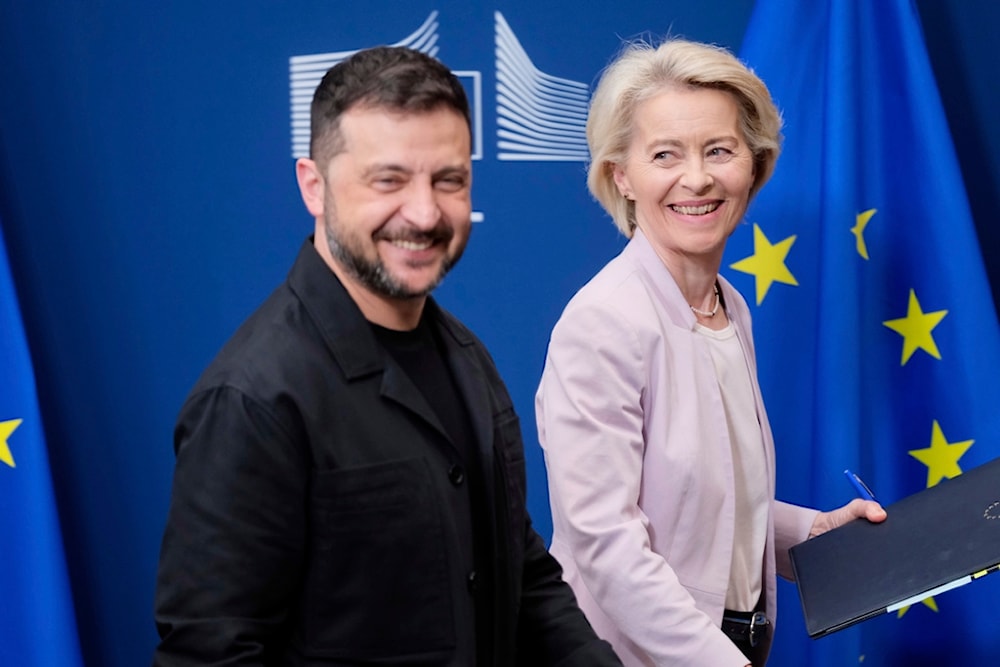
Ukraine's President Volodymyr Zelenskyy, left, walks with European Commission President Ursula von der Leyen after participating in a media conference at EU headquarters in Brussels, Belgium, Sunday, Aug. 17, 2025. (AP)
The European Union has agreed to formally launch the next phase of accession negotiations with Ukraine and Moldova, with talks set to begin next week in Luxembourg.
The decision was reached during a meeting of ambassadors from the EU’s 27 member states in Brussels on Friday, where it was agreed that the first cluster of negotiations would be officially opened on Monday.
EU leaders had previously agreed in December 2023 to open accession talks with both countries, though the process was later delayed amid internal political disagreements within the bloc.
The upcoming meetings mark the formal resumption of a process that is expected to span several years and cover a wide range of institutional and legal reforms.
Hungary’s veto and shifting political positions
The accession process had been stalled due to opposition from Hungary under former Prime Minister Viktor Orban, who had previously blocked progress on Ukraine’s membership bid.
That veto was lifted following a change in Budapest’s political leadership in May, allowing negotiations to move forward.
However, the new Hungarian government has maintained reservations regarding the speed and structure of Ukraine’s potential accession.
Separately, EU officials are debating a $7.6 billion military financing scheme for Ukraine after Hungary ended its opposition to releasing the funds.
While agreement has now been reached to proceed with the first negotiation cluster, Budapest has indicated that it does not support a fast-tracked pathway to membership.
A referendum on Ukraine’s eventual accession remains a possibility if all negotiation chapters are completed in the coming years.
Read more: Ukrainian forces wasting NATO-supplied arms: UK defense sources
Ukraine and Moldova tie EU bid to security concerns
Both Kiev and Chisinau continue to frame EU membership as part of broader security considerations amid ongoing regional tensions with Russia.
Moscow, for its part, maintains that influence over its “near abroad,” referring to former Soviet states, is central to its national security doctrine.
The competing positions reflect a wider geopolitical dispute over the alignment of Eastern European states and the expansion of NATO toward Russia’s borders.
'Enlargement is a strategic choice'
European Council President Antonio Costa and European Commission President Ursula von der Leyen welcomed the decision in a joint statement on social media, describing it as recognition of reform efforts undertaken by both candidate countries.
“All member states agreed to open the first accession negotiations cluster with Ukraine and Moldova,” they said.
They added that “enlargement is a strategic choice,” arguing that expanding the bloc serves shared interests in a period marked by geopolitical uncertainty.
The first cluster of talks will focus on foundational issues, including rule of law standards and governance structures that candidate countries must align with EU requirements.
Read more: European trust in US security guarantees falls to historic low: ECFR


