
Finland, Denmark join call to suspend Spain from Schengen
 7 Min Read
Tens of thousands of migrants entered Spanish Ceuta from Morocco in a single day, prompting a number of European nations to call for Spain's suspension from the Schengen zone.
-
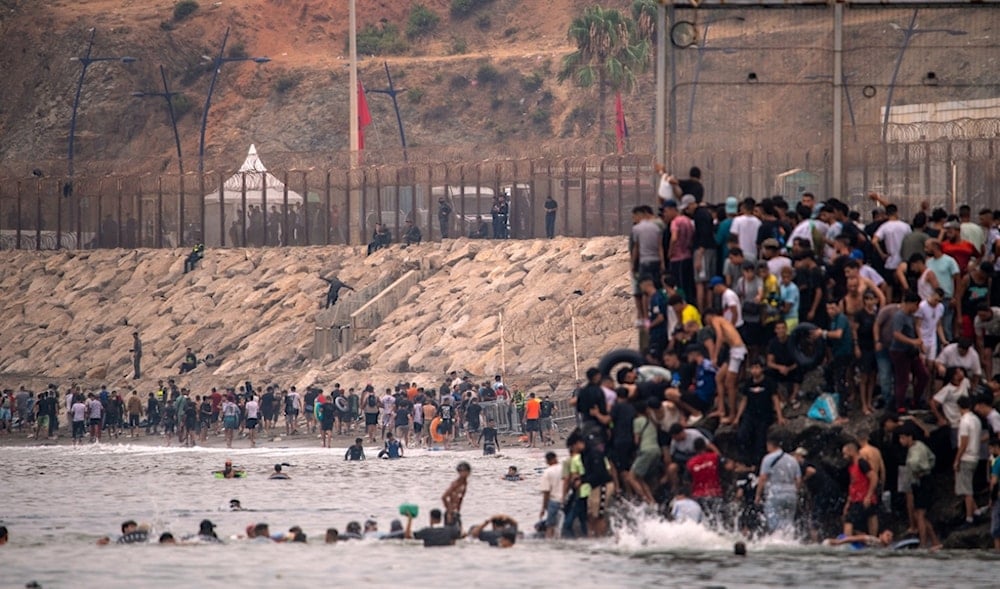
Migrants return to Morocco from the Spanish enclave of Ceuta, Friday, July 31, 2026 (AP)
Finland and Denmark have endorsed Italy's proposal to temporarily exclude Spain from Schengen. The Schengen Area allows passport-free movement across 29 European countries that have abolished border controls at their shared frontiers.
Yesterday, Italian Foreign Minister Antonio Tajani called for the suspension of Spain from the Schengen Area after hundreds of migrants entered Spain’s North African exclave of Ceuta from Morocco.
Italian Prime Minister Giorgia Meloni called the footage from Ceuta "shocking" and threatened to push for Spain's suspension from the Schengen zone, the EU's visa-free travel area, if the situation was not brought under control.
"Italy will not stand idly by," Meloni said on X, adding that Rome was consulting competent bodies before deciding whether to pursue "exceptional measures", including a Schengen suspension.
Le immagini che arrivano da Ceuta sono impressionanti e dimostrano, ancora una volta, che l’immigrazione clandestina fuori controllo rappresenta una minaccia concreta per la sicurezza dei confini europei.
— Giorgia Meloni (@GiorgiaMeloni) July 30, 2026
Mi sono confrontata con il Ministro dell’Interno Matteo Piantedosi.…
What happened?
Spain's autonomous city of Ceuta is struggling to contain a mass border crossing that began Thursday and continued into Friday, with an estimated 60,000 migrants entering from Morocco within a 24-hour window; a figure equivalent to roughly 70% of the city's regular population, according to Ceuta's president.
An important note to make, Ceuta is part of Spain politically, but it sits on the African continent, separated from mainland Spain by roughly 18 miles of water. pic.twitter.com/oO9Mjfr7sM
— Carl Nikephoros Thompson (@Carl_Nikephoros) July 30, 2026
At least 57 people have died in the process, with at least 18 deaths attributed to drowning and a stampede at Tarajal beach, near a border checkpoint with Morocco, AP reported.
The scale of the crossing has overwhelmed local authorities. Spain's Civil Guard workers' association in Ceuta described the situation as one of "serious humanitarian crisis," with thousands of migrants, including unaccompanied children, sleeping in parks and on sidewalks.
"It's chaotic," said Rachid Sbihi, who heads the association. "People are still entering."
INSANE FOOTAGE: Thousands of migrants continue crossing from Morocco into Spain’s Ceuta enclave, as local officials reportedly urge Madrid to declare a national emergency. pic.twitter.com/dlbbKOjBV1
— Breaking911 (@Breaking911) July 30, 2026
Finland, Denmark join Italy wanting Spain out of Schengen
Finland endorsed Italy's proposal to temporarily exclude Spain from Schengen. In a post on X, Finland's Interior Minister Mari Rantanen accused Spain of failing to secure its border in Ceuta. "This cannot continue. All European countries must support Meloni's proposal. Countries that do not fulfill their obligation to protect the external border cannot be members of Schengen," Rantanen said.
Espanja on täysin epäonnistunut suojaamaan Schengen-alueen ulkorajan maahantunkeutumiselta. Näin ei voi jatkua. Kaikkien Euroopan maiden tulee tukea Melonin esitystä. Sellaiset maat jotka eivät täytä velvollisuuttaan suojata ulkorajaa, eivät voi olla Schengenin jäseniä.
— Mari Rantanen (@MariPSRantanen) July 31, 2026
Mette Frederiksen, the Prime Minister of Denmark, also said that the European Union should consider suspending Spain from the Schengen area following the situation in Ceuta. She added that Europe must not repeat the 2015 migration crisis.
Spain's Interior Ministry pushed back against emergency framing, stating that current legislation governing national emergency declarations does not classify migration flows as a national security risk. The Ministry said coordination between Spanish and Moroccan authorities was ongoing.
What triggered the crossing
Authorities in both Ceuta and Madrid have pointed to a recent Spanish Supreme Court ruling as a key factor in triggering the surge. The ruling determined that migrants who arrive by sea cannot be summarily deported, a provision that does not extend to those who cross by land or climb the border fence.
Spanish Prime Minister Pedro Sánchez said the ruling was misread and rapidly circulated through human trafficking networks, prompting a mass movement toward the coast. "It appears that this interpretation of the ruling spread like wildfire over the past few hours through the networks of human trafficking organizations, triggering the kind of mass surge we witnessed yesterday," Sánchez said during a visit to Ceuta on Friday.
Lo que ha sucedido es un ataque a la integridad territorial de España y merece nuestra más rotunda y enérgica condena.
— Pedro Sánchez (@sanchezcastejon) July 31, 2026
Toda España está con la ciudadanía de Ceuta. El Gobierno de España está con la Ciudad Autónoma.
Gracias por la cooperación que siempre hemos mantenido con el… pic.twitter.com/ZqKdUdu7Oy
Migrants reached Ceuta primarily by swimming from the Moroccan town of Fnideq, a crossing of roughly five kilometers, or from the nearby town of Belyounech, where the distance is shorter, AP reported. Video footage showed people using inflatable inner tubes and other flotation devices, while others broke through a gate in the border fence, with many shouting "Viva España" as they entered.
However, many activists in Morocco doubt that the ruling triggered the surge, as most of those migrants could not have possibly been aware of such legal decisions.
Spain deploys military, declares border integrity at stake
Sánchez condemned the border breach as "a violation of Spain's territorial integrity" and placed primary blame on human smuggling networks for exploiting migrants' desperation. Spain's Armed Forces deployed 60 personnel to Ceuta to reinforce the Civil Guard, The Independent reported. Sánchez acknowledged, however, that the Supreme Court ruling may have contributed to the situation, even if it was misinterpreted.
The Spanish Army is moving toward the Ceuta border with Morocco. pic.twitter.com/UV5swszyU2
— Open Source Intel (@Osint613) July 30, 2026
Local businesses in Ceuta shuttered in response. "I'm not opening this afternoon because the situation is extremely tense," Enrique Serrano, a clothing store owner in the city center, told Reuters, adding that business owners were organizing to protect their property and families.
Ceuta's president had raised the alarm earlier in the week, warning that migrant reception centers were already over capacity before the surge, according to AP. Spain's Interior Ministry declined to confirm exact numbers, saying it would release its next migration report on Monday.
Morocco's response on the ground
On the Moroccan side of the border, police deployed additional personnel and used water cannons and warning shots to prevent further crossings, though migrants continued to enter despite the heavy presence, according to rights groups cited by AP. Those detained at the border were transferred deeper into Morocco, away from Ceuta.
Moroccan forces dispersing the crowds before they reach border checkpoints pic.twitter.com/I5kyAwH7TZ
— Zineb Riboua (@zriboua) July 31, 2026
Morocco's ambassador to Spain, Karima Benyaich, said the crossing happened against her country's wishes and described conditions in Ceuta as difficult. "We have always prioritized legal, orderly and safe migration for all," she said.
Nonetheless, footage circulated online shows men in Morocco's Royal Gendarmerie uniforms standing idly as trucks filled with young men unload near the border with Spain.
ESTO ES MUY GRAVE. Me llegan estas imágenes de cómo las autoridades marroquíes vacían camiones llenos de jóvenes cerca de la frontera con Ceuta.
— Taleb Alisalem (@TalebSahara) July 30, 2026
Quien no quiera ver que se trata de una operación perfectamente preparada por el régimen, es que es ciego. pic.twitter.com/YpxFAaF7Wb
By Friday morning, the waters near the border fence were strewn with buoys, shoes, and other abandoned belongings, AP reported. Large groups of migrants were also seen walking back toward Morocco voluntarily.
🇪🇸🇲🇦 MIGRANTS ALREADY RETURNING TO MOROCCO
— DD Geopolitics (@DD_Geopolitics) July 31, 2026
Dozens of migrants are returning to Morocco after a large influx into Ceuta. Some of the migrants have stated that they did not have access to food in Ceuta, while others have said they were "deceived" into entering the area.
Despite… pic.twitter.com/rd1r3aCdA8
Unrest extends to Melilla
The situation was not limited to Ceuta. Migrants also attempted to cross into Melilla, Spain's other autonomous city on the North African coast, prompting clashes in Bni Nsar, the Moroccan town on that border.
Comienza a reproducirse en Melilla la situación vivida en Ceuta: nuevos vídeos del asalto masivo por Beni Enzar y el Dique Sur. pic.twitter.com/tJptmfXtVF
— Onda Cero Melilla (@ondaceromelilla) July 30, 2026
Migrants threw rocks at police and set vehicles on fire, according to local media and rights groups cited by AP, resulting in injuries among security forces and multiple arrests. The Moroccan Association of Human Rights said the Melilla attempts appeared directly linked to events in Ceuta.
Both Ceuta and Melilla have long been disputed, with Morocco considering them occupied territories.
A crisis worse than 2021
The crossing drew comparisons to May 2021, when approximately 10,000 people, including many minors, entered Ceuta within days, albeit police in Ceuta described the current situation as worse. "We are one step away from operational collapse," an unnamed officer told El País newspaper.
The underlying conditions driving migration have not changed. Ahmed Karim, a 33-year-old Moroccan who crossed Thursday, told AP that the lack of jobs at home left few alternatives. "Many people want to go to Europe, America, but they don't have the opportunity," he said.


