
Germany's AfD wins first state parliament speaker post
 2 Min Read
Germany's far-right AfD secured its first state parliamentary speakership with Tobias Rausch's election in Saxony-Anhalt.
-
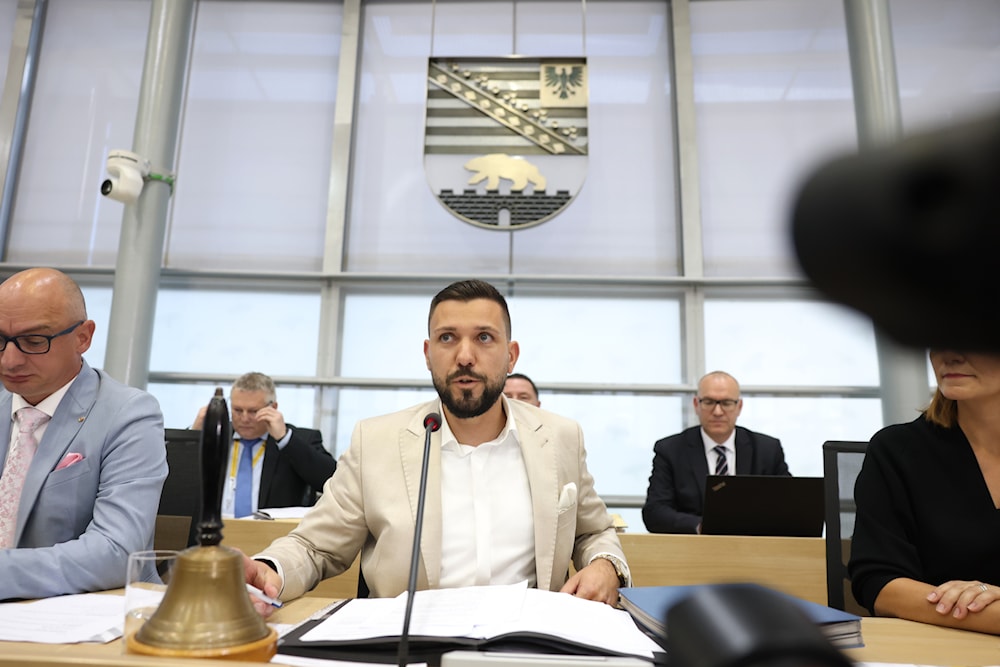
The newly elected state parliament president Tobias Rausch, center, of the Alternative for Germany (AfD) party, sits on the podium following his election during the constituent session of the newly elected German federal state parliament of Saxony-Anhalt in Magdeburg, Germany, Tuesday, Oct. 6, 2026 (AP)
Germany’s far-right Alternative for Germany (AfD) secured its first state parliamentary speakership on Tuesday, as lawmakers in the eastern state of Saxony-Anhalt elected Tobias Rausch following the party’s victory in September’s regional election.
Rausch, 35, received 48 votes in favor, with 29 lawmakers voting against and five abstaining, during the newly elected parliament’s inaugural session in Magdeburg, according to the German news agency dpa.
The result gives the AfD a prominent institutional position as it seeks to translate its electoral gains into a broader role in governing the state.
BSW support challenges political firewall
The AfD won 43.8% of the vote in the September 6 election, securing 39 of the parliament’s 83 seats and falling short of an outright majority.
The Sahra Wagenknecht Alliance (BSW), which holds five seats, had pledged to support Rausch, citing the convention that the largest parliamentary group provides the speaker. His final tally exceeded the two parties’ combined 44 seats, although the secret ballot prevents identifying which individual lawmakers supported him.
BSW’s position challenges the political “firewall” maintained by other parties against cooperation with the AfD. The CDU, Social Democrats, Greens, and Left Party have ruled out collaboration with the far-right party, whose Saxony-Anhalt branch is classified by the state’s domestic intelligence agency as a confirmed right-wing extremist organization.
State leadership remains undecided
The parliamentary speaker chairs plenary sessions, enforces debating rules, and oversees the legislature’s administration. The position also carries representative responsibilities and authority over access and security within parliamentary buildings, giving its holder influence beyond ceremonial duties.
Rausch’s election does not determine the leadership of Saxony-Anhalt’s government, which requires a separate parliamentary vote.
AfD regional leader Ulrich Siegmund hopes to become state premier in December. His party remains three seats short of the 42 needed for an absolute majority, leaving its attempt to take control of the state government dependent on the conduct of other parliamentary groups.
Read more: Anti-AfD protests sweep Germany after far-right election victory


