
Far-right and far-left gains deal fresh blow to Germany's Merz
 4 Min Read
With Merz's approval near 10 percent, the pressure on his leadership is mounting from both sides at once.
-
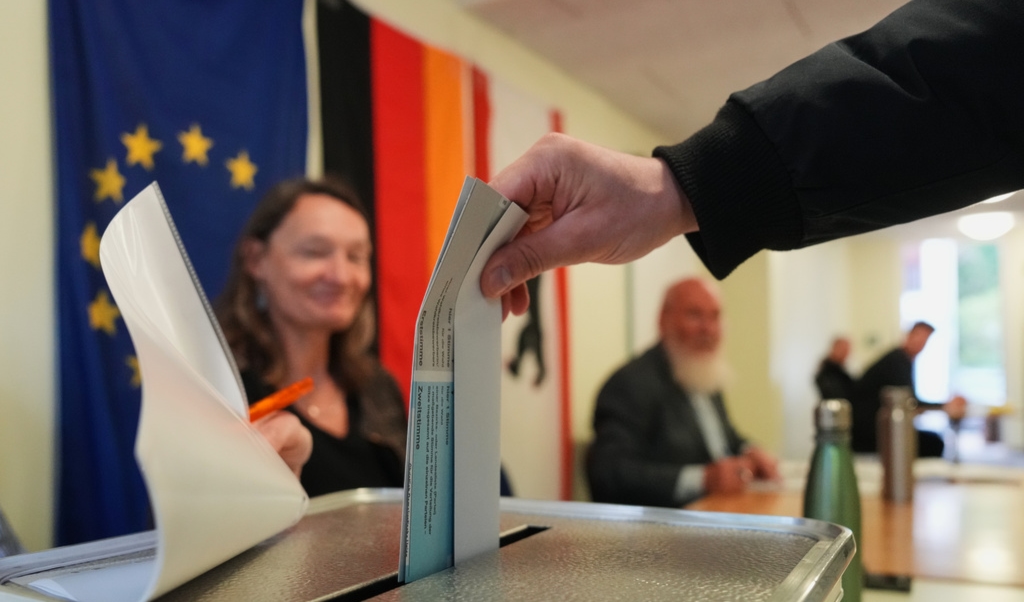
A man casts his ballots for the Berlin state election in Berlin, Germany, Sunday, Sept. 20, 2026. (AP Photo/Markus Schreiber)
Germany's political fringes both gained ground at the expense of the governing center on Sunday, compounding a rough stretch for Chancellor Friedrich Merz less than two weeks after his party's last electoral setback.
In Mecklenburg-Western Pomerania, exit polls from public broadcasters ARD and ZDF put the far-right Alternative for Germany (AfD) in first place with 37-38 percent, ahead of the center-left SPD at roughly 35.5-36.5 percent.
Merz's Christian Democratic Union (CDU) barely cleared the five percent bar needed to hold seats in the state legislature, its weakest showing there on record. The result carries added sting for Merz given the region includes the political home turf of his longtime CDU rival, former chancellor Angela Merkel, who led Germany for 16 years before Merz's turbulent 16 months in office.
Despite the AfD's win, state premier Manuela Schwesig looked on track to stay in power, with her SPD positioned to form a three-way coalition alongside the Greens and Die Linke that appeared headed for a majority.
Roughly 1.3 million people were registered to vote in Mecklenburg-Western Pomerania. It is now the third German state where the AfD has finished as the top vote-getter.
Berlin swings toward Die Linke
In the capital, where about 2.5 million people were eligible to cast ballots, the far-left Die Linke pulled ahead with 24.5-26 percent, putting it roughly five points clear of the CDU's approximately 20 percent. The CDU currently shares power in Berlin's governing coalition.
The AfD also gained a double-digit share of the vote in the city, though a standing "firewall" of non-cooperation among the mainstream parties left it without a realistic route into government in either state.
Die Linke campaigned in Berlin on seizing rental units from large corporate property owners to ease the city's housing squeeze, alongside positions opposing German military aid to Ukraine and favoring an eventual German exit from NATO.
Should the preliminary count hold, the party's candidate, Elif Eralp, would become the first Berlin government leader of Turkish origin.
AfD claims a mandate
AfD leaders framed Sunday's result as proof the party has moved into the political mainstream. Co-leader Alice Weidel declared the party had "displaced the CDU as the people's party" once the first numbers came through, while co-chair Tino Chrupalla called it a sensational outcome and argued the party had earned a clear mandate to govern.
The AfD's candidate for state premier, former radio host Leif-Erik Holm, said he would invite every party to talks, but conceded that forming a government would be difficult given that no other major party is willing to sit in coalition with the AfD, a stance consistent with the firewall holding elsewhere in the country.
Merz vows to stay despite setback
Merz pulled his party's leadership into an emergency huddle as the results rolled in and moved swiftly to quash renewed talk that he might be pushed out.
He acknowledged the CDU had been denied any boost from the national government's standing in either race, but said "the reforms have to come," framing the party's economic and social overhaul, covering tax policy, healthcare, pensions, and bureaucratic red tape, as unfinished business he intends to see through.
He argued "these reforms are the antidote to the poison of authoritarianism" spreading through German society. AfD co-chair Tino Chrupalla needled Merz publicly over the results and called on him to step down.
Merz enters this latest test with his personal approval rating hovering near 10 percent after a year and a half in the chancellery, while the AfD has overtaken his coalition in nationwide polling at around 30 percent, running on pledges to leave the eurozone, cut off support for Ukraine, and carry out large-scale deportations of migrants without legal status.
Third straight setback since Saxony-Anhalt
Sunday's results extend a losing streak that began two weeks earlier in Saxony-Anhalt, where the AfD posted a record 44 percent and pushed the CDU into a distant second.
An AfD state lawmaker in Mecklenburg-Western Pomerania told AFP that Merz's stalled reform agenda, particularly his failure to deliver a promised immigration crackdown, had helped drive the party's momentum nationwide.


