
Germany’s Merz under pressure after AfD election triumph
 4 Min Read
The AfD’s sweeping victory in Saxony-Anhalt deals a major blow to Friedrich Merz as Germany’s political establishment confronts a growing far-right challenge.
-
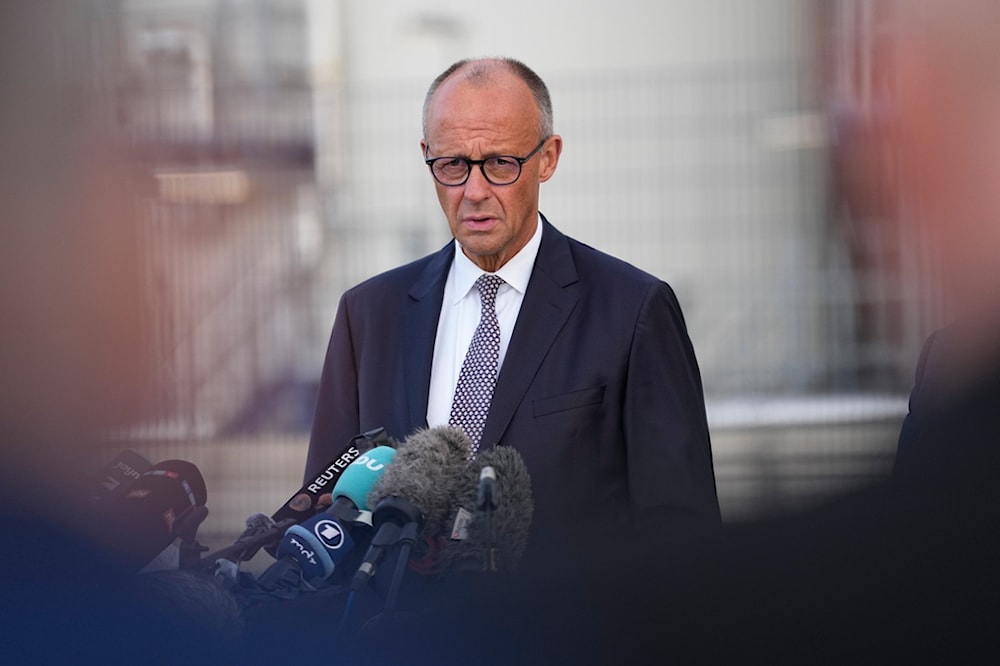
German Chancellor and Christian Democratic Union (CDU) party leader Friedrich Merz gives a press statement after visiting UPM Biochemicals in Leuna, Germany, Thursday, Sept. 3, 2026. (AP Photo/Matthias Schrader)
German Chancellor Friedrich Merz is set to meet with members of his CDU party on Monday following a major electoral setback, as the far-right Alternative for Germany (AfD) secured its strongest result yet in a state election in eastern Germany.
The AfD won 44% of the vote in Saxony-Anhalt on Sunday, according to projections by German public broadcasters, far ahead of the center-right CDU, which secured about 18%.
The result represents a significant setback for Merz’s government and places additional pressure on the Chancellor as his approval ratings have declined sharply.
CDU state premier Sven Schulze appeared visibly dejected after the vote and acknowledged that national government policies had complicated his campaign.
“We often faced headwinds, and that wasn't always easy,” Schulze said.
Read more: Germany approves nearly $930mln in military exports to 'Israel'
AfD delivers major blow to Merz’s CDU
The AfD’s result brings the party closer than ever to taking control of a state government. The party, which is classified as “right-wing extremist” by Germany’s domestic intelligence agency, fell just short of an absolute majority in the Saxony-Anhalt state parliament.
According to broadcaster projections, the AfD was three seats short of the 42 needed for an outright majority.
The result has sent shock waves through Germany’s political establishment, where extremist parties have remained largely excluded from state and federal government since the end of World War II.
“For the first time since the end of World War II, the AfD -- a party whose state branch is classified as right-wing extremist -- is close to securing an absolute majority,” Schleswig-Holstein CDU premier Daniel Guenther said. “This is a shocking moment for our country.”
The election is particularly damaging for Merz, who remained silent publicly as the results emerged Sunday evening from CDU headquarters in Berlin.
Election result deepens pressure on Berlin
The AfD’s 35-year-old lead candidate, Ulrich Siegmund, used the result to directly target Merz, describing the Chancellor as “a very good campaigner” for the AfD.
Siegmund said the party had “made history” and that voters had sent “a signal to Berlin.”
“Every day with Merz in the chancellery was one day too many,” he added.
AfD national co-leaders Alice Weidel and Tino Chrupalla called on the party’s Saxony-Anhalt branch to seek control of the state government, presenting the result as a potential blueprint for the 2029 federal election.
The outcome therefore extends beyond the immediate struggle over forming a government in Magdeburg. It also signals the growing challenge the AfD poses to Germany’s established parties at the national level.
Read more: German rocket reaches orbit as Europe pushes space autonomy
Coalition arithmetic leaves Saxony-Anhalt uncertain
Despite its commanding lead, the AfD does not have enough seats to govern alone.
Opposing it is a grouping comprising the CDU, center-left SPD, Greens, and far-left Die Linke. However, these parties also lack a clear majority.
Another potential kingmaker is the small BSW, a leftist party that takes a hard-right position on immigration, provided it crosses the 5% electoral threshold needed to enter the state parliament.
The AfD could also seek to attract lawmakers from other parties, potentially allowing it to strengthen its position without winning an outright majority.
Siegmund said his party was prepared to “extend a hand to all forces that want to bring about a fundamental political shift with us.”
The resulting coalition negotiations could therefore become a test of whether Germany’s established parties can prevent the AfD from entering government at the state level.
AfD looks toward 2029
The Saxony-Anhalt result gives the AfD significant political momentum as Germany’s parties look toward the next federal election.
The party’s advance also exposes the growing political divide between eastern Germany and the country’s established political centers. Economic concerns, immigration, dissatisfaction with Berlin, and broader opposition to the political establishment have increasingly shaped electoral battles in the east.
For Merz, the challenge is immediate. The CDU’s poor performance in a state where it has traditionally maintained a strong presence raises questions about whether the Chancellor’s national political strategy can withstand the AfD’s continued expansion.
Read more: Lavrov says Germany 'wants war again,' dismisses drone accusations


