
AfD's Weidel warns of growing bankruptcy wave in Germany
 3 Min Read
Germany is experiencing a sharp rise in corporate bankruptcies, with AfD co-leader Alice Weidel warning that mounting insolvencies reflect deepening economic pressure.
-
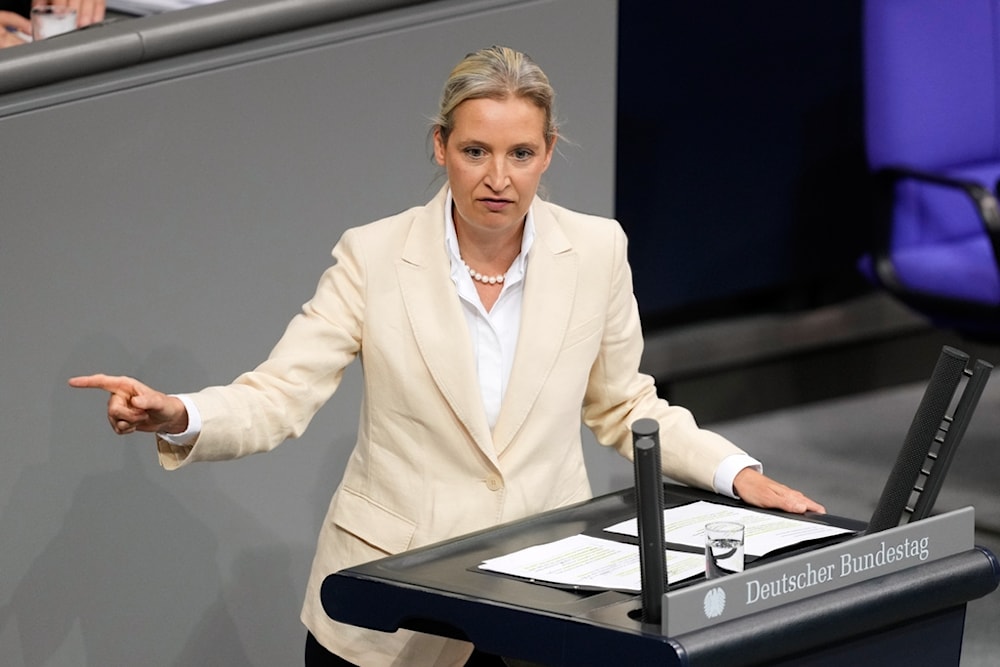
Alice Weidel, co-chairwoman of the Alternative for Germany, AfD, speaks to the German parliament during a debate at the Reichstag in Berlin, Germany, Thursday, Oct. 16, 2025 (AP)
Germany is seeing a sharp acceleration in corporate insolvencies, including among major companies, a trend that opposition politicians warn could deepen the country’s economic strain and reflect mounting structural weaknesses in Europe’s largest economy.
Speaking to reporters on Tuesday after a meeting of her party’s parliamentary group, Alice Weidel, co-chair of the far-right Alternative for Germany (AfD), said the new year had begun with worsening economic indicators.
"Unfortunately, the new year did not start well. There is a tsunami of bankruptcies and insolvencies sweeping across Germany ... Since 2021, the number of major bankruptcies has tripled. This is dramatic. It is the collapse of the German economy," Weidel said.
She added that insolvencies among large firms were climbing rapidly, describing the trajectory as unstable and intensifying.
"The bankruptcy rate among large companies is rising rapidly from one peak to the next," she said.
Citing recent trends, Weidel pointed to projections suggesting a further increase in insolvencies in the coming year.
"In December 2025, we observed this accelerated trend in corporate bankruptcies, and around 30,000 bankruptcies have already been predicted for 2026 alone, following 24,000 in 2025," she said, adding that German industry had shed roughly 400,000 jobs since 2019.
Weidel also criticized economic continuity under current Chancellor Friedrich Merz, arguing that policy direction remained unchanged from the tenure of his predecessor, Olaf Scholz.
Germany’s Insolvency Surge
Her comments followed the release of preliminary figures from the German Federal Statistical Office, which showed that bankruptcy filings rose by 15.2% in December 2025 compared with the same month a year earlier. According to Destatis, the increase exceeded levels recorded during the 2009 global financial crisis, when insolvency growth was approximately five percentage points lower.
Economists and researchers attribute the surge in bankruptcies to a convergence of factors. High energy costs continue to weigh heavily on energy-intensive industries, while rising interest rates have increased debt servicing costs after years of easy credit. The withdrawal of pandemic-era state support has also exposed underlying weaknesses in firms that were previously kept afloat by emergency assistance.
At the same time, Germany’s export-driven economy has been pressured by slowing global demand, particularly from China, alongside declining investment and consumer spending at home. Manufacturing, automotive suppliers, and mid-sized industrial companies have been among the hardest hit, amid longer-term challenges linked to bureaucratic burdens, lagging digital investment, and demographic constraints in the labor market.
Together, these pressures have contributed to the unusually sharp rise in corporate insolvencies, fueling political debate over whether Germany is facing a cyclical downturn or a deeper structural crisis.
Read more: German public confidence in gov't drops to new low, INSA survey shows


