
Germany’s Merz questions strategy behind US-Israeli war on Iran
 3 Min Read
German Chancellor Friedrich Merz warns that any attempt at "regime change" is unlikely and the war may drag on.
-
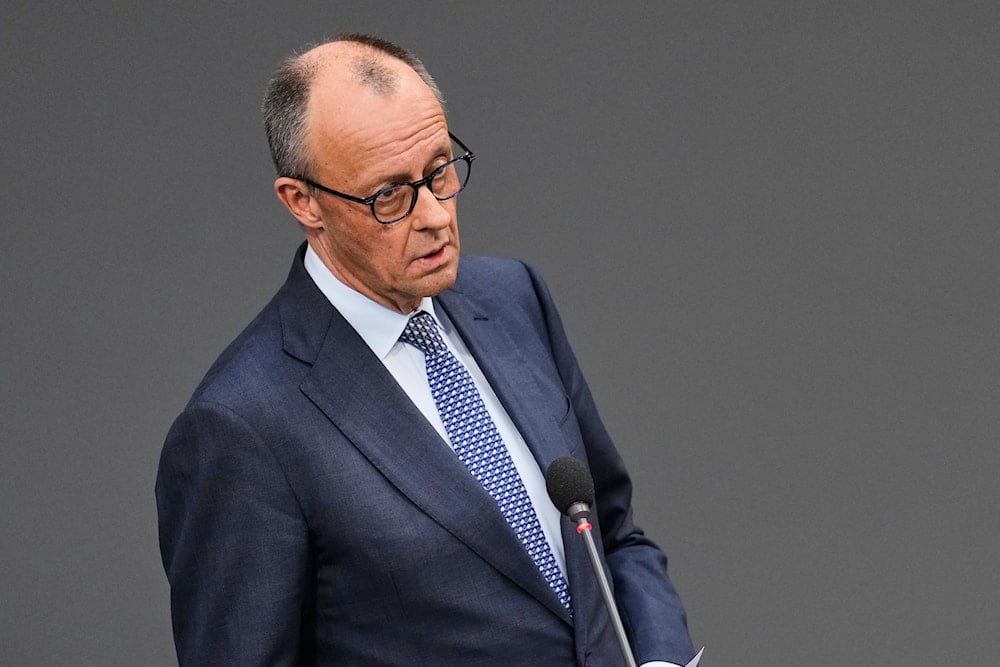
German Chancellor Friedrich Merz speaks during a Q&A at the German parliament Bundestag in Berlin, Germany, Wednesday, March 25, 2026 (AP)
The ongoing US-Israeli war on Iran is unlikely to result in "regime change", as the month-long war shows no signs of slowing, German Chancellor Friedrich Merz said Friday.
"Is regime change really the goal?" he asked at a forum in Frankfurt organized by the FAZ newspaper. adding, "If that's the goal, I don't think you'll achieve it. It's mostly gone wrong" in past wars, he said, referencing the Afghanistan war.
"I have serious doubts as to whether there is a strategy and whether that strategy is being successfully implemented," he added. "In that respect, it could take even longer."
Germany has resisted US President Donald Trump's criticism of NATO members for not joining attacks on Iran, maintaining that it is not their war. Merz said Friday that he believes Trump has accepted this position.
He also noted that Germany would consider helping provide military protection in the Strait of Hormuz if a ceasefire is reached, stating that "this requires an international mandate, it requires approval from the German parliament and, prior to that, a cabinet decision. And we are far from that."
US allies increasingly confused on US strategy for war on Iran
US allies are expressing growing confusion over the direction of United States policy amid the ongoing US-Israeli war on Iran, as mixed signals from Washington complicate diplomatic coordination and raise concerns about the conflict’s trajectory.
Diplomats from Europe, Asia, and West Asia report uncertainty over Washington’s objectives and frustration over the lack of clarity from the White House. “I have no idea what they are trying to do,” an Asian diplomat told POLITICO, referring to US policy toward Iran. Several others noted that neither the White House nor the State Department has offered clear guidance on military intentions, even as the United States has deployed thousands of additional troops to West Asia.
The mixed messaging from US President Donald Trump has added to the confusion. While he has expressed a preference for a negotiated settlement with Iran, he has also warned that he would “keep blowing them away.” US envoy Steve Witkoff emphasized that diplomacy remains a priority, yet the simultaneous troop deployments have raised expectations of a possible escalation in the conflict.
Allies are increasingly worried about the economic and strategic consequences of the war. Disruptions linked to tensions in the Strait of Hormuz have affected global markets, and partner countries report mounting economic strain. “Moving all those assets to the Gulf just to call them back — if a deal is actually struck is a pretty expensive move,” a second Asian diplomat told POLITICO.
Some observers suggest that Washington’s ambiguity may be deliberate, allowing flexibility to either escalate or de-escalate the conflict. “It serves the administration to both keep the option to walk away and claim a win, or to escalate and go deeper,” a European diplomat said.


