
Iran secures grip on Hormuz, leaving US-Israeli strategy in turmoil
 4 Min Read
The Guardian reports that the US is falling short of its objectives in the war on Iran, as Tehran leverages control over the Strait of Hormuz to shift the strategic balance.
-
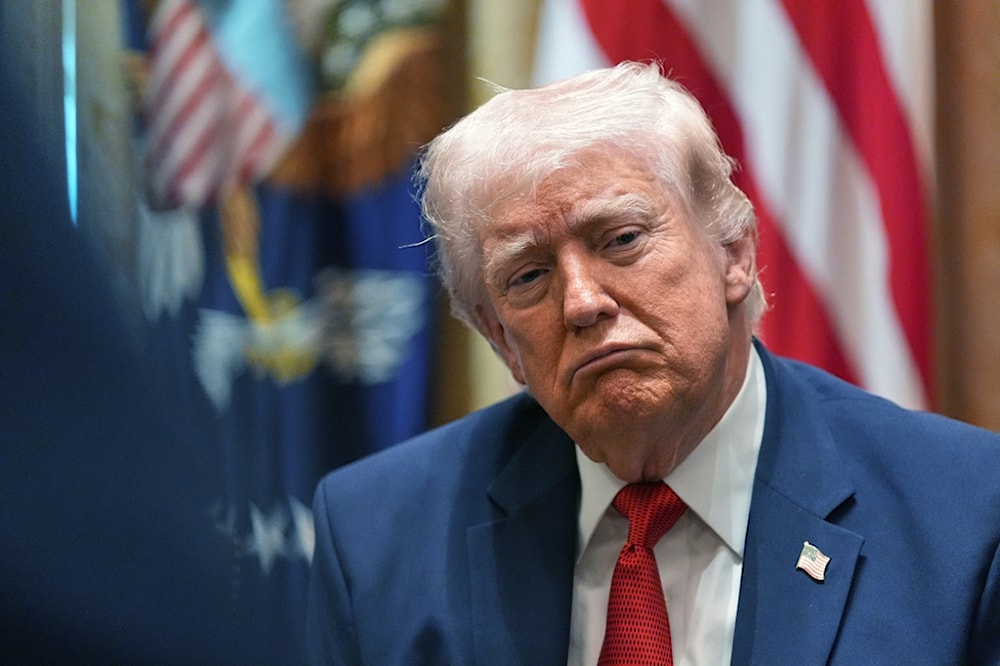
US President Donald Trump listens during a Cabinet meeting at the White House, Thursday, March 26, 2026, in Washington (AP)
The ongoing US-Israeli war on Iran has turned into a prolonged and costly confrontation, with Washington failing to achieve its core objectives while Tehran consolidates its strategic position and asserts effective control over the Strait of Hormuz, The Guardian reported on Friday.
In an analysis by Diplomatic Editor Patrick Wintour, the report indicated that four weeks into a war initially expected to conclude within days, the United States is further from a diplomatic resolution than it was months earlier. Despite sustained military operations, Washington has been unable to force Iran to dismantle its nuclear program under the terms of a 15-point proposal presented in May 2025.
The center of gravity in the confrontation has increasingly shifted toward the Strait of Hormuz, a vital global energy corridor. Iran has exercised sovereign control over the waterway, shaping conditions of access through a calibrated deterrence posture that has compelled insurers and shipping companies to halt operations. US Secretary of War Pete Hegseth acknowledged that “the only thing prohibiting transit in the strait right now is Iran shooting at shipping,” though the report noted that the credible threat of such action alone has been sufficient to disrupt flows.
According to the analysis, Tehran is also advancing mechanisms to formalize its authority over the strait, with tanker operators reportedly engaging Iranian authorities to secure passage. Proposals under consideration could institutionalize differentiated access, granting smoother transit to vessels from states that maintain non-hostile relations with Iran, including India, China, and South Korea.
Strategic shift confirmed
The disruption has had far-reaching implications for global energy markets. With most traffic through the strait halted, an estimated 10 to 13 million barrels of oil per day have been removed from circulation, driving price pressures and exposing the structural fragility of global supply chains. The report noted that US President Donald Trump himself expressed surprise that oil prices had not risen further under current conditions.
Analysts cited in the piece pointed to a decisive shift in strategic momentum. Sir Alex Younger, former head of MI6, said that “the reality is the US underestimated the task and I think, as about two weeks ago, lost the initiative to Iran,” adding that Tehran demonstrated resilience by dispersing its capabilities and adapting its operational posture early on.
Mairav Zonszein of the International Crisis Group described the situation as a major Western setback, stating that “it is becoming painfully clear that not only the United States and Israel are losing this war, but that this is one of the biggest strategic failures of the west, with the most significant consequences for regional geopolitics and the global economy since world war two.”
Limited options
The report further indicated that Washington is facing mounting pressure both internationally and domestically, as the costs of the war continue to rise without delivering tangible gains. While US officials maintain that Iran is under strain and open to negotiations, experts remain skeptical that Tehran will accept maximalist demands, particularly those targeting its nuclear program, missile capabilities, and sovereign authority over Hormuz.
As the war unfolds, the analysis concluded that Iran’s strategic command of a critical global chokepoint has reshaped the balance of power, placing the United States in a position where its options are increasingly constrained to escalation, negotiation on revised terms, or strategic retreat.
Read more: IRGC turns back 3 ships at Hormuz, cautions civilians in Gulf


