
Global military spending hits record high, Europe driving rise
 4 Min Read
Global military spending rose 2.9% to $2.89 trillion in 2025, led by Europe, despite a decline in US expenditure, according to SIPRI.
-
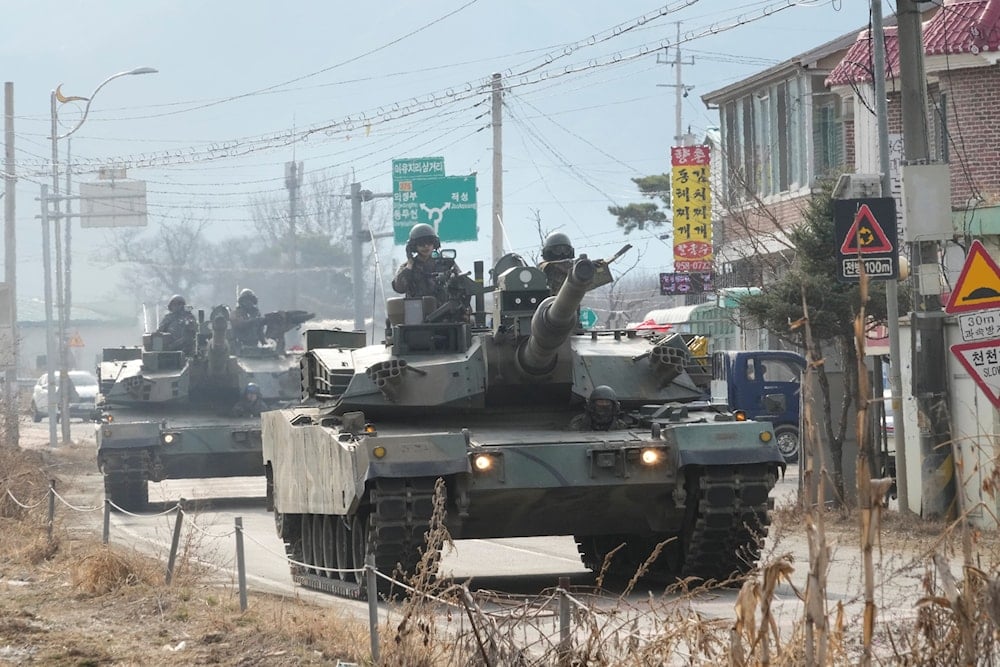
South Korean army's tanks move to attend a joint river-crossing exercise between South Korea and the United States as a part of the Freedom Shield military exercise in Yeoncheon, South Korea, on March 14, 2026 (AP)
Global military spending continued its upward trajectory in 2025, rising by 2.9% to reach $2.89 trillion, despite a notable decline in United States expenditure, according to a report released on Monday by the Stockholm International Peace Research Institute (SIPRI).
The report found that global military spending has now increased for the 11th consecutive year, accounting for 2.5% of global gross domestic product (GDP), the highest level recorded since 2009.
"Given the range of current crises, as well as many states' long-term military spending targets, this growth will probably continue through 2026 and beyond", SIPRI said in the report.
The world’s top three military spenders, the United States, China, and Russia, together accounted for $1.48 trillion, or 51% of total global expenditure.
US military spending declined by 7.5% in 2025 to $954 billion, largely due to the absence of newly approved military financial assistance to Ukraine under US President Donald Trump.
According to the report, US military funding to Ukraine had totaled $127 billion over the previous three years. "The decline in US military expenditure in 2025 is likely to be short-lived", SIPRI said.
“Spending approved by the US Congress for 2026 has risen to over $1 trillion, a substantial increase from 2025, and could rise further to $1.5 trillion in 2027,” it said.
Europe emerged as the primary driver of increased global spending, with a 14% rise bringing total military expenditure on the continent to $864 billion. SIPRI noted that rising defense budgets in European NATO member states contributed to the sharpest annual growth in Central and Western Europe since the end of the Cold War, alongside continued increases in Russia and Ukraine as their war entered its fourth year.
Elsewhere, "Israel’s" military spending declined by 4.9% to $48.3 billion as the war on Gaza wound down in 2025, while Iran’s expenditure fell for a second consecutive year, dropping by 5.6% to $7.4 billion.
NATO forced to spend more under Trump pressure
The surge in European military spending in 2025 is closely tied to evolving targets within NATO, particularly following increased pressure from US President Donald Trump for allies to contribute more to collective defense.
For years, NATO had maintained a benchmark requiring member states to spend at least 2% of their GDP on defense, a target reaffirmed at earlier summits but inconsistently met by several European members.
That dynamic shifted significantly on June 25, 2025, when NATO leaders agreed at a summit in The Hague to adopt a far more ambitious framework, committing most members to raise defense and security-related spending to 5% of GDP by 2035.
The new target is structured as 3.5% of GDP for core military spending and an additional 1.5% for broader security investments such as infrastructure, cyber defense, and resilience.
This shift came largely in response to Trump’s long-standing demands that European allies shoulder a greater share of the alliance’s defense burden, with his administration linking US security commitments to higher allied spending.
Countries in Eastern and Northern Europe, including Poland and Estonia, were among the strongest supporters of the increase, citing heightened security concerns linked to Russia and already moving toward or beyond existing NATO spending benchmarks. Major economies such as Germany and the United Kingdom also signaled alignment with the new targets, albeit with longer implementation timelines.
However, some Southern and Western European countries expressed reservations about the pace and scale of the increase. Nations such as Spain and Italy raised concerns over fiscal constraints and domestic political pressures, while others called for a broader definition of security spending to include non-military areas, reflecting divisions within the alliance over how quickly and extensively the targets should be met.
As a result, European NATO members accelerated budget increases in 2025, with defense spending rising sharply as countries began aligning their fiscal policies with the new long-term targets and preparing national roadmaps due by mid-2026.


