
Polish PM questions US loyalty to NATO defense commitment
 5 Min Read
Donald Tusk questions whether the US would remain loyal to its NATO commitment to defend Europe in the event of a Russian attack.
-
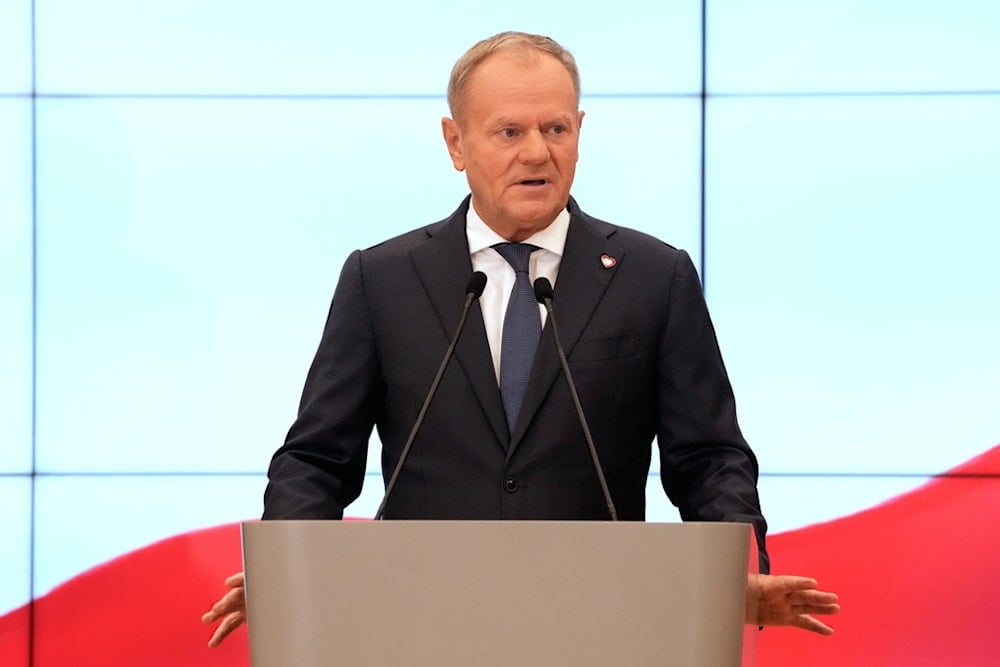
Poland's Prime Minister Donald Tusk speaks during a press conference announcing changes in his government in Warsaw, Poland, Wednesday, July 23, 2025 (AP)
Europe's biggest and most pressing question is whether the United States is ready to be as loyal as described in NATO treaties, Poland's Prime Minister Donald Tusk stated.
His warning comes as Russian President Vladimir Putin could attack an alliance member in "months", he told the Financial Times.
The unusual intervention from a Polish leader reflects growing uncertainty across Europe following President Donald Trump's threats and inconsistent commitment to the continent's defense. Tusk noted that some members of the US-led defense alliance "pretended that nothing happened" when approximately 20 Russian drones breached Poland's airspace last year.
"For the whole eastern flank, my neighbors, the question is if NATO is still an organization ready, politically and also logistically, to react, for example against Russia if they try to attack," Tusk said.
Tusk seeks practical guarantees, not just paper commitments
Tusk stressed that his words should not be interpreted as skepticism toward Article 5, NATO's mutual defense pledge, but rather as a desire to transform guarantees on paper into something very practical. He said he wants to believe that Article 5 is still valid, but sometimes he has problems doing so.
Poland is the largest spender in NATO by GDP, already meeting the alliance's 5 percent target, and remains one of Europe's most staunchly pro-NATO and pro-transatlantic countries.
Tusk said Washington treats Poland as the best and closest ally in Europe, but questioned what that means in practice if something happens.
EU summit discusses mutual defense clause
Tusk's warning comes as an EU summit is taking place in Cyprus, including discussions about the bloc's own mutual defense clause, Article 42.7 of the EU treaty, in response to Trump's threats to withdraw from NATO and ambiguous language about honoring Article 5.
European Commission President Ursula von der Leyen said this spring that the bloc should bring Article 42.7 "to life". However, many countries remain wary of steps that could be seen as undermining NATO or questioning the US commitment to defend Europe, which has been the bedrock of continental security since World War II.
The departure of Hungarian Prime Minister Viktor Orbán, an ally of Putin, opens the door for discussions on Article 42.7 and a larger role for the EU in defending the continent. Tusk said that as long as Orbán was in office, there was no direct connection with Budapest on defense. He added that the election of pro-EU conservative Péter Magyar would make Hungary a much better collaborator on defense and in its approach to Russia.
Europe becoming more aware of need for common defense
Tusk said the discussions on Article 42.7 are about defining practical ways countries would support each other in the event of an attack. He said a real alliance requires true tools and real power when it comes to defense instruments and military mobility.
"This is why my obsession now and my mission is to reintegrate Europe," Tusk said. "It means common defense, a common effort to protect our eastern borders."
He added that one positive aspect of the Ukraine war is that Europe is becoming more aware that it must come together on military aspects and defense.
Intensified criticism of NATO allies
Trump has repeatedly criticized NATO members over their response to the war on Iran, particularly their reluctance to support naval efforts aimed at securing the Strait of Hormuz, which was closed to international shipping following the start of the war on February 28.
In an interview for Reuters on April 1, Trump questioned the strength of US commitment to NATO, responding to questions about potential withdrawal by saying, “Wouldn’t you if you were me?”
He has also targeted UK Prime Minister Keir Starmer, accusing him of being “cowardly” for not joining US military action against Iran, stating Britain was “No Winston Churchill,” and dismissing British aircraft carriers as “toys".
Britain initially declined a US request to support offensive operations from its bases, later agreeing only to defensive missions intended to protect civilians in the region, including British nationals, during Iranian retaliation.
War Secretary Pete Hegseth has acknowledged that the Iran war exposed divisions within NATO, noting that while Iran’s longer-range missile systems cannot reach the United States, they are capable of striking European territory.
“We get questions, or roadblocks, or hesitations ... You don't have much of an alliance if you have countries that are not willing to stand with you when you need them,” Hegseth said earlier this month at the Pentagon.
A Pentagon spokesperson told Reuters the department is preparing “credible options” for the president in response to allied actions, emphasizing that NATO cannot function as a “one-way street,” while declining to comment on internal discussions.
Read more: Pentagon internal email outlines US options to punish NATO allies


