
How US security guarantees became a strategic liability in the Gulf
 10 Min Read
Are the current escalations in West Asia creating a new balance of power, or exposing the contradictions of a security architecture in which US bases and guarantees have become liabilities?
-
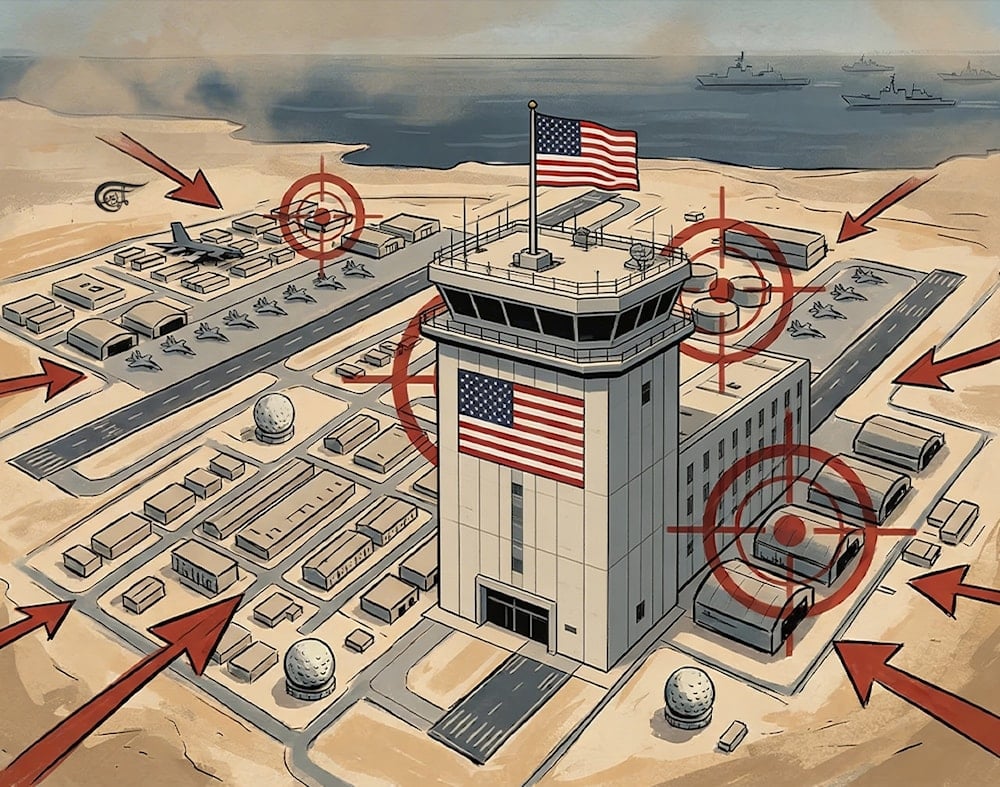
Illustration of US military base located in the Gulf. Designed by Zaynab el Hajj for Al Mayadeen English.
What follows in the wake of every escalation in West Asia is not the emergence of a new balance of power but the renewed visibility of an old one. The claim that the region has suddenly been rearranged confuses revelation with transformation. The balance was always there. Moments of crisis simply make the underlying structure harder to disguise: who has the power to destroy, who is made to absorb destruction, and whose territory becomes the geography of war.
The current war on Iran has brought this structure into sharp view, revealing how quickly the region’s military infrastructure, alliances, and logistical networks can become an operational map of retaliation.
This dynamic is not simply a question of deterrence or alliance formation. It concerns the way imperial power organizes space, resources, and violence. War is not an accident that interrupts the system; it is one of the ways the system operates, a sphere in which destruction becomes a mechanism for managing crises and preserving strategic dominance.
Ticking time bombs
For decades, many Arab states built their security strategies around the American military presence: basing agreements, integrated air defense systems, training partnerships, and arms purchases that tied not only weapons systems but military doctrine itself to US force posture.
In official discourse, this arrangement was described as protection. But that description confuses the ideological presentation of empire with its material function. The architecture was never primarily about protecting the region from “chaos.” The language of chaos itself forms part of the ideological machinery that legitimizes foreign military presence while limiting the emergence of autonomous regional forces.
Within that narrative, threats are defined less by actual expansionist capacity than by the degree to which political actors challenge imperial order. Iran is a clear example. The Islamic Republic emerged from a revolutionary movement that overthrew a US-backed monarchy and asserted political sovereignty against external domination. Yet within dominant strategic discourse, that autonomy is frequently recoded as instability and danger.
This does not mean that relations between Iran and Gulf states have been uniformly hostile. They have oscillated between rivalry, accommodation, and pragmatic cooperation. What the US security architecture did was institutionalize a particular interpretation of that relationship, one in which Iran appeared primarily as a permanent threat requiring external military guardianship.
The purpose of the security architecture was therefore not simply deterrence but containment: integrating the region into a wider order in which war, oil, and strategic dependency reproduce US hegemony. In this sense, the system is not designed to resolve conflict but to manage it indefinitely, a fact reflected in the current war on Iran, where analysts increasingly note the absence of a clearly defined political endgame.
This is why West Asia is often described as a region where global contradictions are unusually concentrated. Oil routes, military infrastructure, and geopolitical rivalry converge there in ways that bind regional politics to the broader dynamics of global power.
Infrastructure of empire
Seen in this light, the current escalation does not merely expose a contradiction within the security system. It exposes the system itself.
US bases and infrastructure are not unfortunate assets that have suddenly become vulnerable. They are operational nodes of an imperial architecture designed to project force and sustain strategic dominance.
In periods of calm, this apparatus appears as deterrence. In periods of war, it reveals what it always was: an infrastructure of power, command, and coercion.
That is why these bases become targets. Their vulnerability is not incidental to their protective function; it flows directly from their strategic role. The guarantee becomes the liability because it was always anchored in a machinery of threat.
The same indifference extends to the treatment of the Strait of Hormuz. Roughly one-fifth of the world’s oil supply passes through this narrow corridor each day, and the economies of the Gulf depend heavily on its uninterrupted operation.
Yet the willingness of the United States to escalate militarily in the very waters that sustain those economies illustrates the asymmetry of the relationship: most of the risks are regional, while the strategic calculations are external.
As tensions rise, Gulf exporters bear the economic consequences through disrupted shipping, rising insurance costs, and heightened market volatility. Analysts sometimes describe this danger as a miscalculation. But the logic of the war suggests otherwise. Donald Trump himself dismissed the resulting oil spike as “a very small price to pay” for “safety and peace,” effectively acknowledging that such economic losses are treated as acceptable within Washington’s broader strategic calculus.
Security without sovereignty
This also explains why the Gulf’s so-called security guarantees rarely take the form of genuine mutual defense treaties.
Their ambiguity is not a flaw in the system. It is part of how the system works.
They bind peripheral states to Washington without granting them sovereign parity. They generate expectations of protection while preserving American strategic flexibility. The host absorbs the political costs of association, the financial burden of militarization, and the retaliatory risks of escalation.
What is presented as an alliance, therefore, operates more like a hierarchy of managed dependence.
Arms transfers deepen this relationship materially. Weapons sales do more than enhance defense capabilities. They lock states into logistical chains of maintenance, training, spare parts, and doctrinal integration that tie their military systems to the United States.
The result is not simply security cooperation but a structure in which sovereignty becomes progressively weaker while dependence becomes structural.
The normalization of empire
The so-called “Abraham Accords” belong within this same trajectory.
They were presented as peace agreements, but politically they extended a US-anchored security system by formally integrating “Israel” into a regional architecture already organized around American primacy.
What was framed as diplomacy was, in practice, a reconfiguration of the existing order. Military integration, intelligence cooperation, logistical coordination, and economic normalization were meant to consolidate a bloc capable of stabilizing that order under pressure.
What was called peace was therefore the institutionalization of a war system by other means.
In that sense, the abandonment of the Palestinian cause is not merely a moral concession; it is a strategic one. By helping entrench the very regional order that generates instability and dependence, such normalization ultimately turns against the sovereignty and security of the states that embrace it.
Hormuz strategic leverage
Recent escalation has revealed why this arrangement was always unstable. The logic of retaliation does not concern itself with diplomatic language. It identifies the infrastructure that enables power.
Recent escalation has revealed why this arrangement was always unstable. The logic of retaliation does not concern itself with diplomatic language. It identifies the infrastructure that enables power.
A base matters because it launches, surveils, coordinates, and protects the machinery of force. Once hostilities begins, those installations move immediately into the target field.
The same applies at sea. Naval deployments presented as protecting shipping lanes become part of the war's operational geography the moment they enter military confrontation.
The Strait of Hormuz illustrates this dynamic with particular clarity. In the context of the current war, Iran has openly signaled that vessels linked to the United States or "Israel" may be treated as legitimate targets and that oil transit itself can become part of the battlefield.
Washington’s response has revealed another layer of contradiction. While the United States has floated the idea of escorting commercial vessels through the strait, President Donald Trump has simultaneously called on other powers, including China, to help secure the corridor, arguing that they benefit from the energy that passes through it. Yet the response has been uneven: several countries heavily dependent on Gulf energy have so far avoided committing to a US-led maritime coalition, reflecting both legal constraints and reluctance to be drawn directly into the war.
The request is striking given Washington’s broader confrontational posture toward Beijing, from tariff wars to tensions over Taiwan. It illustrates a deeper asymmetry: the war is prosecuted within a US-led security architecture, yet the burden of stabilizing its consequences is increasingly shifted onto others.
This is not a breakdown of the system. It is the system revealing itself.
Hosting the contradiction
The dilemma for regional states follows directly from this structure.
Integration into a US-led security system may bring access to arms, training, and diplomatic patronage. But it also incorporates those states into the target profile of the same system.
Ports, air bases, radar networks, and command centers cease to be neutral national assets. They become components of a wider war machine.
In this sense, the host state no longer simply hosts security. It hosts contradiction.
That contradiction becomes particularly visible in moments of escalation. Several Gulf governments deeply integrated into the US security architecture have voiced concern about regional instability and have at times lodged diplomatic protests against Iran. Yet their public statements rarely extend the same direct criticism to the US-Israeli strikes that trigger war, instead calling for restraint and de-escalation in more general terms.
Russian Foreign Minister Sergey Lavrov pointed to this asymmetry when he asked Gulf representatives whether they had condemned the US-Israeli aggression against Iran or massacres such as the strike on a girls’ school in Minab, which killed 170 students.
Normalization deepens that dynamic. Once certain Arab territories are openly folded into an order linking US military primacy with Israeli regional integration, they are no longer perceived merely as diplomatic actors. They become enabling structures of imperial power.
That perception carries strategic consequences regardless of treaty language. What appears diplomatically as stabilization can appear materially as alignment with a machinery of aggression.
Empire unmasked
The conclusion, then, is not that a new West Asia is being born. It is that an old order is being exposed.
The security architecture that promised protection was always structured by domination, dependency, and militarized hierarchy. Vulnerability was not an accidental byproduct; it was built into the system.
In a regional war environment, the guarantee and the target become inseparable because both belong to the same imperial structure.
What today’s escalation reveals is not the arrival of a new balance of power but an older truth: empire sustains itself through organized violence, and the Arab region remains one of its central theaters.


