
Greenland parties reject Trump threats over US takeover talks
 4 Min Read
Greenland's political parties unanimously rejected US President Donald Trump's renewed threats to seize the territory, insisting that Greenland's future must be decided solely by its people amid rising geopolitical tensions in the Arctic.
-
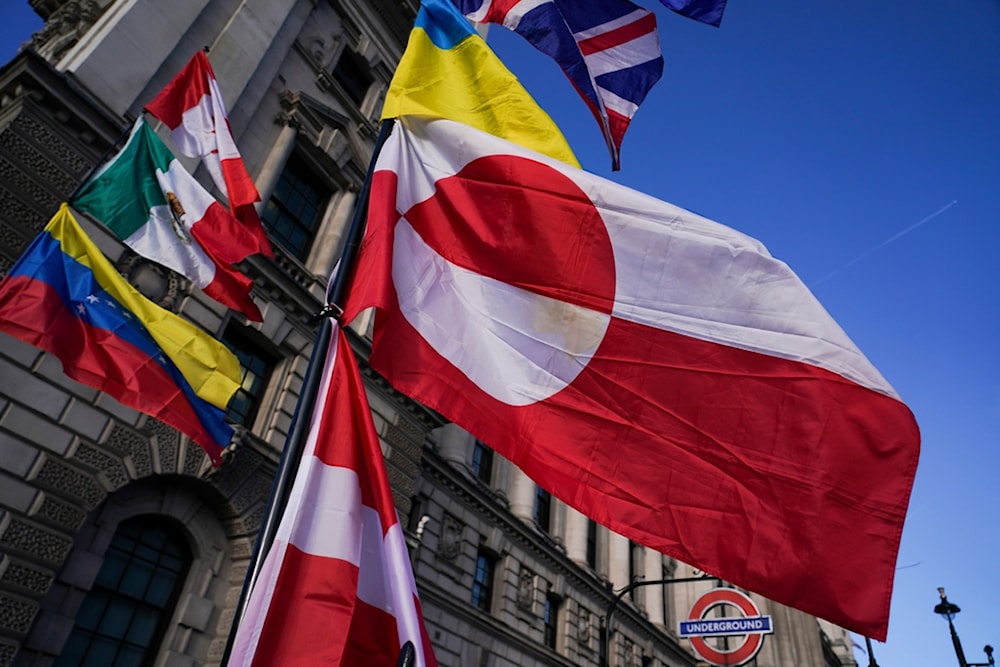
A Greenland flag waves in Westminster, in London, Wednesday, January 7, 2026. (AP Photo/Alberto Pezzali)
Greenland's political leadership has issued a firm rejection of any attempt by the United States to assert control over the Arctic island, after US President Donald Trump again suggested Washington could use force to seize the Danish autonomous territory.
The rare joint statement, released late Friday and signed by leaders of five parties represented in Greenland's parliament, came in direct response to Trump's declaration that the United States was "going to do something on Greenland, whether they like it or not".
"We don't want to be Americans, we don't want to be Danish, we want to be Greenlanders," the party leaders said, stressing that "the future of Greenland must be decided by Greenlanders".
"No other country can meddle in this. We must decide our country's future ourselves, without pressure to make a hasty decision, without procrastination, and without interference from other countries," they added.
Colonial echoes
The comments followed renewed alarm across European capitals after the White House confirmed this week that Trump remains interested in acquiring Greenland and declined to rule out military action. Diplomatic efforts are now intensifying as European governments attempt to formulate a coordinated response.
Public reaction in Greenland reflected deep sensitivities rooted in the territory's colonial history. Julius Nielsen, a 48-year-old fisherman in Nuuk, told AFP: "American, no! We were a colony for so many years. We're not ready to be a colony again, to be colonised".
Greenland was governed as a Danish colony until 1953 and was granted home rule in 1979. While independence remains a long-term aspiration for many, there is broad caution over the pace of such a transition.
"I really like the idea of us being independent, but I think we should wait. Not for now. Not today," said Pitsi Mari, a telecoms worker in the capital.
Independence pressure
The current governing coalition has reaffirmed that stance, opposing immediate separation from Denmark. Even Naleraq, the opposition party that secured 24.5 percent of the vote in Greenland's 2025 legislative election and advocates rapid independence, signed the joint statement rejecting external pressure.
"It's time for us to start preparing for the independence we have fought for over so many years," Naleraq lawmaker Juno Berthelsen said in a Facebook post.
Trump has repeatedly argued that US control of Greenland is vital for national security, citing increased Russian and Chinese activity in the Arctic. On Friday, he claimed, "We're not going to have Russia or China occupy Greenland. That's what they're going to do if we don't. So we're going to be doing something with Greenland, either the nice way or the more difficult way."
Greenland, located between North America and the Arctic, has drawn growing international interest due to its strategic position, rare earth mineral reserves, and estimates of substantial oil and gas deposits. The United States has maintained a military presence on the island since World War II.
Diplomatic fallout
Denmark and several European allies have expressed shock at Trump's statements. Danish Prime Minister Mette Frederiksen warned that an invasion of Greenland would end "everything", referring to NATO and the post-war transatlantic security framework.
Trump later attempted to soften his tone, saying: "I'm a fan of Denmark, too, I have to tell you. And you know, they've been very nice to me." However, he went on to question Danish sovereignty, adding: "But you know, the fact that they had a boat land there 500 years ago doesn't mean that they own the land."
US Secretary of State Marco Rubio is expected to meet Denmark's foreign minister and Greenlandic officials next week, as diplomatic contacts accelerate in an effort to contain the fallout.
Meanwhile, NATO's top military commander in Europe, General Alexus Grynkewich, said the alliance was not facing an immediate crisis despite the controversy, as Trump approaches the end of his first year back in power.
Read more: Greenland 'will not be annexed: Union chief slams Trump's threat


